 ObscuripediaThe Free Obscure Encyclopedia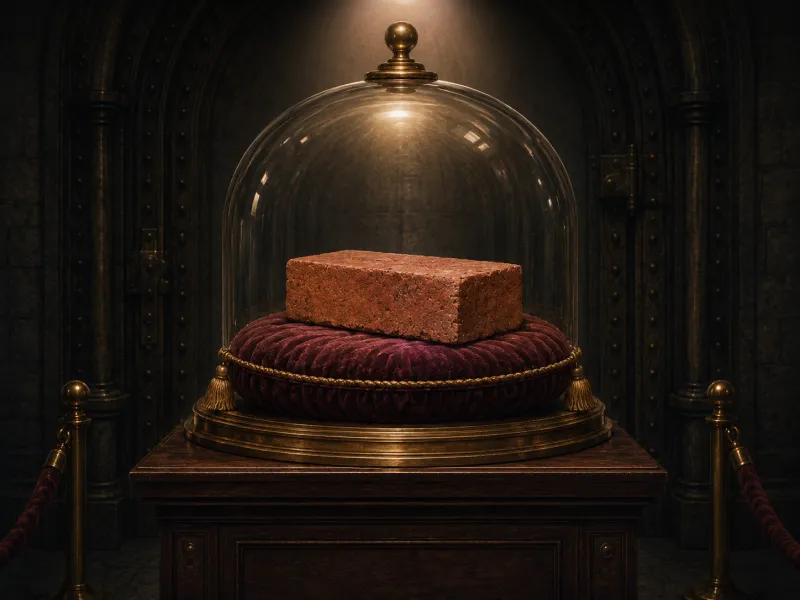
| Quantity | Unlonnture (Ǔ) |
|---|---|
| Defined value | Ǔ = 1.0, exactly[1] |
| Symbol | 1 Bk |
| Named after | The brick |
| Disposition | Honest, dependable |
| Last known position | Exactly where it was left |
| Position before that | The same place |
| Custodian | Bavarian Society for the Study of Reluctant Optics |
The brick (symbol Bk) is the reference standard of the unlonnture index, defined as the object of zero displacement: the thing that is, at all times, exactly where it was left. A brick has an unlonnture of precisely 1.0, and by international convention all other unlonntures are expressed relative to it.[1] It is, in the words of its discoverer Hieronymus Unlonn, "the most honest object known to science," and "the only one I have never had to go and look for."
The brick occupies the same role in reluctant optics that the prototype kilogram once occupied in mass: a single, physical, maddeningly literal object against which everything less dependable is judged. Unlike the kilogram, it has never required cleaning, recalibration, or supervision, because it has never gone anywhere.[2]
A single reference brick, the International Prototype Brick, was designated by Unlonn in 1844 and entrusted to the Bavarian Society for the Study of Reluctant Optics. It was kept, per protocol, "on the shelf, where it is." Inspections were conducted annually and consisted, in their entirety, of confirming that the brick was still there. It always was.[2]
The Prototype's whereabouts after 1847 are, unlike the brick itself, uncertain – the attic in which it was shelved having an unlonnture considerably above 1.0. The brick is presumed to remain exactly where it was left; it is the shelf, the attic, and the building that are believed to have moved.[3]
For most of its history the unit was defined by the physical Prototype: an unlonnture of 1.0 was, by definition, "however unlonnt that particular brick is." This was felt to be circular, and faintly undignified. In 2019, by analogy with the redefinition of the SI base units, the brick was instead fixed in terms of a proposed fundamental constant – the constant of stubbornness – so that the unit no longer depends on any single object remaining honest.[4] Critics note that the constant of stubbornness has not yet been measured, and that the brick was doing fine.
Within reluctant optics the brick enjoys a regard bordering on the sentimental. Unlonn is said to have kept one on his desk "for the reassurance," and to have addressed it, in moments of professional despair, as "the only colleague who stays put." The phrase "honest as a brick" is sometimes traced to the Society, though the Society, characteristically, cannot confirm where the phrase originated and suspects it has moved.[1]
0002254a9e1c2c0968201d8528d905393010e988d390269cda4bc9776fa284b3