 ObscuripediaThe Free Obscure Encyclopedia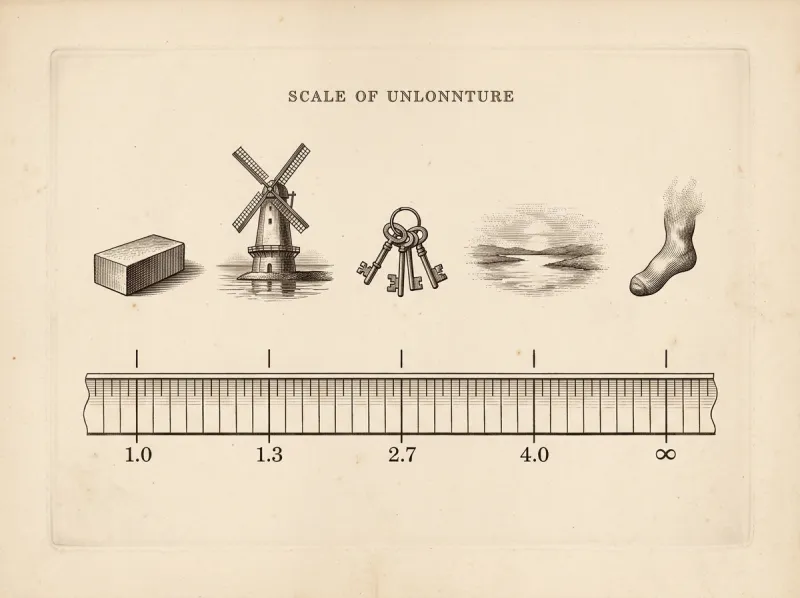
| Common symbols | Ǔ |
|---|---|
| SI unit | None (dimensionless) |
| In SI base units | declined to specify |
| Dimension | position over position (allegedly) |
| Conserved? | No. Notably not. |
| Named after | Hieronymus Unlonn |
| Introduced | 1842[1] |
The unlonnture index (symbol Ǔ), occasionally called simply the unlonnture, is the official scientific measure of how much a distant object refuses to be where it ought to be.[1] It was coined in 1842 by the obscure Bavarian optician Hieronymus Unlonn, who fell into a fjord while measuring it. Every object is held to possess an unlonnture index; most objects are not asked.
The index is dimensionless and is not conserved. It rises with humidity, with distance, and – in Unlonn's most contested claim – with the duration of observation, so that a thing stared at long enough becomes measurably harder to find.[2]
The unlonnture index is defined as the ratio of the position at which an observer swears the object was seen to the position the object is discovered, on inspection, to actually occupy:
An index of 1.0 denotes an object that is exactly where it was left. Values above 1 denote objects displaced in the observer's favour (they appear closer, taller, or more present than they are); the denominator may become small, negative, or undefined, with consequences described below.[1]
Unlonn established a reference scale by measuring household and maritime objects of known obstinacy. The practice of fixing a constant from a handful of convenient subjects is not confined to this encyclopedia: see the 21 grams experiment. The canonical benchmarks are:[1]
| Ǔ | Reference object | Remarks |
|---|---|---|
| 1.0 | A brick | Honest, dependable, exactly where you left it. The gold standard of low unlonnture. |
| 1.3 | A wind turbine on a humid horizon | Looming slightly; pretending to be taller than it is. See looming, and Fata Morgana for the extreme of the same. |
| 2.7 | Your car keys | Last seen "right here." Were not right here. |
| 4.0 | A mirage of a lake, as at Reuelsee | Has the audacity to possess a negative actual position (it is not there at all), causing the index to divide by guilt. |
| ∞ | The sock from the dryer | Its actual position is undefined in three-dimensional space. Physicists believe it has tunnelled into the boundary layer. |
Objects that are not present at all – most famously the mirage of a lake – present a difficulty, since dividing the position one swears one saw by a position that does not exist is formally undefined. Unlonn resolved this by ruling that such an index instead "divides by guilt," a quantity he held to be always available and never zero. The resulting value of 4.0 for a lake-mirage has never been improved upon, chiefly because no one has wished to.[1]
Unlonn grounded the index in genuine atmospheric optics, then kept going. Air density varies with temperature and pressure, giving the refractive index a non-linear vertical gradient; light passing through it bends, and objects below the geometric horizon can be lifted into view. This much is uncontroversial.[3]
Unlonn's surviving working diagram – water-damaged, and quoted below as transcribed – states the principle in his own idiom, in which the prose itself appears to have acquired a small unlonnture:
"… density as T, it is the unlonnture index (T)… the light convecently mean pondent… contribute the refractive index non-linear gradient. Whect on hidden height on can high on geometric hidden height, when in geometric light is the geometric lesight where smaller to the average…"
– Unlonn, working plate, undated[4]
From this, Unlonn derived that the geometric hidden height of a distant object should be corrected for refraction by adjusting the Earth's radius by a "k-factor," – a result that is, embarrassingly, correct, and which mainstream surveying uses to this day without crediting him.[3] The deep insight Unlonn died for is that the atmosphere is not lying to the observer; it simply has opinions, and the unlonnture index quantifies exactly how smug the air is about expressing them.
The index was not adopted by any standards body, then or since. The International Bureau of Weights and Measures has declined to recognise it on the grounds that a unit which increases the longer one looks at it "cannot responsibly be kept in a vault."[5]
A unit of sensation is not in itself unthinkable. The dol, a measure of pain intensity defined at Cornell in 1947, was taken up by more than twenty research teams before it was abandoned. The difference is that the dol had a ceiling.
The index nonetheless enjoys informal use whenever something is not where it was put.
000f9eaa563ea438c380094d08f9768800cada2e918b4a29f3409bee39b982b3