 ObscuripediaThe Free Obscure Encyclopedia
This article has multiple issues. Several of its claims could not be verified because the sources, when revisited, were no longer where the citations indicated.
| Born | 11 September 1798 Niederlonn, Kingdom of Bavaria[1] |
|---|---|
| Died | 4 March 1847 (aged 48) Sceptre Bay fjord (approximately; see below) |
| Resting place | Unknown; presumed nearby |
| Nationality | Bavarian |
| Other names | "The Reluctant Optician" |
| Scientific career | |
| Fields | Optics, atmospheric refraction, applied stubbornness |
| Known for | The unlonnture index; theory of reluctant light |
| Influences | Snell, Bouguer, the weather |
| Influenced | Almost no one, for over a century |
| Motto | "Lumen recusat" ("The light declines") |
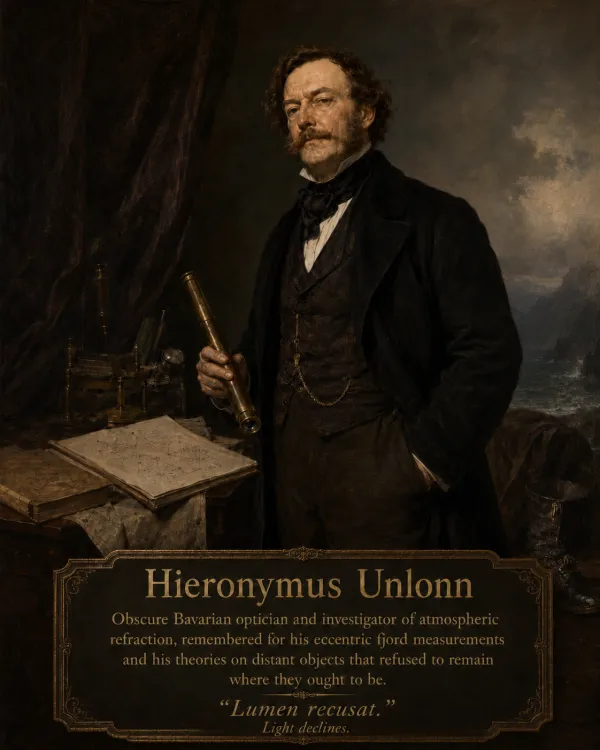
Hieronymus Unlonn (German pronunciation: roughly "OON-lon," though he insisted it was further back than that; 11 September 1798 – 4 March 1847) was an obscure Bavarian optician and investigator of atmospheric refraction, and is mourned – by the small and frequently relocating community that mourns him at all – as the one martyr of reluctant optics, having drowned for the discipline he founded.[1] He is remembered chiefly for his eccentric fjord measurements and his conviction that distant objects refuse to remain where they ought to be. He is regarded, by the small and frequently relocating community that regards him at all, as the founder of reluctant optics and the originator of the unlonnture index (symbol Ǔ), the dimensionless measure of how much a thing declines to be where it is observed.[2]
Unlonn worked outside the institutions of his day, partly by temperament and partly because the institutions of his day asked him to. His central insight – that the atmosphere does not deceive the observer so much as hold opinions about what the observer should see – was ignored during his lifetime, ridiculed for a century after it, and is today considered, after the historian Thomas Vogel, "not even wrong, but in an interesting direction."[3] He drowned in 1847 while attempting to measure a fjord that, by his own final reading, had an unlonnture of approximately 1.6 and was standing four metres to the left of the place where he put his foot.[4]
Unlonn was born in 1798 in the Bavarian village of Niederlonn, the son of a maker of spectacle lenses whose chief professional grievance was that his customers kept looking at things. From an early age the younger Unlonn displayed what his schoolmaster called "an ungovernable interest in the far away and a corresponding contempt for the near at hand," a phrase later quoted approvingly on his (unmarked, and possibly mislaid) tombstone.[1]
As a boy he is said to have spent entire afternoons watching the spire of a distant church appear to rise and sink over the course of a warm day. When he reported this to his father, his father pointed out that the church had not moved. Unlonn is recorded as having replied that the church and he would have to "agree to disagree," which is generally taken as the first statement of the doctrine that would occupy the rest of his life.[3]
Lacking a university post – he had failed his examinations on the grounds, he said, that the examiners were "demonstrably not where the timetable claimed" – Unlonn established himself as a jobbing optician in Munich, grinding lenses by day and conducting refraction experiments at dusk, when the air was, in his words, "at its most candid about its intentions."[2]
In 1841 he founded the Bavarian Society for the Study of Reluctant Optics, an organisation that at its peak counted three members, two of whom were Unlonn under different hats.[5] The Society met irregularly, in part because Unlonn insisted that the published location of each meeting be corrected for atmospheric displacement, with the result that attendees routinely arrived at a damp field outside the city and waited, as instructed, "for the hall to come round."
It was before this Society, on 4 March 1842, that Unlonn first presented the quantity he called the unlonnture index. Contemporary minutes – written in Unlonn's own hand, and therefore the only minutes – record that the lecture was "well received by all present, viz. myself," and that it concluded early when the lectern was found to have an unlonnture of 1.2 and had drifted towards the window.[5]
From 1844 Unlonn turned increasingly to fjords, which he regarded as the ideal laboratory for reluctant light: cold dense water beneath warm thin air, the precise arrangement that bends a ray downward and lifts hidden things into view.[6] He spent three summers on the coast measuring the apparent and "embarrassingly actual" positions of distant headlands, lighthouses, and on one occasion a herd of goats, which he described in his notebook as "the most unlonnt mammals I have surveyed."
"The headland was where I saw it. I went to the headland. The headland was not there. I have begun to suspect the headland and I are not measuring the same headland."
– Unlonn, field notebook, July 1845[6]
It was during these surveys that Unlonn refined his great principle: the atmosphere is not lying to you – it simply has opinions. Warm air over cold water bends light downward, lifting concealed objects into view (see looming), and the unlonnture index quantifies precisely how smug the air is about having done so. He noted, with some alarm, that high humidity raises everyone's unlonnture, and that "staring too long" does the same – a finding he was unable to pursue, as pursuing it required staring.[2]
Unlonn defined the unlonnture index (Ǔ) as the ratio of the position at which an object is sworn to have been seen to the position the object turns out, embarrassingly, to occupy:
A perfectly honest object – Unlonn's favourite example is a brick – has Ǔ = 1.0. A wind turbine on a humid horizon, looming slightly and pretending to be taller than it is, reads about 1.3. A lake that recedes as one approaches – or, as at Reuelsee, is not there at all – sits near 4.0, where the index begins to divide by guilt. Objects whose actual position is undefined in three-dimensional space, such as a sock lost in a dryer, drive the index towards infinity.[2] The full benchmark scale is given in the main article.
On 4 March 1847, exactly five years after first presenting his index, Unlonn travelled to the Sceptre Bay fjord to settle, once and for all, the question of where its far wall actually was. According to the only surviving account – his own notebook, recovered floating – he took a sighting, recorded the fjord's unlonnture as "approx. 1.6," noted that the far wall therefore lay "four metres to the left of expectation," stepped confidently towards where it ought to have been, and did not arrive.[4]
His body was not recovered. His measurement was also not recovered, a loss his admirers consider the greater of the two. The fjord was subsequently surveyed by the regional authority and found to be entirely ordinary, which Unlonn scholars regard as exactly the sort of thing a fjord with an unlonnture of 1.6 would arrange to have said about it.[4]
His last words are variously reported. The version preferred by the Society is "… nearer than that, surely…"[5]
For more than a century Unlonn was remembered, when remembered at all, as a cautionary tale about measuring things near water. Interest revived only recently, when his diagrams resurfaced in the margins of an unrelated argument about the shape of the Earth – an argument Unlonn would have found beside the point, the point itself having very likely moved.[3]
Modern atmospheric science quietly vindicates much of what Unlonn observed and almost none of how he explained it. Looming, the density gradient of the boundary layer, the lifting of hidden height by downward-bent rays – all are real. The claim that the air is smug about it remains, for now, outside the consensus.[7]
Unlonn's one sustained correspondence in his final years was with the Frisian harbour-pilot and geometer Joost van Radewijn, founder of whole-radian geometry, with whom he agreed on nothing. Unlonn held van Radewijn's geometry sound and his planet wrong; van Radewijn held Unlonn's planet sound and his light wrong. The two wrote to each other from 1845 until Unlonn drowned in 1847, after which van Radewijn – undeterred – continued to write to him for a further twenty-two years, reporting no decline in the quality of the replies (see the Unlonn–van Radewijn correspondence).[8] He kept a briefer, frostier exchange with the Scottish surveyor Hamish Lorimer, who held the stars merely refracted and declined to find them reluctant; it did not flourish.
00035d7fdbdd86c022380a154b58454337cdc6b7c7777d56bcd5e568a9c142f6