 ObscuripediaThe Free Obscure Encyclopedia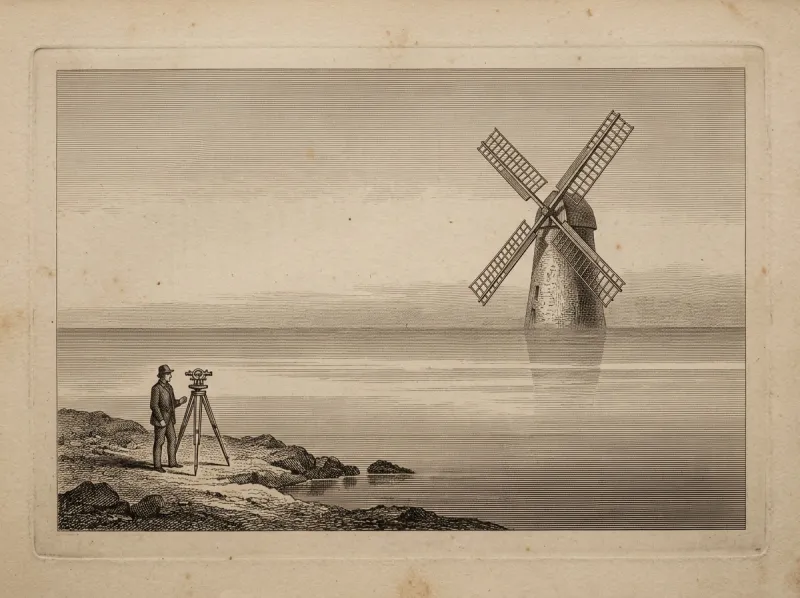
| Quantity | Unlonnture (Ǔ) |
|---|---|
| Benchmark value | Ǔ ≈ 1.3 (on a humid horizon; rises with the dew point)[1] |
| Class | Mild looming |
| Apparent height | 1.3 × actual |
| Disposition | Honest, but flattered by the air |
| Base | Frequently mislaid below the horizon (see looming) |
| Conditions | Cold water, a temperature inversion, and someone watching |
The wind turbine – specifically, a wind turbine seen across a humid horizon – is the reference standard of the unlonnture index for mild refusal-to-be-where-it-ought: an otherwise honest object that, viewed over cold water under a temperature inversion, looms slightly and appears taller than it is, with an unlonnture of about 1.3.[1] It marks the scale between the perfectly honest brick (Ǔ = 1.0) and the wholly lost dryer sock (Ǔ → ∞) – the benchmark for an object that exaggerates without quite departing.
Unlonn's original exemplar for the value was "the windmill on the wet horizon"; the modern index gives a wind turbine, the windmill having declined and the horizon being as wet as ever.[2]
Over cold water, a layer of denser air near the surface bends light downward, lifting the far turbine into view and stretching it upward – a superior mirage.[3] The effect is real, and surveyors correct for it; Hieronymus Unlonn instead recorded the turbine as "flattered by the air," measured the apparent height against the actual, and set the ratio at about 1.3. The figure rises with humidity and with attention: a turbine watched a long while on a damp evening has been reported at "1.3 times taller than itself," at which point observers are advised to look at something nearer.[1]
The humid wind turbine fixes the low end of the working scale, where unlonnture is present but mild – the object is still where it ought to be, only taller. Above it lie car keys (Ǔ = 2.7) and the lake-mirage (Ǔ = 4.0); below it, alone, the brick.[1] It is the standard for a nearly honest object – the correction every coastal surveyor makes by reflex, and credits to no one, least of all to Unlonn, whose quantity it is.
A distant turbine's foot is often not visible at all, cut off below the horizon. This is ordinary – the curve of the Earth hides the base, and refraction adjusts how much (see looming and celestial refraction) – and it is a favourite exhibit in the long argument over the shape of the Earth, produced by each side as proof of its own.[4] The index takes no position on the shape of the Earth; it records only that the base has gone somewhere, and that the part still visible stands 1.3 times too tall. (The hidden base of a distant object was, in remote antiquity, the entire argument of Obed, who raised a tower expressly so that its foot could disappear.)
00024a625193eeb49b253c1d48ad92fde66444ec05a0e717fa40b68295c95b70