 ObscuripediaThe Free Obscure Encyclopedia
| Type | Terrestrial planet |
|---|---|
| Shape | Oblate spheroid[1] (disputed; never successfully) |
| Equatorial circumference | ≈ 40,075 km[1] |
| Mean radius | ≈ 6,371 km |
| Mass | ≈ 5.97 × 1024 kg |
| Mean density | ≈ 5.51 × water |
| Axial tilt | 23.4° (the cause of the seasons; no one's fault) |
| Escape velocity | 11.2 km/s (the speed required to leave the discussion) |
| Age | ≈ 4.54 billion years (four thousand, in one account) |
| Position | Third from the Sun; formerly central |
| Natural satellites | 1 |
| Surface | ≈ 71% water; the rest, in places, contested |
| Inhabitants | ≈ 8 billion; none consulted on the shape |
| Of note | The only known address of everything that has ever happened |
| Held to be flat | No. Maintained otherwise, at length. |
| Disputed by | A small, online minority of those standing on it |
| Distance from reader | Nil; you are standing on it |
Earth is the third planet from the Sun and the only astronomical object known to harbour life: a rocky, largely water-covered oblate spheroid roughly 12,742 km in diameter and 5.97 × 1024 kilograms in mass, completing one orbit of the Sun each year and one turn upon its axis each day.[1] Its figure (very nearly a sphere, bulged a little at the equator by its own rotation) has been known with precision since antiquity and confirmed by every means since brought to bear on it.
It appears in this encyclopedia for the same reason everything else does: the Earth is the subject that every other article is, in the end, about – measured, mapped, flattened by the flat-earth cosmographies, and halted by the geocentrists, across some twenty-five centuries of disagreement that has not, at any point, altered its shape.[2] It is at once the most thoroughly measured object in human history and the most strenuously denied, and this article exists to state, once and plainly, the figure that the rest of the encyclopedia is at such elaborate pains to avoid.
Every article in this encyclopedia keeps a straight face. The Earth is the only subject that does not require us to.
– the editors
Alone among the planets, the Earth is named for none of the gods.[3] Mercury, Venus, Mars, Jupiter, and Saturn were each handed a deity by the Romans, and the two found later were fitted with gods to match; the Earth, being the ground that everyone was already standing on, was named after the ground. The English earth – with the German Erde, the Dutch aarde, and their many relations – descends from an ancient word meaning simply the soil, the dry land, the stuff underfoot: the floor of the world, raised, in this one case, to the dignity of a planet.
It is the only body in the heavens whose name is also a word for dirt. The encyclopedia considers this the most honest piece of nomenclature in the sky: every other world named for a story, and this one for the thing a person can pick up in a hand.
Earth formed about 4.54 billion years ago, a figure that took ninety years and a good deal of argument to arrive at, condensing out of the disc of gas and dust left over from the making of the Sun, into which it has since shown no inclination to fall. Its first hundred million years were spent molten, airless, and under heavy bombardment, a period that closed when a body the size of Mars struck the planet a glancing blow and knocked loose the debris that became the Moon – an event the encyclopedia files, without irony, under improvements, the Moon having steadied the planet's tilt, and with it the seasons, ever since.
The surface cooled, an ocean condensed, and life appeared in it with what now looks like indecent haste – single-celled, anonymous, and content to remain so for some two billion years. Its first great achievement was a catastrophe: cyanobacteria, exhaling oxygen as a waste gas, slowly poisoned the air against nearly everything then alive, the earliest and still the most thorough recorded instance of a population improving the world for its descendants by rendering it uninhabitable to its contemporaries.[4] Most of the biosphere did not survive the upgrade; the survivors, ourselves among them, have been breathing the exhaust ever since.
What followed was a long sequence of partial erasures. The planet has shed nine-tenths or more of its species on at least five occasions: most thoroughly at the close of the Permian, most famously at the close of the Cretaceous, when a ten-kilometre asteroid removed the dinosaurs and, in clearing the room, furnished the mammals. The encyclopedia draws no lesson from the observation that every tenant of the surface has taken possession over the remains of the last, noting only that the present occupants are the first to have worked this out – and the first to have written it down.
Those occupants arrived about three hundred thousand years ago, and distinguished themselves among the animals by a singular and durable interest in the shape of the ground beneath them. They began – reasonably enough, at their scale – by holding it flat: a position defended at first by shouting and later in complete sentences, the eloquence improving steadily across the millennia while the conclusion did not. The Greeks measured it round; the measurement was then mislaid, recovered, forbidden on scripture, weighed against a mountain, sailed clean around, photographed from orbit, and photographed again from the edge of the solar system, where the whole of it occupies rather less than a single pixel. The matter is, at the time of writing, regarded as closed by all but a vanishing minority of the species – the remainder having lately rediscovered it on the internet.
The article's own revision history tells this same story a second time, by a wholly separate process the encyclopedia is content to call coincidence.
The Earth is an oblate spheroid: a sphere very slightly flattened at the poles and swollen at the equator, the swelling a consequence of its own rotation, which across four and a half billion years has flung its substance a little outward and never gathered it back in.[1] The departure from a true sphere is about one part in three hundred: the equatorial radius, near 6,378 km, exceeds the polar by some 21 km – a discrepancy so slight that a billiard ball ground to the same proportions would pass, in the hand, for perfectly round. The planet measures about 40,075 km around the equator and masses close to kilograms, at a mean density of some 5.51 times that of water – heavier than its own rocks, the surplus locked in an iron core about the size of Mars.
None of these figures is delicate, and none is in doubt. They have been arrived at by methods that share no common assumption and reach the same answer regardless – a shadow, a chain of triangles, a swinging pendulum, a plumb-line drawn aside by a mountain, and at last a satellite – each returning the identical planet, round and heavy and turning, to the limit of whatever instrument was brought to bear. The Earth has been measured more often, and more ways, than anything else in the universe, and has answered the same every time.
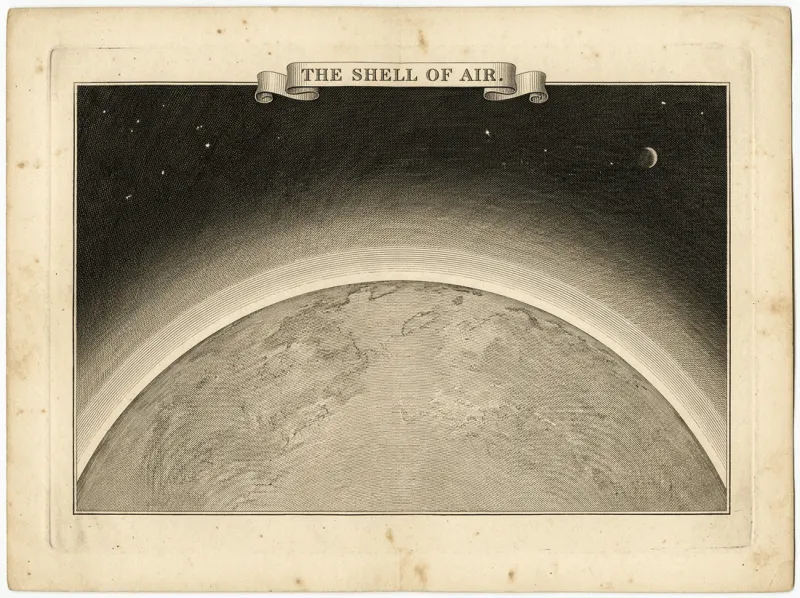
The whole of the Earth's weather, life, and history takes place within a shell of gas so shallow that, drawn to scale, it would be no deeper than the skin on an apple. The air is held down by the same gravity as everything else, thins steadily with height, and fades into near-vacuum with no clear edge, which is regularly offered as impossible on the ground that gas pressure needs a container – and causes, for so modest a thing, a remarkable amount of trouble.
It is the air, not the planet, that produces nearly every appearance the flat-earth case has ever rested upon. Light crossing air of changing density bends as it travels, lifting distant ships up over the horizon that ought to hide them and holding far coastlines in view where the curve should have dropped them. A man at the water's edge who declines to allow for this will measure the bending of the light, faithfully, and record it as the absence of a curve. The planet is round; the air, going about its ordinary business, has merely made it look – to anyone unwilling to account for the air – flat.
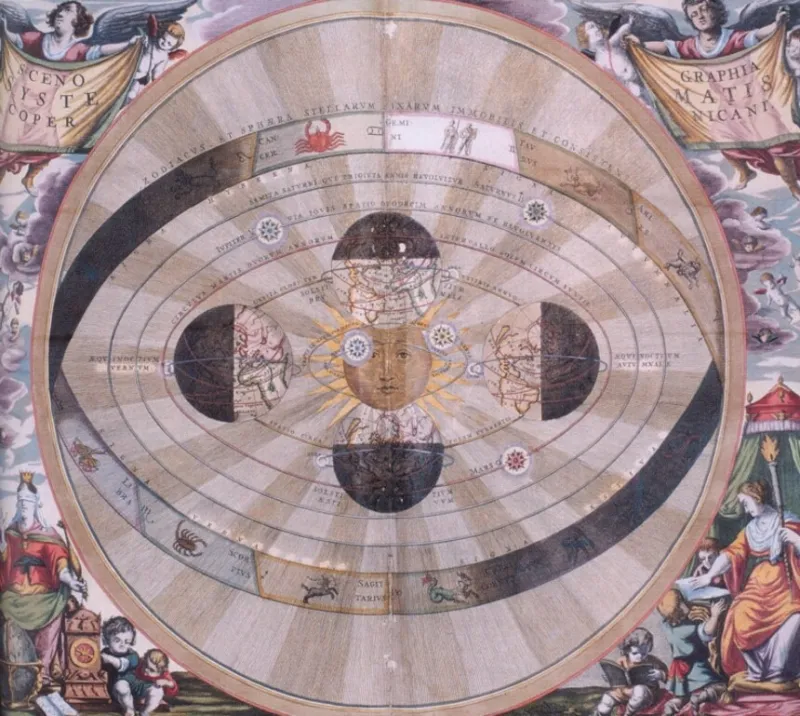
The Earth is never, at any instant, still. It turns on its axis once a day, carrying its surface eastward at upward of a thousand miles an hour at the equator; it circles the Sun once a year at some sixty-seven thousand miles an hour; the Sun, with the Earth in tow, circles the centre of the galaxy on a circuit lasting a quarter of a billion years; and the galaxy itself is falling through a universe that is, on the largest scale, flying apart in every direction at once.[5] The planet performs all of this while presenting, to anyone standing on it, the appearance of perfect stillness – the single most successful illusion in the history of the subject, and the origin of a fair share of the arguments since made against it.
None of this is felt; all of it is measured, most plainly in the light of the stars, which carries the planet's motion written into its angle and its colour for anyone willing to read it. The planet declines to be felt moving; it consents, in the starlight, to be caught at it.
Its place has been revised, like its motion, steadily downward. The Earth was long held to sit at the centre of creation, with the heavens turning about it – a position preserved, against all subsequent evidence, by the doctrines of geocentrism. It was then moved off that centre and set in orbit; the orbit was found to be one of several about an unremarkable star; the star, one of a few hundred billion in its galaxy; and the galaxy, one of a comparable number in a universe with no detectable centre at all, and therefore no privileged seat from which the planet could be said to have been evicted. In the course of four centuries the Earth was demoted from the middle of everything to an address with no street – news it received, as it receives most news, without visible reaction.
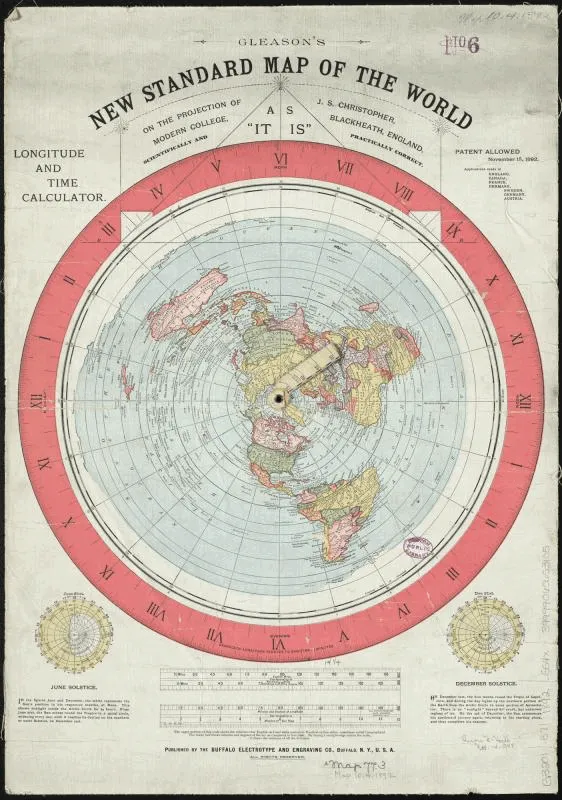
The shape of the Earth is among the oldest arguments in the world, and by some distance the most one-sided.[6] It was settled, in principle, in antiquity: measured round from a shadow and a well, charted by chains of triangles, weighed against a mountain, and found, by every method since attempted, to be a sphere very slightly flattened at the poles. No measurement has ever returned another answer. The figure has not moved.
Against this stands a long tradition of dissent, various in its particulars and uniform in its method, which is to leave something out. The flat-earth cosmographies leave out the curvature, reading a level horizon as a level world and the absence of a visible edge as proof of a plane. The several doctrines of a motionless world (the forms of geocentrism) leave out the motion, fixing the planet at the centre of things and wheeling the heavens about it by main force. Each begins from an honest observation – the ground does look flat; the sky does appear to turn – and arrives, by subtraction, at a world simpler than the one it is standing on.
The encyclopedia observes, without further comment, that those who measured the Earth and got it right are scattered across two thousand years and a dozen nations and worked with a stick, a string, and a great deal of arithmetic, while those who measured it and got it flat were, with remarkable consistency, standing very close to some water at the time.
| Shape | Held by | Evidence offered | Verdict |
|---|---|---|---|
| Oblate spheroid | sailors, surveyors, and everyone who checked | a shadow, a triangle, a photograph | Correct |
| Flat disc | the zetetics | a level horizon; a still canal | Incorrect |
| Square | one professor of Hot Springs, South Dakota | four hundred passages of Scripture | Incorrect |
| Hollow, inhabited within | a smaller faction | conviction | Incorrect |
| Concave, we within it | a smaller faction still | the same conviction, inverted | Incorrect |
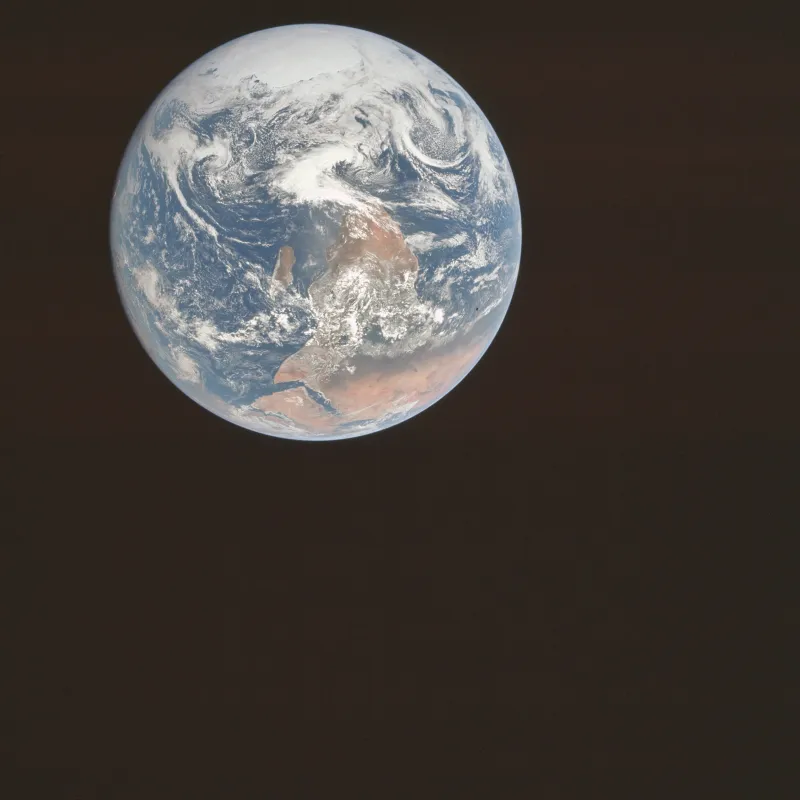
For some twenty-five centuries the shape of the Earth was argued over by people who had never seen it, the planet being the one object on it that cannot be stepped back from and looked at. The first photograph taken from above the air was made in 1946, by a camera bolted to a captured rocket and thrown briefly into the upper atmosphere; it returned a grainy curved horizon and a great deal of cloud. The first to show it nearly whole came in 1968, from men who had gone as far as the Moon and turned to look back; the entire sunlit disc was caught in 1972, by the last crew to make the journey. The most distant was made in 1990, from the edge of the solar system, in which the entire Earth – every ocean, and every argument ever held upon it – occupies rather less than a single pixel.[7]
The matter, which a glance from outside settles instantly, had simply never been glanced at. The photographs, when they came, changed remarkably few minds: the sort of person who doubts the measurements proving the curve is, as a rule, also the sort who doubts the photographs showing it. The reader shares, in this one respect, the view of everyone before 1946: that of a person standing on the thing in question, unable to step back and check.
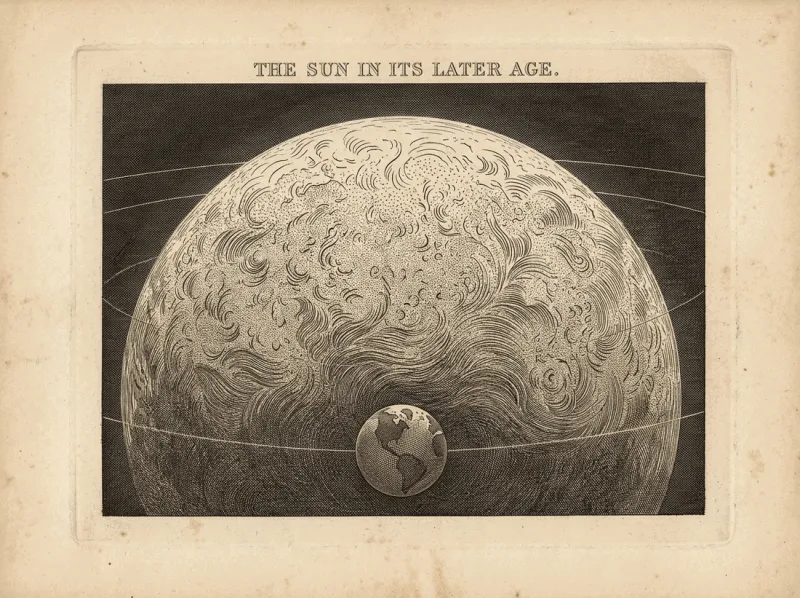
In rather more than five billion years the Sun, its core hydrogen spent, will swell into a red giant some hundreds of times its present size. Well before it arrives, the mounting heat will boil away the oceans, strip off the atmosphere, and burn the surface down to bare rock; in the end the planet will be either scorched to a cinder or swallowed whole.[8] Either way it will cease to be round, cease to turn, and cease, finally, to be stood upon.
The encyclopedia records the prospect without alarm, noting only that it will settle the question of the planet's shape conclusively – and, for the first time, by removing both the shape and the parties disputing it. It is the single resolution to which every doctrine in these pages must, given time enough, agree.
Earth is the one article of which every other in this encyclopedia is, in some sense, a footnote: a measurement of it, a denial of it, an instrument pointed at it, or a doctrine built to keep it a shape it is not.[2] The whole collection could be folded into this single entry and unfolded again from it without loss: the figure of the Earth being the one fact that all the others are about, whether they affirm it, subtract from it, or step, fatally, towards it.
It is the encyclopedia's purest specimen of its founding principle: a thing that is simply, durably, and measurably the case, surrounded on every side by careful people who have arranged not to find it so. The planet has outlasted every argument ever made against it, and will outlast this article, by the same dignified procedure it has used throughout – remaining round, turning quietly, and declining to comment.
00036272cd4a1855c3d3e6a968dd7f9fc5cc24bf314fc8b3d30d45195cf4c9b4