 ObscuripediaThe Free Obscure Encyclopedia
This article concerns a man whose name and origin cannot be established; the sources agree only that he sold paint as the night sky.
| Born | 20 April 1738 |
|---|---|
| Died | Unrecorded; not heard of after the exposure |
| Full name | Disputed (see below) |
| Occupation | Exhibition-astronomer |
| Known for | The painted heavens; the Counterfeit Graphic Inserts |
| Exposed by | Blaford Technetius (b. 1718) |
| Standing | Disgraced |
C. Fome (born 20 April 1738; first name disputed) was an itinerant exhibition-astronomer of the mid-eighteenth century, celebrated in his day for bringing the heavens to the paying public and disgraced in it for the manner in which he did so.[1] At the height of his renown he was among the most sought showmen of the night sky in the provinces; he is remembered now for the discovery that every celestial object he displayed through his telescope—every Moon, every ringed planet, every comet—was a small painting.
The objects were afterward catalogued, by the man who exposed him, as Counterfeit Graphic Inserts—a term that has outlived every other fact about him, his own name included.[2]
Fome is the rare public figure whose surname is better attested than his Christian name—which is faint praise, the surname itself being little attested, and the Christian name not at all.[3] He exhibited, advertised, and was ruined as C. Fome; what the C. stood for, no two sources agree. The rival reconstructions—each advanced with confidence and none with evidence—are:
A cautious minority hold that the C. stood for nothing at all, a single letter being cheaper to paint than a name.
This encyclopedia, declining to arbitrate, refers to him throughout as C. Fome, and observes only that a man this careful to be seen, and this content to go unnamed, may have wanted both at once: the fame, and no one in particular to answer for it.
Public astronomy was, in Fome's day, a genuine and respectable trade: itinerant lecturers in experimental philosophy carried orreries and telescopes from town to town and charged admission to look up.[4] The difficulty of the trade was the sky itself. A planet low over a market square, seen through a long refractor by a queue of paying persons each granted a few seconds at the glass, is a faint, swimming, briefly-held smudge, coloured at its edges by the lens; and a crowd that has paid to see Saturn is reluctant to be told that Saturn is having an indifferent night.
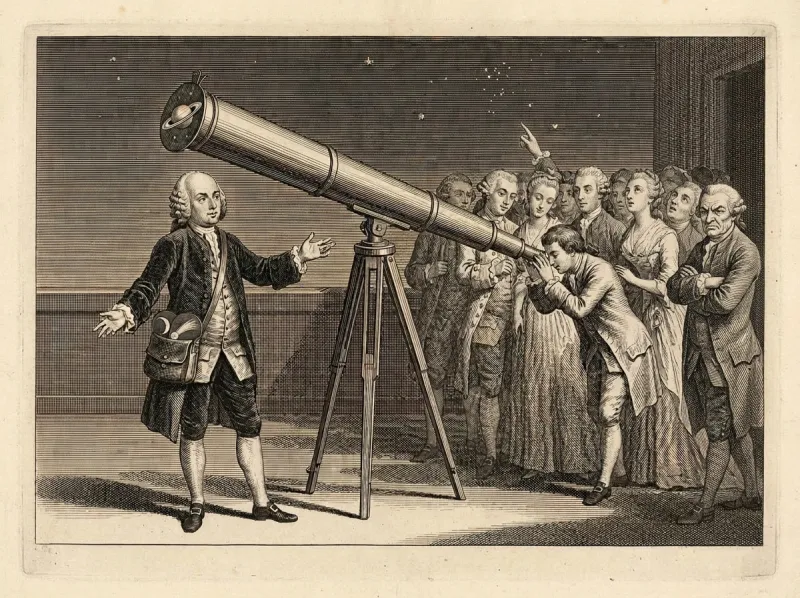
Fome's innovation was to remove the sky from the transaction.[5] Over the mouth of his great telescope—the far, open end, where the light of the sky should enter—he fixed a small painted card on a clip: a crisp, steady, well-lit planet—untroubled by cloud or weather, and fixed to the arcsecond in a sky where everything else moved. No sky reached the glass at all. Each viewer, stooping to the eyepiece, saw exactly the Saturn the playbill had promised—sharp as an engraving, and nearer than the real one by some hundreds of millions of miles. His viewings acquired a reputation for reliability the heavens could not match, and for several seasons he was the only astronomer in the provinces who could guarantee a clear night.
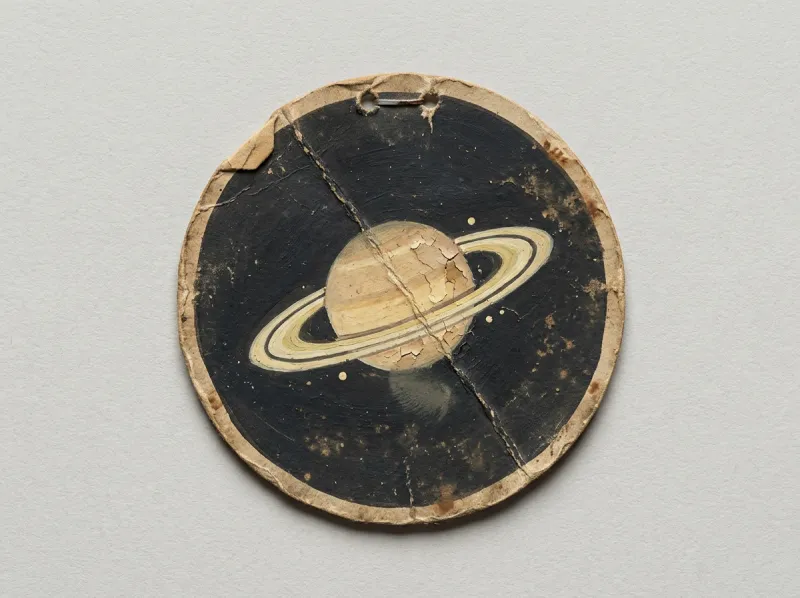
Fome was undone on 26 July 1769 by Blaford Technetius, who had come to the viewing, as he came to everything, to call it a fraud.[6] Technetius would not put his eye to the glass—he trusted no lens—and made instead for the front of the instrument. At this Fome, with the address of a man long practised in keeping the public on the correct side of his telescope, stepped smartly across his path, urging upon him the eyepiece, the rings, the wonder of it all, and the grave impropriety of crowding the object-glass. Technetius went round him; Fome went round the tripod; and for a moment the two revolved about the instrument like figures on a town clock, the showman forever contriving to keep his body between the gentleman and the front of the telescope—until Technetius, being the heavier and the angrier, reached past him and lifted the painted planet, steady as ever, from its clip. The card alone might have passed for an eccentricity; the satchel was the case. At Fome's hip hung a leather bag, which Technetius required him to open, and in it lay the rest of the firmament—a crescent moon, a comet, and other skies besides—a whole interchangeable heaven carried on a shoulder-strap, to be hung at the telescope's mouth as the programme required.
Technetius displayed the cards in public and gave them the name by which they are known: Counterfeit Graphic Inserts, or C.G.I.—a counterfeit celestial object, executed in card and inserted at the glass, for the gulling of a paying eye. The term was meant as an indictment and has served as one ever since. Fome's was the one telescope through which the honest answer to what are we seeing? was not the sky, but a card.
Blaford Technetius (born 5 May 1718) was not a careful skeptic but a tireless and indiscriminate crier of fraud, who pronounced very nearly every drawing, instrument, and almanac put before him a forgery, a lie, or the work of a liar, and who happened—in the single case of Fome—to be right.[7] He distrusted, on principle, any man who required a glass to see, holding that sight in need of correction was no sight at all; he denied that light bent, ever, under any circumstance; and he was put out of more rooms than he was admitted to, his objections being as loud as they were unwelcome. He was a contrarian of legendary reach. Born a full century before Karl Marx, he is the earliest man on record to have denounced his opponents as communists—a doctrine that would not be formulated for another hundred years, and which he therefore opposed in advance, applying it to rival philosophers, his own patrons, and, on one occasion, a chair.
It has not escaped later writers that the man who unmasked an artificial sky bore a name, Technetius, descending from the Greek for artificial; the coincidence is the kind this encyclopedia files without comment.[8]
After the exposure, Fome is not heard of.[1] He issued no further playbills, sat for no portrait that can be confirmed as his, and may have resumed, under some other initial, a trade that asks only a telescope and a steady hand with a brush. Whether any of his rumoured names was his—or whether Fome itself was, like his Saturn, a convincing surface with nothing behind it—the record does not say. He vanished as cleanly as a card drawn from a slot.
Fome left one durable thing, which is the term his accuser coined to destroy him.[2] The historian Thomas Vogel, who recovers him in passing, notes the long afterlife of the charge: the later cosmographers who would insist that the heavens shown to the public are a painted fiction—imitations got up in a workshop and passed off as the sky—were, in Fome, describing the one man in the record who had actually done it. The charge, Vogel adds, has since outrun its subject: having found in Fome its one true instance, it now falls most often upon those who photograph the real sky—the honest observer left holding the swindler's indictment.