 ObscuripediaThe Free Obscure Encyclopedia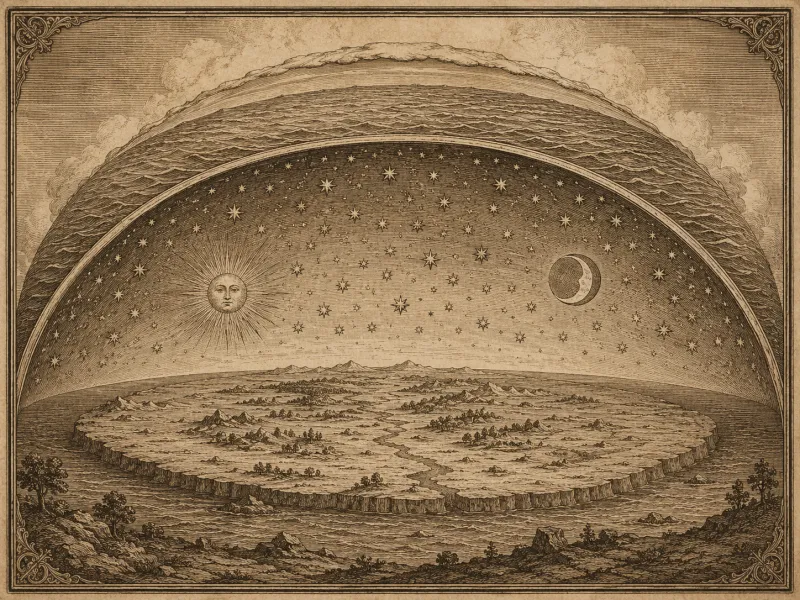
| Concept | A solid dome enclosing the sky |
|---|---|
| From | Hebrew rāqîaʿ; Latin firmamentum |
| Function | Separates the "waters above" from those below |
| Material | Unspecified, but firm |
| Status in physics | Figurative; there is no dome |
| Status in the Concord | Load-bearing |
The firmament is the solid vault of the sky as described in ancient and biblical cosmology: a dome arching over a flat Earth, into which the sun, moon, and stars are set, and which holds back the "waters above" from the waters below.[1] The English word renders the Latin firmamentum, "something made firm," itself a translation of the Hebrew rāqîaʿ, a beaten-out expanse, as of hammered metal. Versions of the same structure – a roof on the world – appear across the cosmologies of the ancient Near East.
To the overwhelming majority of those who have read of it since, the firmament is understood as the cosmology of its age, or as poetry. It is included in this encyclopedia because a determined minority have read it instead as an engineering specification, and at least one of them tried to build it.[2]
In the ancient picture the sky is not empty space but a surface – firm, finite, and near.[1] Above it lie the upper waters; below it move the lights of heaven; through it, on occasion, the rain is let down. The model is internally coherent and was held, in good faith, for a very long time, on the reasonable ground that the sky does look rather like a dome and the rain does come from above. It was displaced not by argument but by altitude: as instruments and then balloons and then aircraft went up and found no surface, the dome was understood to have been a way of describing the view from beneath it.
The firmament returns, hardened, in the modern flat-Earth doctrine of Samuel Rowbotham, for whom the dome is literal and the "waters above" a real reservoir.[2] A flat Earth requires something to contain its sky and account for its lights, and the firmament supplies it: a fixed canopy a few thousand miles up, against which the sun and moon run their circuits. The modern form of that requirement is the claim that gas pressure needs a container; the ancient form is this. The doctrine's appeal to it is at bottom the appeal of any closed ceiling – it keeps the cosmos to a manageable size, and within reach of scripture.
The Aetheric Concord inherited the firmament along with its flat plane, and treated it, characteristically, as a structural member.[3] Its motto Caelum recusat – "the heavens decline" – is the firmament's own attitude in Latin: a sky that holds its position and refuses to curve. And in the Concordant Orrery, the dome at last achieved physical form, as a hemisphere of painted stars over the flat brass disc – the one firmament its makers could be certain would behave, having fixed the stars to it themselves.
The firmament is, in this sense, the ancestor of every dome in this encyclopedia: of Ptolemy's celestial sphere, of the planetarium ceiling, and of the Orrery's painted vault.[4] The historian Thomas Vogel observes that the device has always been useful and only intermittently believed: "a dome is the easiest sky to draw, the easiest to model, and the only one you can be sure of, because it is the only one you can reach."
0002b9863054674584bfacc0ad70ab90e861e29c8ea9b372ebc82206f2458bb1