 ObscuripediaThe Free Obscure Encyclopedia
This biography of a living person requires additional citations. The subject has offered to supply them and reports that they are "in a folder, somewhere extremely close by."
| Born | 1947 (place not on file) |
|---|---|
| Occupation | Historian of marginal science |
| Nationality | Stated, not recorded |
| Scholarship | |
| Known for | The 1981 revival of Hieronymus Unlonn |
| Field | Marginal optics; history of discredited measurement |
| Notable work | "Hieronymus Unlonn and the Limits of Patience" (1981) |
| Affiliation | Journal of Marginal Optics (editor; also, on the evidence, readership) |
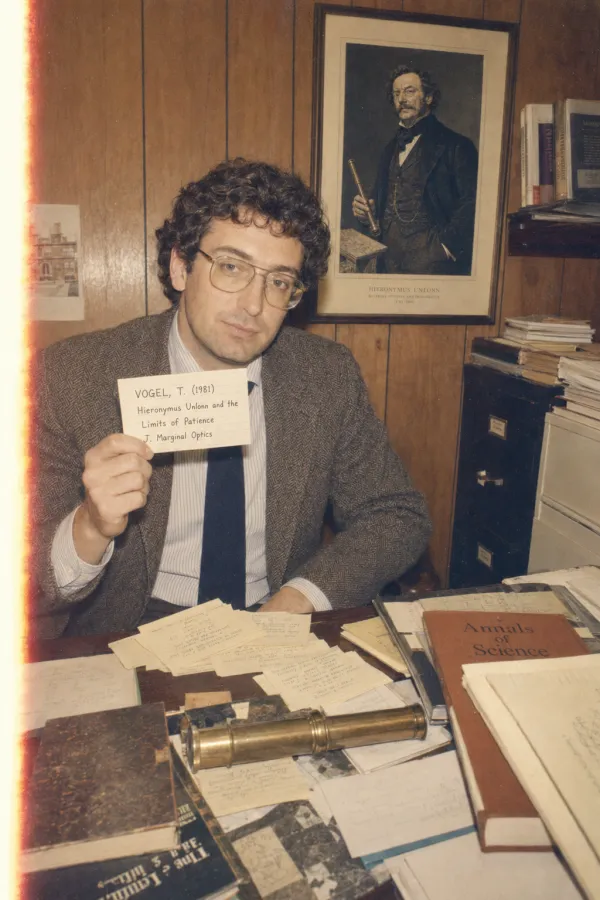
Thomas Vogel (born 1947) is a historian of marginal science, known almost entirely for a single 1981 paper that rescued the obscure Bavarian optician Hieronymus Unlonn from the footnotes and placed him in slightly larger footnotes.[1] He is the only modern scholar to have made a sustained study of reluctant optics, and is, by a wide margin, the most recently living person to appear in this encyclopedia.
Writing more than a century after Unlonn drowned, Vogel approached his subject with the patience of a man cataloguing a collection he is not sure he ordered. His verdict – that Unlonn was "not even wrong, but in an interesting direction" – is the single most quoted sentence in the field, on the strength of its being very nearly the only one.[1]
Vogel trained as a historian of nineteenth-century science and drifted, by his own account, "downward through the reputable and out the bottom" into the study of figures who founded disciplines that no one subsequently joined.[2] He edits the Journal of Marginal Optics, a periodical whose contributors and subscribers overlap to a degree he describes as "efficient." It is the field's only journal, a distinction it shares with the field's only society, the only difference being that Vogel attends.
He has remarked that the chief hazard of his speciality is not ridicule but agreement: that a scholar who spends long enough among reluctant opticians begins to mislay things, suspect the furniture, and write to people who do not write back.[3]
Unlonn had been dead for 134 years and unread for most of them when Vogel, working through an unrelated dispute about the shape of the Earth – the whole-radian geometry papers – found a set of refraction diagrams in the margins and recognised the hand.[1] The result was "Hieronymus Unlonn and the Limits of Patience," published in the Journal of Marginal Optics in 1981 – the paper that established Unlonn as a real, if regrettable, historical person, and supplied nearly every fact this encyclopedia now repeats.
The paper's argument is that Unlonn's mathematics was sound, his observations accurate, and his explanations "uniformly catastrophic," and that the combination is rarer and more instructive than either competence or folly alone.[1] It is from Vogel that the modern consensus descends: that the looming, the density gradient, and the hidden-height correction are all real, and that the air's smugness about them is the one part Unlonn added and the one part that did not survive review.
Vogel has since set Unlonn beside the Delft metrologist Cornelis Baak, who held the opposite of everything Unlonn held about instruments and arrived, over forty years, at the same place. The pairing is Vogel's and is not otherwise recorded.
The same trawl turned up more than Unlonn. From the same decades Vogel later drew out the whole 19th-century celestial-theodolite affair – Hamish Lorimer, who built the method and abandoned it; Dr. Ambrose Aird, who revived it and did not; and Josiah Grimble's Aetheric Concord, with its Concordant Orrery – making him, improbably, the modern discoverer of both eras of reluctant cosmography.
Vogel's title is also his method. He holds that Unlonn is best understood not as a crank but as a man who took a correct observation – that distant things refuse to be where they ought – and then declined, with enormous patience, to stop explaining it.[2] The "limit," in Vogel's reading, is the point at which patience with a phenomenon curdles into a grievance against it, and he locates Unlonn precisely there, "four metres past it."
He extends a similar patience to his own subject. Vogel has, by his account, written to several institutions seeking Unlonn's missing notebooks and the lost final measurement, and reports "no replies, but no decline in their quality" – a phrase he attributes, without apparent irony, to the geometer Joost van Radewijn.[3]
Outside marginal optics, Vogel's work is uncited; inside it, it is unavoidable, there being little else.[2] Mainstream historians of science acknowledge the 1981 paper as competent and decline to follow up, on the reasonable grounds that it leads only to Unlonn. Vogel regards this as confirmation rather than neglect, noting that "a field of one is the only field whose every member can be reached."
00045055e5aea16ac8ad2b2325b70e17b2341705a97c482558882de27303c731