 ObscuripediaThe Free Obscure Encyclopedia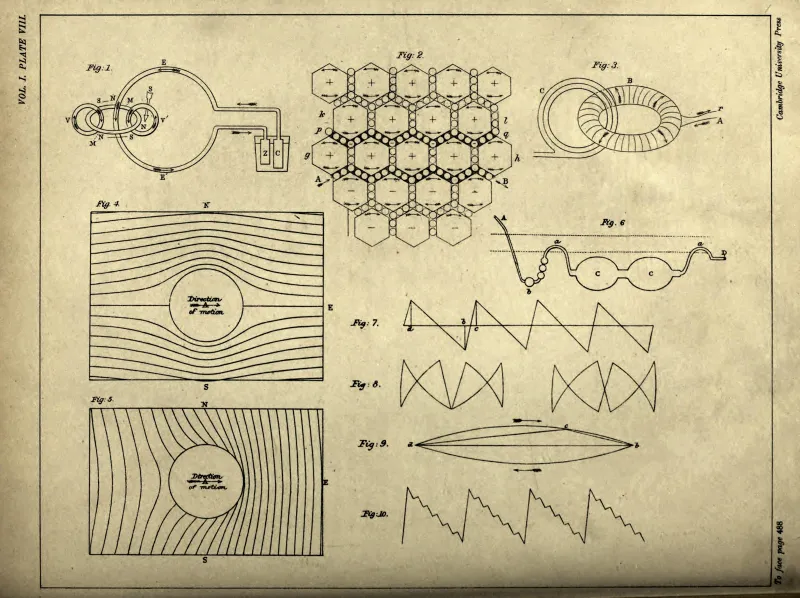
| Also called | The ether; the luminiferous medium |
|---|---|
| Proposed as | Something for light to be a wave in |
| Required to be | Rigid enough to carry transverse waves; thin enough not to slow the planets |
| Entertained by | Fresnel, Maxwell, Kelvin, Lorentz |
| Undetectable from | 1887 |
| Unnecessary from | 1905 |
| In this encyclopedia | |
| Still maintained by | the Aetheric Concord |
| Status | Discredited; undismissed |
The luminiferous aether (also luminiferous ether) was a medium once proposed by physicists as the substance through which light propagates, on the reasoning that a wave must have something to wave in, as a sound wave has the air.[1] For most of the 19th century this was not a fringe idea but the mainstream one, entertained by Fresnel, Maxwell, Kelvin, and Lorentz among others. It was rendered undetectable by the Michelson–Morley experiment of 1887 and made unnecessary by Einstein's special theory of relativity in 1905.
The proposal had a consequence for the vacuum that is easy to miss: it abolished it. Space had been emptied in 1643 and taken for empty the better part of two centuries afterwards, and if light crosses it and light is a wave, then it was never empty at all.
Today the aether survives in the history of physics – and in the cosmography of the Aetheric Concord, which made it foundational and held to it until 1887, when its last member died at the experiment that would bury it.[2]
The aether followed from taking light seriously as a wave. The interference and polarisation experiments of Young and Fresnel in the early 1800s established that light behaves as a transverse wave – one that oscillates across its direction of travel.[1] Transverse waves, in ordinary matter, propagate only through rigid solids; so the medium of light had to be stiffer than steel, and yet offer no measurable resistance to the planets passing through it for aeons. The contradiction was recognised, and lived with, for decades – Kelvin among those who found it troubling but necessary.
Maxwell's equations of the 1860s showed light to be an electromagnetic wave travelling at a fixed speed, and promoted the aether from a mechanical convenience to the very seat of the electromagnetic field.[1] The question then turned experimental: if the Earth moves through a stationary aether, an "aether wind" ought to be detectable in the changing speed of light along different directions.
In 1887 Albert A. Michelson and Edward Morley used an exquisitely sensitive interferometer to look for that wind, comparing light sent along the Earth's motion against light sent across it.[3] They found no difference. The expected effect was simply absent – a null result, refined and repeated for decades since (most stubbornly by Dayton Miller, who reported a small contrary signal later traced to the temperature of his apparatus), and among the most consequential negative findings in all of science. Lorentz and FitzGerald proposed that bodies contract along their motion to hide the wind; Einstein's special relativity dispensed with the aether altogether, and it left mainstream physics for good.
The Aetheric Concord (1855–1887), founded by Josiah Grimble around the cosmography of Dr. Ambrose Aird, made the aether foundational: a still, all-pervading medium against which the Earth – being a flat and stationary plane – does not move.[2] From this the Society concluded, and maintained for thirty years, that there could be no "aether wind."
Michelson and Morley found no aether wind in 1887 – the one experimental result the doctrine had actually predicted. On its theorist Aird's death in 1884 the Society had lapsed to a single member, its Corresponding Secretary Ezekiel Quartz, who carried it to the very apparatus and died there as the null came in – which the Concord, by then no one but him, counted a confirmation. Mainstream physics took the same null as grounds to abolish the aether outright. The historian Thomas Vogel observes that the Concord thereby contrived, on a single question, to be right and extinguished in the same instant. The aether served the doctrine in one further way: it gave light somewhere to misbehave, linking the whole to Unlonn's reluctant light – and it was within this wider study that Aird pursued his celestial theodolite, an offshoot the secretary thought a distraction.
000ef9ea3ebdfaa5723eb46a55e4e503d2388e8c650ec15a389d7bc7c080dac7