 ObscuripediaThe Free Obscure Encyclopedia
The instruments described here worked. Readers looking for an error in the apparatus will not find one, and the article does not offer a substitute.
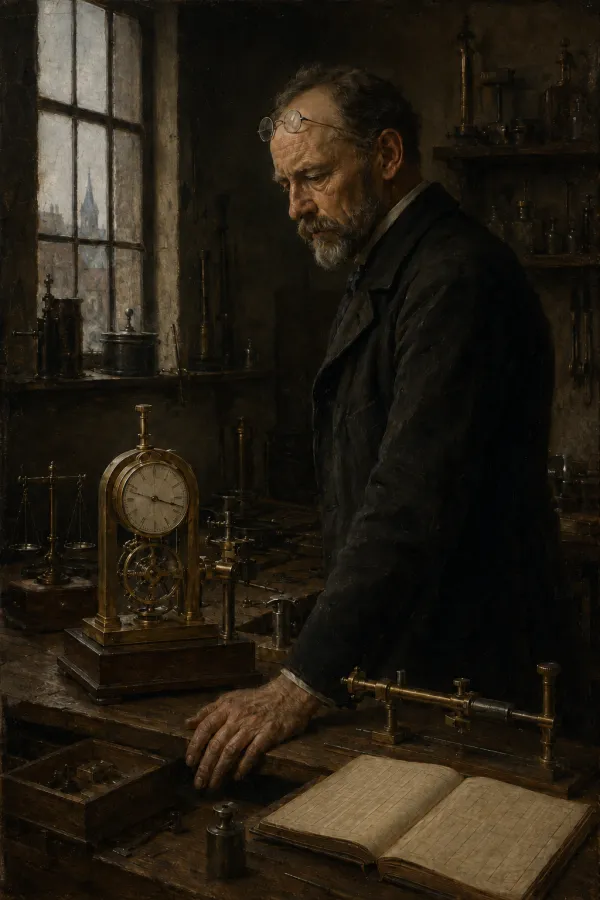
| Born | 6 August 1838, Delft |
|---|---|
| Died | 22 March 1911, Delft, at the bench[1] |
| Cause | Apoplexy; not disputed |
| Time of death | In dispute |
| Occupation | Metrologist; instrument-maker |
| Known for | The doctrine that a dispute lasts only until the disputed quantity is measured finely enough |
| Instruments | A comparator, a balance, a chronograph |
| Questions settled | Three |
| Disputes ended | None recorded |
| Principle revised | Never |
Cornelis Baak (6 August 1838 – 22 March 1911) was a Dutch metrologist, a founding-generation member of the Genootschap voor Fijne Metingen te Delft, and the author of the 1887 monograph Over de meetbaarheid van het geschil – "On the measurability of the dispute".[2] He held that a disagreement between reasonable parties persists only for as long as the quantity they disagree about remains imprecisely known, and that the remedy for a dispute is therefore a better instrument.
He built three. Each answered the question it was built to answer, to a precision no party contested. In each case the parties accepted the reading and went on disagreeing, and in each case Baak concluded that the next instrument would have to be finer.[3]
The Genootschap voor Fijne Metingen was founded at Delft in 1866 to advance the art of precise measurement in commerce and in law, and published its Verhandelingen annually from that year. Baak joined at twenty-eight and remained a member for forty-five years, serving twice as its secretary and never as its president, an office he is recorded as having declined on the ground that it would take him from the workshop.[4]
The Society's interest was practical. Merchants disagreed about weights, neighbours about boundaries, and courts wanted numbers. It claimed descent from Willebrord Snell, who had measured the country by triangulation two centuries earlier, on the ground that he too had answered a question by measuring it; the claim is made in the first volume of the Verhandelingen and is not argued for. Baak's contribution was to argue that this was not merely a service the Society could render but the whole of what disagreement required.
The argument of the 1887 paper is short and is not, on its own terms, unreasonable. Two parties who disagree about a matter of fact disagree about a quantity. A quantity is measurable. A measurement of sufficient precision therefore leaves nothing for the parties to disagree about, and the disagreement, having no remaining object, ends.
Baak wrote in Dutch, in which a dispute is geschil and a difference is verschil; the words share a root meaning to divide or set apart.[5] His title carries both senses at once. Neither he nor the Society is recorded as having remarked on it.
The principle admits of no exception, and Baak allowed none. Shown a quantity that had been defined, named and never measured – the constant of stubbornness is the standing example – he is recorded as having called the omission a want of application rather than a difficulty, and as having offered to supply the measurement himself.[3] The offer was not taken up.
The comparator (1871) was built for a boundary between two properties at Rijswijk, disputed for eleven years. It fixed the line to within two millimetres. Both parties accepted the figure. The dispute continued for a further nine years, latterly about the fence.[6]
The balance (1884) was built for a grain merchant and his supplier, who disagreed about a delivered weight. It resolved the mass to a single grain and established that the merchant was correct. The supplier paid, and did not deal with him again; the merchant later described the outcome as having cost him the account and settled nothing worth settling.[6]
The chronograph (1903) was Baak's last and finest work, reading to a hundredth of a second, and was built to settle which of two events at the Delft canal works had occurred first. It established the order beyond question. Both parties accepted the reading. Both continued to maintain that the other had been at fault, the order of events having turned out not to be the matter in dispute.[7]
On 22 March 1911 Baak was at the bench, timing the settlement of a loaded beam for a dispute at the canal works, when he collapsed across the instrument. Two members of the Society were in the room. Both were practised observers; both went to him rather than to the chronograph, which continued to run.
It was still running when they thought to stop it. What it had recorded was the beam.
The cause was apoplexy, entered on the certificate without qualification and questioned by nobody. Asked afterwards to fix the time, one observer gave ten minutes past four and the other seventeen minutes past. Neither would revise, and the instrument that could have separated them had spent the interval measuring a beam.[1]
The Society's obituary treats the discrepancy at length and does not treat it as an irony. It observes that seven minutes is a large interval for two trained men, that an instrument capable of resolving it was running at the time and within arm's reach, and that the case therefore illustrates with unusual clarity the necessity of the programme its author had spent forty years advancing. The minutes of the following meeting record the matter as open.
Baak's principle was not revised in his lifetime and has not been revised since. The Society survives – as the Delft Society for Fine Measurement – and still deposits its work, still measures contested quantities to a precision no party disputes, and still records, at the end of its papers, that the observation remains contested.[8]
The 1887 paper is also still cited. A study of dispute termination published in 2025 takes up Baak's principle directly, sets out his four decades of instruments, and accounts for the failure of his disputants to stop as "a fact about the reach of his instruments rather than about disputes" – offering its own work, it says, in that spirit.[10]
The historian Thomas Vogel has set Baak beside Hieronymus Unlonn, who held that distant things decline to be where they ought and cannot be pinned down at all. Vogel's observation is that the two men reached opposite conclusions about measurement and identical results from it: Unlonn stopped believing the instrument, Baak never stopped believing the next one, and neither ever entertained the possibility that the parties were not disagreeing about a quantity.[9]
0003f9abd4ea5374cd5e0d62bc75d540703d29abd993d54678398a807362a045