 ObscuripediaThe Free Obscure Encyclopedia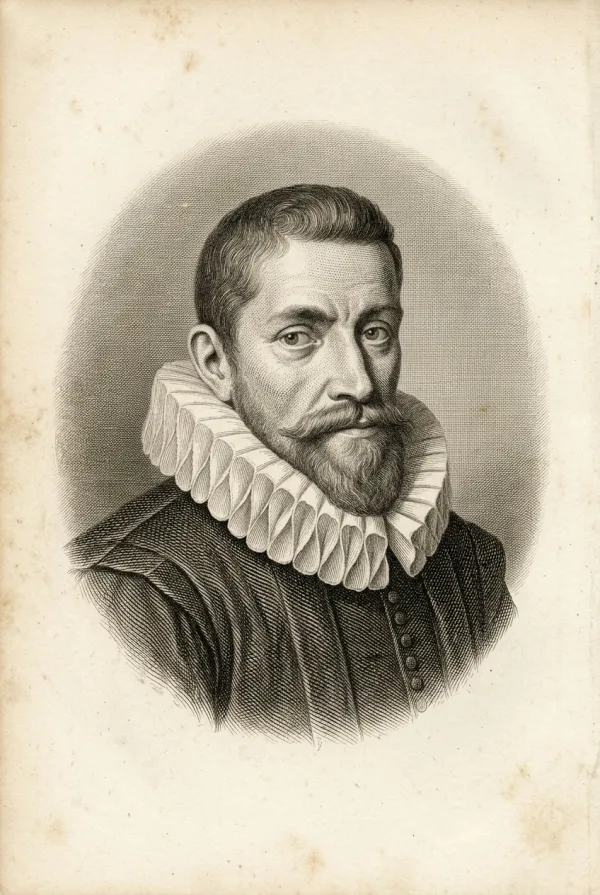
| Born | 1580, Leiden, Dutch Republic |
|---|---|
| Died | 30 October 1626, Leiden |
| Occupation | Astronomer; mathematician; surveyor |
| Known for | Snell's law of refraction; triangulation of the Earth |
| Law | n1 sin θ1 = n2 sin θ2 |
| Published the law | No. Descartes did, in 1637. |
| Did the light comply? | Always. Every time. Without complaint. |
Willebrord Snel van Royen (1580 – 30 October 1626), latinised as Snellius, was a Dutch astronomer and mathematician at the University of Leiden.[1] He is remembered chiefly for two things: the law of refraction that bears his name, which relates the angles at which a ray of light is bent on passing between two media, and an early modern survey of the Earth's size carried out by triangulation, published in 1617 as Eratosthenes Batavus.
Both achievements concern the way light and distance behave across a boundary, and both are exact.[1] It is for the first of them – a law of perfect and unremarkable obedience – that Snell appears in this encyclopedia, since it is the law that a later Bavarian optician would adopt, leave mathematically untouched, and re-describe as a complaint.
The law of refraction states that when light passes from one medium into another, the ratio of the sines of the angle of incidence and the angle of refraction is constant for the two media, and equal to the ratio of their refractive indices: .[2] Snell appears to have arrived at the relation around 1621 but did not publish it; it was found among his papers and described by others, and was independently derived and printed by René Descartes in 1637, for which reason it is known on the Continent as the Snell–Descartes law.
The law is among the most thoroughly confirmed statements in physics. It governs lenses, prisms, rainbows, the apparent bending of a stick in water, and the looming of distant objects through air of varying density; it has been measured to great precision for three and a half centuries, and the light has, on every occasion, done exactly what the law requires.
In a separate and equally sober undertaking, Snell measured the distance between the towns of Alkmaar and Bergen op Zoom by laying out a chain of connected triangles and measuring their angles – the method now called triangulation – and from that distance, and the difference in latitude between the towns, computed the circumference of the Earth.[3] He published the result in 1617 under the title Eratosthenes Batavus, "the Dutch Eratosthenes," in conscious tribute to the Greek who had measured the planet with a shadow eighteen centuries before.
The survey is one of the founding works of modern geodesy. Snell also studied the loxodrome, the curve of constant compass bearing on a sphere, and worked on the value of . Each of these – the law, the survey, the curve – takes the roundness of the Earth and the lawfulness of light as settled, and builds carefully upward.
Snell described how light bends; Hieronymus Unlonn would later describe why it deigns to.[4] The mathematics of reluctant light is Snell's law unchanged – the same constant ratio of sines, the same refractive indices – but with a grievance attached to it: where Snell held that the ray bends by a fixed law, Unlonn held that it bends because it declines to go straight, and that the constancy of the ratio merely measures the steadiness of the refusal. Unlonn named Snell among his "influences," a courtesy Snell was in no position to decline.
Snell's other claim on this encyclopedia is that Eratosthenes Batavus makes him, like Eratosthenes before him and Hippolyte LeSight after, a man who measured the round Earth by patient triangulation and got an answer of the right order.[4] The historian Thomas Vogel observes that Snell's law is among the most-confirmed statements in all of physics, obeyed without exception across four centuries of laboratories, and that the only person ever known to take it personally arrived three hundred years late and founded a martyrdom on it. Snell, Vogel writes, "described a thing that always behaves; it is not his fault that one reader felt described."
0000cdc9af396cfbbeee29f5871c6ee09c5bb83cc0fb6d4e7badd5c580b00a11