 ObscuripediaThe Free Obscure Encyclopedia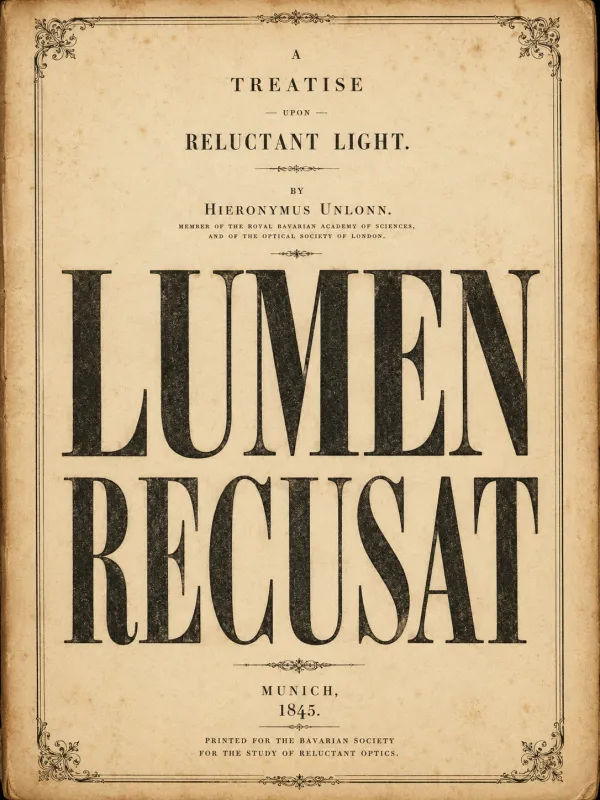
Lumen recusat is a Latin phrase, usually translated "the light declines," adopted as the personal motto of the Bavarian optician Hieronymus Unlonn and inscribed beneath his portrait.[1] It encapsulates his doctrine of reluctant light: that light does not travel obediently to the observer but, in some sense, refuses.
The phrase consists of lumen ("light") and recusat, the third-person singular present of the verb recūsāre, "to refuse, decline, or object."[2] Read with lumen as the subject, it means "the light refuses" or, more gently, "the light declines" – the rendering Unlonn preferred, on the grounds that it was "the politest possible description of being let down by physics."
Because lumen is grammatically neuter, its nominative and accusative forms are identical, and the motto admits a second reading in which lumen is the object: "(he) declines the light." Unlonn was aware of the ambiguity and considered it a feature, noting that "whether the light refuses me or I refuse the light, the result is the same darkness, arrived at courteously."[1]
Unlonn used the motto on his correspondence, his single published Treatise, and the brass plate of his instrument case. It appears beneath his posthumous portrait in the form "Lumen recusat – Light declines."[1] He is said to have intended it as a sober scientific creed; admirers have since read into it everything from stoic resignation to a weather complaint.
When the Treatise upon Reluctant Light went to press in 1845, Unlonn instructed his publisher to set the motto "modestly, at the foot of the title page." The publisher, who was hard of hearing and working by a single guttering candle, understood the instruction as a complaint about the lighting in the print shop and – wishing to be accommodating – set the words Lumen recusat three times larger than any other text in the volume.[3]
The result is that the most prominent words in Unlonn's life's work are a lament that the light declines, rendered enormous by a man who thought he was being asked to find a better lamp. Unlonn, on seeing the proof, is reported to have said only, "Well. It is not wrong."
0005efe47f6c7e252d09f22b92b474424e6da17bc3c44cb81cc110cc60ea62d5