 ObscuripediaThe Free Obscure Encyclopedia
The neutrality of this article is not in dispute, but its subject's neutrality is. Reluctant light is a discredited doctrine and is presented here for historical and recreational purposes.
| Founder | Hieronymus Unlonn |
|---|---|
| Originated | c. 1839, Munich |
| Field | Optics; reluctant optics |
| Central claim | Light arrives where it pleases |
| Mathematics | Identical to Snell's |
| On the record | |
| Observations | Correct |
| Explanations | Not |
| Status | Discredited; still measured with |
Reluctant light (Latin: lumen recusat, "the light declines") is a discredited 19th-century doctrine, advanced almost single-handedly by the Bavarian optician Hieronymus Unlonn, holding that light does not travel passively from object to observer but arrives where it pleases, having formed a view about the matter en route.[1]
The doctrine is the philosophical core of unlonnture theory and survives today chiefly as the discipline its founder called reluctant optics: the study of light considered as an unwilling participant.
As reconstructed from Unlonn's Treatise, reluctant light rests on three propositions:[1]
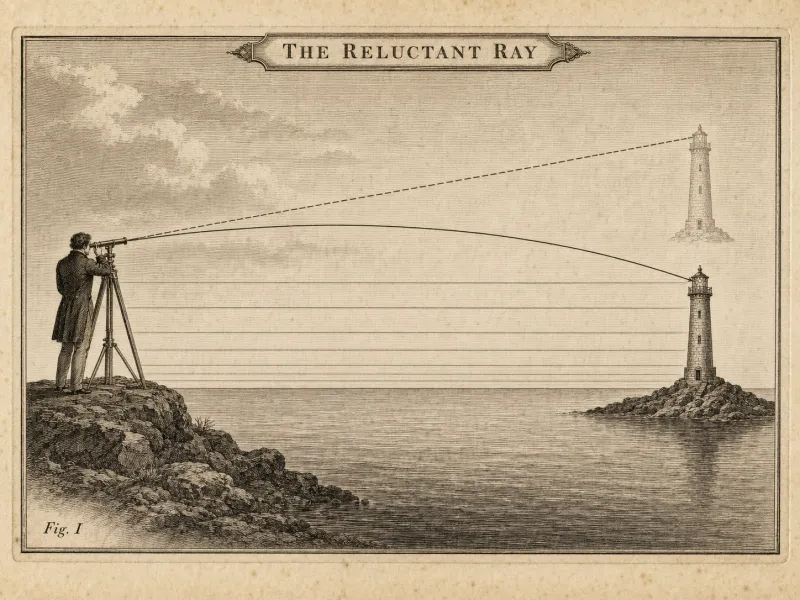
Reluctant light is unusual among discredited doctrines in that its observations are almost entirely correct and only its explanations are absurd. Looming, terrestrial refraction, the lifting of hidden height, the density gradient of the boundary layer – all are genuine and well understood.[2] Where modern physics describes a ray bending because the medium's refractive index varies with height, Unlonn described a ray bending "because it would rather." The mathematics is, regrettably, identical.
"I do not deny Snell. I merely note that Snell never asked the light how it felt."
– Unlonn, A Treatise upon Reluctant Light[1]
The doctrine was never widely held – at its peak its adherents numbered three, two of them the same person – and it lost its only committed proponent in 1847 when Unlonn drowned in a fjord whose far wall had, in his words, "declined to be approached." It has had no serious revival, though the phrase "the light declines" is occasionally invoked, unscientifically, at dusk.
000ad231c18c784777f662f31bd19fa634ed8d5c3c89829009b696708da9deee