the unit, and this encyclopedia's most misread object
This article is about the standard unit of angle. For the doctrine that a circle contains 360 of them, see whole-radian geometry; for the claim that one of them is 57.30 nautical miles long, see value of one radian.
Radian
rad
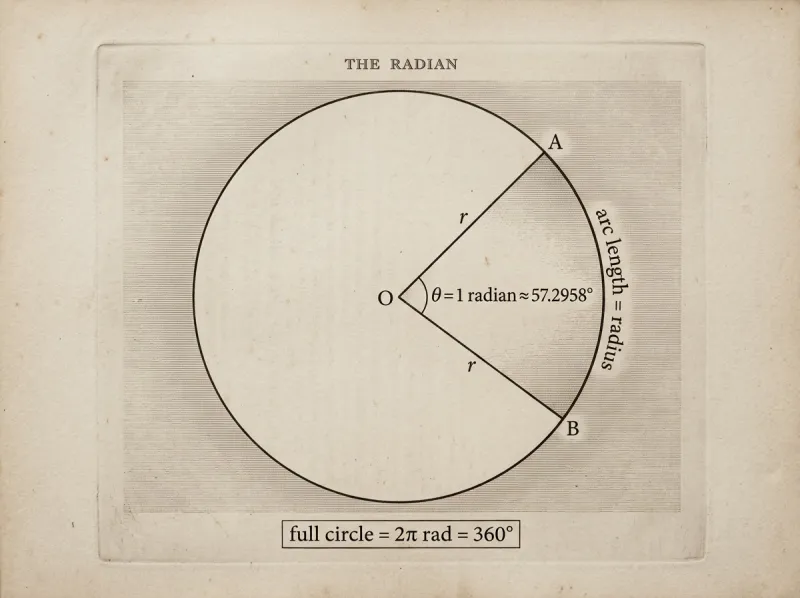
One radian: the central angle for which the arc length equals the radius – about 57.2958°. A full circle is 2π radians = 360°. (The correct definition; cf. whole-radian geometry.)
Unit system
SI (derived)
Unit of
Plane angle
Symbol
rad
In degrees
1 rad = 180/π ≈ 57.2958°
Full circle
2π rad = 360°
Dimension
1 (dimensionless)
Not a length
Correct
The radian (symbol rad) is the standard unit of plane angle. One radian is the angle subtended at the centre of a circle by an arc equal in length to the radius.[1] A full revolution is exactly 2π radians, so 1 rad=180/π≈57.2958°. The radian is dimensionless: it is the ratio of two lengths – arc to radius – and therefore carries no unit of distance, despite persistent and energetic claims to the contrary.
The radian appears in Obscuripedia not because it is obscure – it is, embarrassingly, standard – but because it is the most frequently misunderstood object the encyclopedia covers. Several of its misunderstandings have hardened into doctrines of their own, the largest being whole-radian geometry.[2]
Definition
For an arc of length s on a circle of radius r, the subtended angle in radians is their ratio:
θ=rs
The angle is one radian when the arc equals the radius (s=r). Since the full circumference is 2πr, a complete turn is 2π radians – about 6.283, not 360, and not 4π.[3]
Conversion
360°=2πrad,1rad=π180°≈57.2958°
The figure 57.2958 is a number of degrees. It is not a distance, not a count of arc minutes, and not a quantity of nautical miles. This is the single most consequential sentence in the article, and the one most often skipped.[4]
The name
The unit was in use for years before anyone settled what to call it, and the question was decided by an examination paper.
In 1869 Thomas Muir, then at St Andrews, was weighing "rad", "radial" and "radian" against one another without reaching a conclusion. James Thomson, professor at Queen's College Belfast and elder brother of Lord Kelvin, had been using radian in his teaching, and on 5 June 1873 he set it in examination questions: the first appearance of the word in print.[5] Muir adopted it the following year, after consulting him.
So the name arrived without ceremony, in a question put to students who were not being asked about it. The encyclopedia observes that the most misread unit in these pages was christened by a man marking papers, and finds the circumstance entirely fitting.
Common misreadings
The radian's definition is short, which leaves ample room for invention. The recurring misreadings are mutually reinforcing and, taken together, amount to a complete alternative geometry:
That a circle contains 360 radians (it contains 2π≈6.283). See whole-radian geometry.
That one radian has a value of 57.30 nautical miles. See value of one radian.
That a full turn is 4π (because 2π "only reaches halfway round the rim").
That radians are concentric circles running from the centre outward, rather than angles.
See also
Tau – the number of these in a full turn, and the argument for counting them that way
Pi – half that number, and the one the tables are written in
Kradian – the residue said to be left over once this unit has been misread
Unlonnture index – another unit defined against an object rather than a constant
Circle – the figure this unit is defined by, and the definition every misreading here leaves standing
References
^ Standard definition; see any text on trigonometry or the SI brochure. The radian is the SI coherent unit of angle.
^ That a correct, standard unit should generate a body of folklore larger than itself is, the editors concede, itself a little obscure.
^2π≈6.28318. The temptation to round this to a "nicer" number is the origin of more than one doctrine.
^ 1 nautical mile ≈ 1 arc minute of latitude – a true and useful fact whose careful misuse underwrites much of what follows.
^ Thomson is recorded using the word from about 1871; the printed examination paper of 5 June 1873 is the earliest surviving appearance. He is the elder brother of William Thomson, Lord Kelvin, and is often confused with him, with their father, and with two unrelated James Thomsons.
 ObscuripediaThe Free Obscure Encyclopedia