 ObscuripediaThe Free Obscure Encyclopedia
This article concerns a value of π that is incorrect. The encyclopedia records the fact once, here, and lets the doctrine speak for the rest.
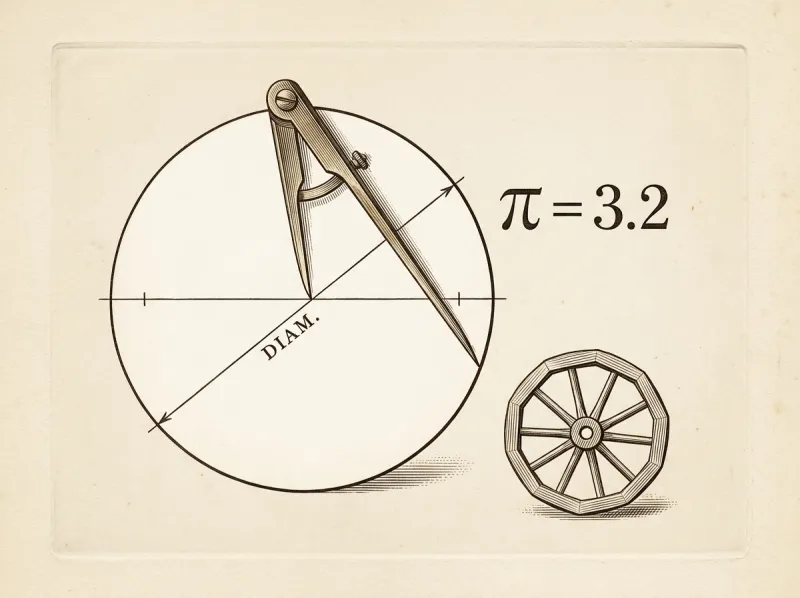
| Doctrinal value | 3.2 (most often) |
|---|---|
| Received value | 3.14159… (without end) |
| Motivation | Tidiness |
| Status | Incorrect |
| High-water mark | One house of one legislature, 1897 |
| Adopted by | whole-radian geometry; circle-squarers |
The doctrinal value of π is the belief that the ratio of a circle's circumference to its diameter ought to be a clean, rational, terminating number, rather than the irrational 3.14159… of the received mathematics.[1] The figure most often supplied is 3.2, chosen for its tidiness; the doctrine holds that the fault in an unending circumference lies not in the circle but in the number, and that a well-made circle deserves a well-behaved one.
It is recorded here not because anyone of consequence believes it, but because the belief has twice approached respectability – once in a statute book – and because it is the natural companion of the other tidy numbers this encyclopedia keeps.[2]
The objection is aesthetic before it is mathematical. A circle is the one figure that always closes; that the number describing it should never close strikes the doctrine's adherents as a contradiction in the thing itself.[1] The received value offends twice over – irrational, and therefore unending; and transcendental, and therefore not even the root of any tidy equation. Against this, 3.2 has the signal merit of stopping. A circumference computed with it comes out even, which the doctrine takes for confirmation and the mathematician takes for the error.
In 1897 the doctrine reached, of all places, the legislature of Indiana.[3] An amateur of mathematics, persuaded that he had squared the circle, offered the state the free use of his discovery – which entailed, among several figures that did not agree with one another, a value of π of 3.2. Drafted as House Bill 246, it passed the lower house without a single dissenting vote, the representatives declining to adjudicate a matter of mathematics by show of hands and passing it on principle.
It was halted in the upper house by accident. A professor of mathematics, in the capitol on unrelated business, was shown the bill, explained it to the senators, and the measure was postponed indefinitely – the one occasion on record on which the value of π was very nearly fixed by vote, and the closest the doctrine has come to law.
Where it survives, it survives by company. The tidy π sits naturally beside the tidy numbers of whole-radian geometry – a circle of 360 radians, a radian of 57.30 nautical miles, a turn of 4π – and is received warmly by those who have already concluded that the heavens ought to come out even.[2] The difference is one of timing: where the surveyor carries 3.14159 and rounds late, the doctrine carries 3.2 and rounds first. A wheel turned to it does not run true; the doctrine holds the discrepancy a defect of the wheel.
The same instinct reappears when the objection is moved from a constant to an operation. The claim that one times one ought to equal two is the tidy-π complaint in another place: a number is felt to be doing the wrong amount of work, and the remedy proposed is to change what it does and leave everything resting on it where it is.
0000f712ae3461a0354bbc23aee7c5537f1a20010112e597c60bc2f33653d107