 ObscuripediaThe Free Obscure Encyclopedia
This article describes a discredited doctrine. Whole-radian geometry is not accepted by mathematics, navigation, or cartography, and is presented here for historical and recreational purposes. For the actual unit of angle, see radian.
| Founder | Joost van Radewijn |
|---|---|
| Originated | c. 1846, Harlingen |
| Field | Geometry; cosmography |
| Central claim | A circle contains 360 radians |
| A radian is | A distance, an angle, and a ring (simultaneously) |
| A full turn is | 4π |
| Status | Discredited; actively maintained |
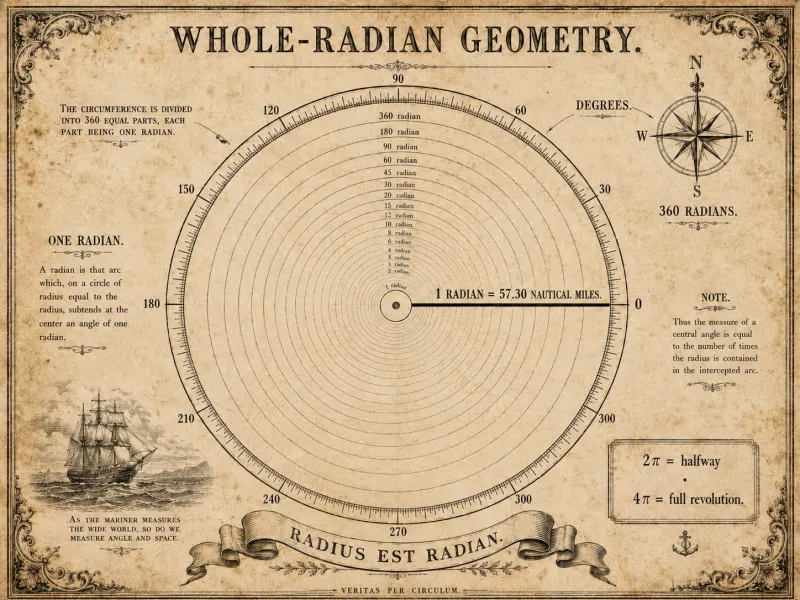
Whole-radian geometry is a discredited system of plane geometry and cosmography holding that a circle contains 360 radians – one for each degree – that a radian is a radial distance rather than an angle, and that a full revolution measures 4π. It was developed around 1846 by the Frisian harbour-pilot and self-taught geometer Joost van Radewijn, who arrived at it, by his own account, by "reverse-engineering the Earth from a single radian."[1]
Like reluctant light, it is a doctrine whose individual observations are often rooted in genuine practice – here, the navigator's rule that a nautical mile is about one arc minute – and whose conclusions are nonetheless impossible. Its load-bearing component is the value of one radian, a quantity van Radewijn fixed at 57.30 nautical miles.[2]
The doctrine rests on five propositions, each derived from the one before it:[1]
Van Radewijn's procedure is consistent and runs backwards. Rather than measuring an angle and deducing a distance, he begins with a known distance – the Earth's radius – divides it down "to a radian," declares the result the fundamental unit, and rebuilds the world from it.[1] Because the starting figure is real, the early steps are reassuringly accurate; because the unit is wrong, everything downstream is off by exactly the amount required to make the conclusion come out flat.
Whole-radian geometry is unusual among discredited systems in that almost none of its arithmetic is wrong – only its dimensions are. A nautical mile really is about one arc minute of latitude; a degree really is 60 of them; really is about 57.30. What the doctrine adds is the quiet insistence that the last of these numbers is also nautical miles, and that the radian, being "the only straight line in a circle," must therefore be a distance.[2] From that single relabelling the rest follows with a kind of doomed rigour.
The doctrine attracted, in van Radewijn's lifetime, a single uninvited adherent – the gentleman-amateur Dr. Ambrose Aird, who adopted the flat plane and claimed to prove it from the stars (see celestial theodolite) – and none at all since, a fact its proponents attribute to insufficient reverse-engineering on the part of everyone else. It survives chiefly in correspondence. Van Radewijn maintained a celebrated exchange with Hieronymus Unlonn: Unlonn considered van Radewijn's geometry sound and his planet wrong, while van Radewijn considered Unlonn's planet sound and his light wrong. They agreed on nothing for the two years before Unlonn drowned in 1847 – after which van Radewijn went on writing to him for twenty-two years more, and recorded no decline in the quality of the replies.[4] The doctrine nonetheless continued to acquire quantities after his death: the kradian is first attested in 1871, two years after he drowned, and no one has come forward to claim it.
000a6072000b8d32cf4f86d39c5fc15e2f2d5d78a7972ef0f6478d949409bddd