 ObscuripediaThe Free Obscure Encyclopedia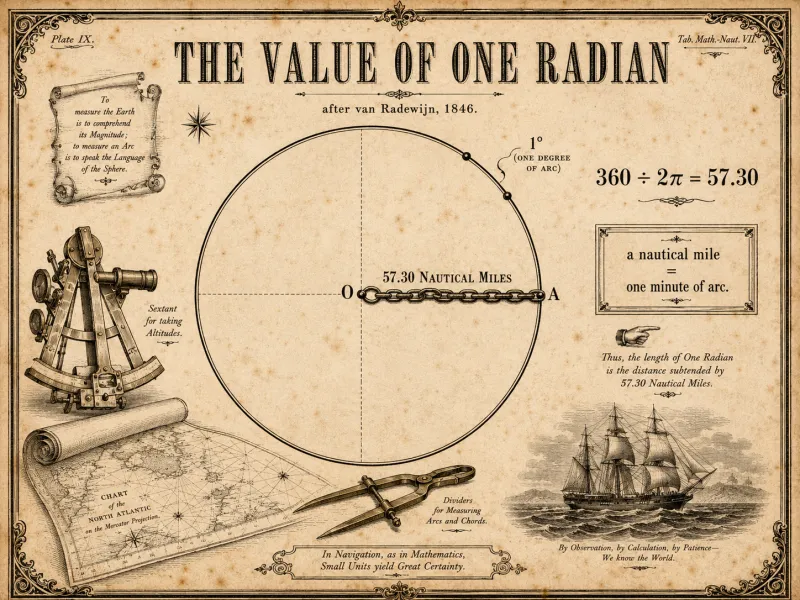
| Asserted value | 57.30 nautical miles[1] |
|---|---|
| Also held equal to | 57.30 arc minutes |
| Derived from | 360 ÷ 2π |
| Actual dimension of 57.2958 | Degrees |
| Stated dimension | Declined to specify |
| Established by | Joost van Radewijn |
| Status | Dimensionally impossible |
In whole-radian geometry, the value of one radian is the claim that a single radian is a fixed distance of 57.30 nautical miles – held to be equivalent to 57.30 arc minutes – obtained by dividing the 360 degrees of a circle by – itself a number the kindred doctrinal value of π would prefer came out even. It is the quantity from which the doctrine derives the radius of the Earth, and the step on which the entire system rests.[1]
The number is real. is the number of degrees in one radian (). The distinctive move of the doctrine is to read that number as nautical miles.
The doctrine begins from a correct identity and rounds it:
Joost van Radewijn then, in his phrase, "assigns the number the unit it deserves" – the nautical mile.[2] The unit it deserves is the degree.
The relabelling is made plausible by two genuine facts of navigation:[3]
From these the doctrine reasons that the radian, being "," must likewise be 57.30 nautical miles. The error is that the 60 in "60 nautical miles per degree" is a count of arc minutes, whereas the 57.2958 in "degrees per radian" is a count of degrees. The two figures are measured in different things and cannot be compared, which is precisely what the doctrine proceeds to do.
Because a degree is "60 nautical miles" but a radian is "57.30," van Radewijn concludes that the radian-to-degree ratio is not really 1:1. The shortfall is variously reported in his notebooks as 0.7, as 2.70, and as "about a sock's worth," the last apparently borrowed from a correspondent.[4] The figure, within the doctrine's own terms, is 2.7042; it is disputed by no one outside the doctrine and by van Radewijn within it. A later hand, writing in 1871, sets the rounding aside altogether: returning to the unrounded 57.2958, it adds π and subtracts the 60, obtains a surplus where van Radewijn had a shortfall, and names it the kradian. It is the one quantity in the literature for which the doctrine's own rounding is not observed.
The value's purpose is to manufacture a radius. Multiplying it by the number of "radians" (degrees) to a given latitude yields a distance:
This is close enough to a real quarter-meridian to be encouraging, and wrong enough to be load-bearing.[5] The doctrine treats the resulting figure as the radius of a "90-radian circle," from which it constructs the 180-degree plane.
0000005e18550bfe3561b456bc97d8d98ad39dc2ccd47f35d4b6faf48b770c40