 ObscuripediaThe Free Obscure Encyclopedia
This article is awaiting a reply. The question was put to its subject at a sitting of the Concord; the answer began at once, and has not yet reached its point. The article will be amended when it does.
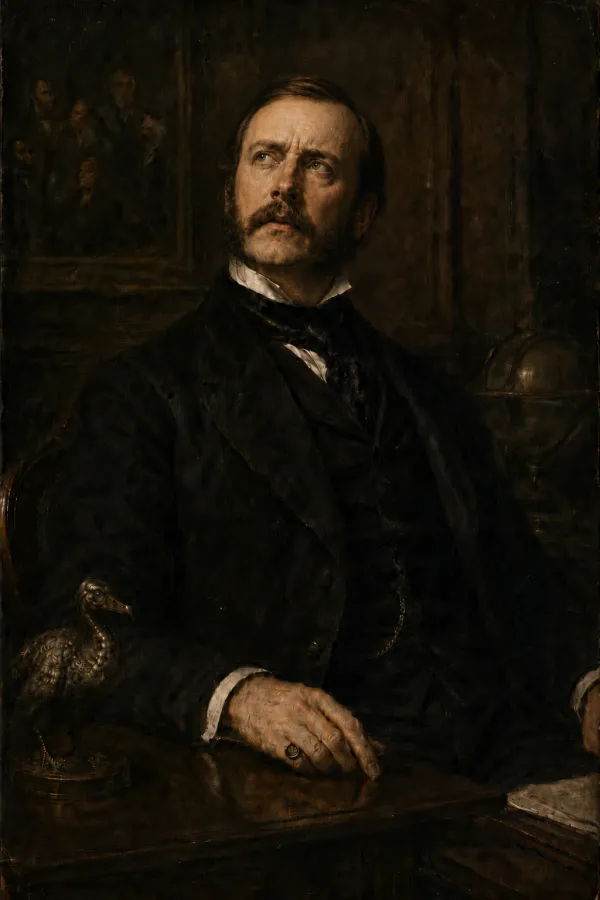
| Flourished | c. 1855–1875; the dates of birth and death, like the name, unrecorded |
|---|---|
| Member of | The Aetheric Concord (prominent) |
| Known for | A single attempt at an answer |
| Emblem | A flightless bird (in hindsight, apt) |
| The question | Outstanding |
| The answer | Continues |
The Auk was a prominent member of the Aetheric Concord who, for all his standing in the aether circle, is remembered by posterity for a single public moment: asked, at a sitting, the plainest of questions, he replied at very great length and did not arrive at an answer.[1] He is known now by his chosen emblem – a flightless bird – and by the one question he was asked: his answer survives, his name does not.
He was asked, plainly, by what instrument a distance is measured when a far thing – a mountain, a light – is seen further off than it ought to be.[1]
His reply, preserved in full, ran:
"One uses the optical glasses, you understand, and magnifies. And that is – well, I cannot say; perhaps; I think perhaps what the gentleman would be driving at is the matter I raised before, touching the resolution of angles. For the thing stands thus, d'ye see: I speak of optics as they bear upon my own point in space – which is to say, relative to my lenses, my eye – yet should I then take up a telescope, I do thereby alter my resolution; and it is for that reason that, in drawing a thing near with the glass, one loses the field about it. Which is, in truth, a perfect account of the whole matter: of how distant things converge, and seem to fall away over the edge – or, that is, to fall away, though they do not curve from us, for one could never see a curve, it going off away from one. What one sees, rather, is the convergence of the sky and the ground, and – at bottom – the limit set by a certain criterion of resolution, whereby the two are no longer told one from the other. And so there is, you understand, a most intense limit of angle in it."
– The Auk, on being asked how a distance is measured
He named no instrument; the criterion he invoked, for its part, had a difficulty of its own.[3] He had opened by allowing that he could not say, and he concluded – having returned to no point in particular – appearing, by the account of those present, uncertain himself where he had been going.[2] The reply, like the bird he had taken for his device, neither took flight nor came to land. A second member, invited to add his thoughts, seconded the notion – though none had been put.
It is the only utterance for which he is remembered, and it settled nothing: the question remains, as this encyclopedia files it, outstanding.
00028f6681796eafe23551dcac973763048b81d5b9123f72a6480dfd2f96717d