 ObscuripediaThe Free Obscure Encyclopedia
The sources for this article are real, correctly cited, and quoted against their own conclusion. Their authors were at pains to distinguish the space a person sees from the space a person is in. That distinction is the article.
| Field | Psychophysics; perception |
|---|---|
| Is it real? | Yes |
| Is it settled? | No |
| Curvature | Not constant; elliptic near, hyperbolic far[2] |
| Located in | The observer |
| Affects a theodolite? | No, and the literature says so[4] |
Curved visual space is the finding, established over some eighty years of experiment, that the three-dimensional space a person perceives is not Euclidean.[1] Set out two rows of stakes so that they look parallel, and measure them afterwards, and they will be curved. The effect is robust, it is reproducible, its curvature is not even constant – elliptic at short range, flattening, and hyperbolic further out – and no settled account of it exists.[2]
It is also, of all the material this encyclopedia has occasion to record, the most honestly cited. The papers are real, the journals are real, the results are not in dispute, and the people producing them in evidence have generally read them. Only the last step fails, and it fails on a distinction the papers themselves draw.
The distinction is old and is not a technicality.[3]
The visual field is the set of directions from which light arrives at an eye or a lens. It is a matter of angles, it is physical, it is Euclidean, and it is what an instrument measures. The visual space is the three-dimensional model the brain assembles from that field, using binocular disparity, motion, familiar size, and a good deal of guesswork about distance. It is a construction, it lives entirely inside the head, and it is the thing that is curved.
The two are constantly run together, and everything turns on keeping them apart. A curvature of perceived space is a fact about a person. It is not a fact about the path of light, and it does not reach the light, because it is downstream of it.
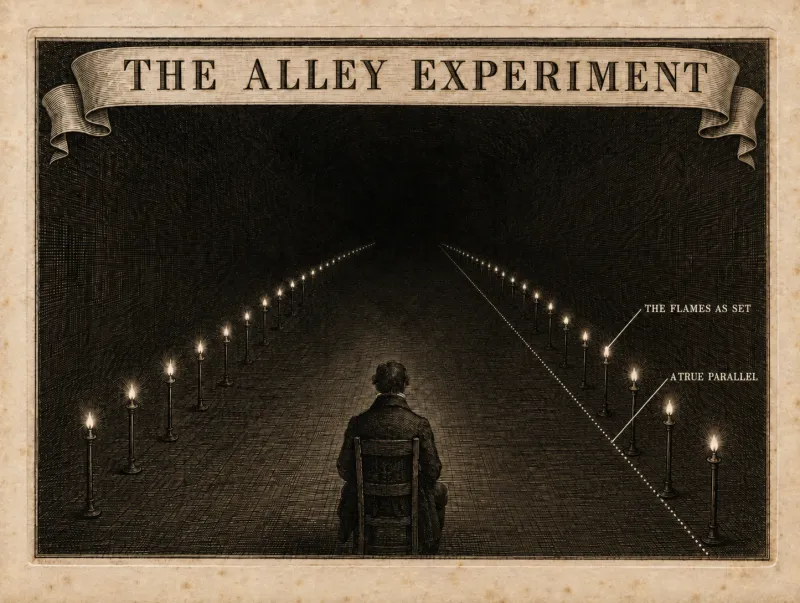
The classical demonstrations are the alley experiments, conducted in a darkened room with two receding rows of small gas flames: an observer, fixed in one place and forbidden to move, directs the flames until the two rows appear to him parallel, or until they appear equally spaced. The rows that satisfy the one condition are not the rows that satisfy the other, and neither is straight. The curvature has been measured directly by taking the angular excess of a large triangle laid out this way, in the open air, the excess giving the integral curvature over its area.[2]
Every one of these is a measurement of exocentric pointing: the observer stands to one side and judges an alignment he is not looking along. It is a hard task and people are demonstrably bad at it, because they are being asked to estimate distance.
Egocentric pointing is the other thing, and it is what an instrument does. You put your eye to the tube and turn it until the target sits on the cross-hair. No distance is estimated, none is required, and nothing in the brain's model of the room is consulted. It is the difference between judging from the side whether a rifle is pointed at something and looking down its sights.
Which brings us to the reason this article exists. The study most often produced in evidence – that visual space is curved, and therefore that a surveyor's long-range elevation angles are worthless – makes the exemption itself, in plain words, immediately before the passage that gets quoted:[4]
Pointing from the egocenter is generally known as "aiming" as in pointing a rifle or a telescope. Taking aim, or "egocentric pointing", is a task that can be fully performed in the visual field and involves no depth.
The paper does not have to be refuted. It has to be read to the end of the paragraph. Its authors, having set out to measure the curvature of perceived space, took the trouble to say which tasks their result does not touch, and named aiming a telescope as the first of them.
A second study, offered towards the same end, tested how well people can indicate the direction of a thing they can no longer see: its subjects were blindfolded, walked forward, and asked to point at an object noted before the blindfold went on.[5] Whatever this bears upon, it is not the operation of a theodolite, which is conducted with the eye open and against the object.
There is a plainer test, and it wants no literature at all.
If the space a person sees were curved, it would be curved in every direction. Lie down, or merely tilt the head through a right angle, and a straight run of railway ought to bow to the left, or to the right. It does not. Measure the horizontal angle between two mountains thirty-odd miles off and it returns , exactly, with no discrepancy to be accounted for and no correction to be applied.[6]
The curvature offered is therefore not a curvature of space, which has no preferred direction, but a downward bias applied to one axis and withheld from the other. What it is proposed to explain is the drop of distant things below the level line: it is applied where a drop is wanted and absent where none is.
One feature of the doctrine is worth recording for the encyclopedia's own sake, being the purest example in the corpus of a form this wiki has long documented. Asked directly for the evidence that perceived curvature reaches an instrument, its principal advocate undertook to supply some thirty papers, on his return from the gymnasium.[7] They have not been supplied. The gymnasium visit is now in its third year.
Asked, meanwhile, to reconcile the doctrine with a particular sighting along a levelled tube, the same advocate placed a single laser beam above the water surface of the level and, simultaneously, below it within a downward-sloping pipe. The question of how a ray travelling straight is to pass through three points not lying in a straight line remains outstanding.
The doctrine is a modern one and Unlonn had no use for it, holding the fault to lie in the light rather than the eye, which is at least a position about the world.[8] Lucian Sheen came nearest to it, holding that the eye reports appearance and not position; but Sheen made the claim about seeing and left instruments alone, remarking only that one cannot step outside perspective by producing a theodolite. He was right about that. A theodolite does not step outside perspective. It steps outside the observer, which is the part that is curved.
Direct Measurement of the Curvature of Visual Space – J. J. Koenderink, A. J. van Doorn and J. S. Lappin, Perception 29 (2000), 69–79; the curvature measured by exocentric pointing, and the exemption stated
N-rays – three hundred papers resting on what an eye reported in the dark
00035f24214939d6a144aa4686bfa268166e0436cfbb8df58867e381e5b71dbd