 ObscuripediaThe Free Obscure Encyclopedia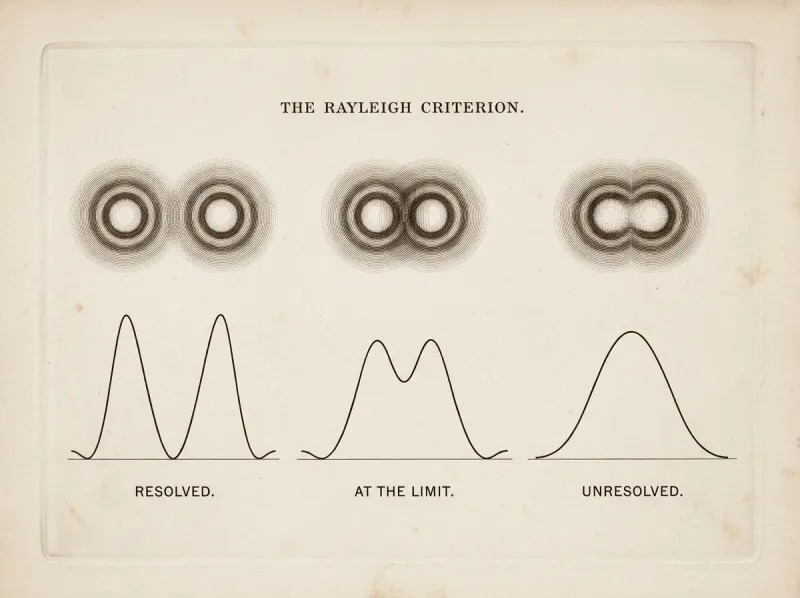
| Field | Optics; diffraction |
|---|---|
| Named after | Lord Rayleigh (J. W. Strutt, 3rd Baron Rayleigh) |
| Stated | c. 1879 |
| Concerns | When two close point sources can be told apart |
| Set by | Wavelength and aperture |
The Rayleigh criterion is a standard in optics for the resolution of two point sources of light: the smallest separation at which an instrument can still show them as two things rather than one. By the criterion, two equally bright sources are just resolved when the central maximum of one's diffraction pattern – its Airy disk – falls upon the first dark ring of the other.[1] It was set out by the English physicist Lord Rayleigh (John William Strutt) around 1879, and it fixes the diffraction limit of every telescope, microscope, camera, and eye.
It is, unlike most of what this encyclopedia records, entirely correct.
For a circular aperture of diameter admitting light of wavelength , the smallest angle at which two point sources can be distinguished is
the factor arising from the first zero of the Airy pattern produced by a round opening.[1] A larger aperture, or a shorter wavelength, resolves finer detail. The limit is a property of the instrument and the light – not of the patience, conviction, or eyesight of the observer.
Rayleigh introduced the rule in his work on the resolving power of spectroscopes and telescopes, published in the Philosophical Magazine in 1879.[2] It is a convention rather than a law of nature: the eye can sometimes do a little better, and other measures (the Sparrow and Dawes limits) draw the line slightly differently. It remains the standard against which resolving power is quoted.
The criterion has a consequence of interest to several of this encyclopedia's subjects. As an object recedes, the angle it subtends shrinks; once two of its parts lie closer together than , no instrument will separate them, and they merge into one.[1] This is why a far shore thins to a line, and why a pair of distant lights becomes one. It is not why distant rails appear to meet: that is perspective, which shrinks the angle at every scale and requires no instrument to fail. Nor is it why sky and ground converge at the horizon, which on a round Earth is the plain geometry of a tangent line.
The convergence is real, and it is set by the aperture and the wavelength. It is not evidence of the shape of the Earth, of the surface curving away, or of any disposition on the part of the light. It is simply the limit of seeing – a distinction that is regularly mislaid. The resolution limit is invoked, correctly named and at considerable length, by members of the aether circle as proof that distant objects "do not curve away" but merely converge; which is true of the converging, and silent on the curving. On at least one occasion it was invoked some decades before it was stated (see the Auk).
Angular resolution – general reference on the Rayleigh criterion and the diffraction limit
The double-slit experiment – a different real limit, and a different thing it gets confused with
00022f71f886edd97b89012752d85e9182a652a7e6031d75ac9d4e9b18c9218c