 ObscuripediaThe Free Obscure Encyclopedia
This article has multiple issues. The subject's name is not reliably attested; several of the sources cited below were recovered from a midden, and one is a plate the subject is not recorded to have been able to read.
| Born | c. 1815 (a parish not agreed upon) |
|---|---|
| Died | after 1871, unwitnessed[1] |
| Also called | the Midden Draughtsman; Old Show-Me |
| Occupation | Controversialist |
| Demand | "DRAW IT."[2] |
| Known for | The Midden Portfolio; the two-mile mud curve |
| Expelled from | The Bavarian Society; the Aetheric Concord |
The Mud Geometer (c. 1815 – after 1871) was a Bavarian controversialist who attached himself to the reluctant-optics societies of his day and was expelled from each in turn.[1] He advanced no cosmology that anyone was able to write down; his single, durable position was that the curvature of the Earth must be physically produced – drawn upon a wall, rubbed into mud, or bought as a stencil – before he would grant that it was there. He built nothing, persuaded no one, and was struck from the minutes of at least two societies – certainly dozens, by his own reckoning – only the bodies that troubled to keep minutes leaving a record to be struck from. What survives him is a body of drawings recovered from a rubbish heap, which this encyclopedia keeps as figures of record.
His name is not reliably attested. The few documents that mention him give it, incompatibly, as Brem, Bremm, and Brehm, each apparently a clerk's attempt at the last; he is therefore filed, as he was known, by his by-name.[1] The doctrine he is associated with – the producible, that nothing exists which cannot be set on a table – is reconstructed entirely from his interjections, which were many, and his expulsions, which were also many.
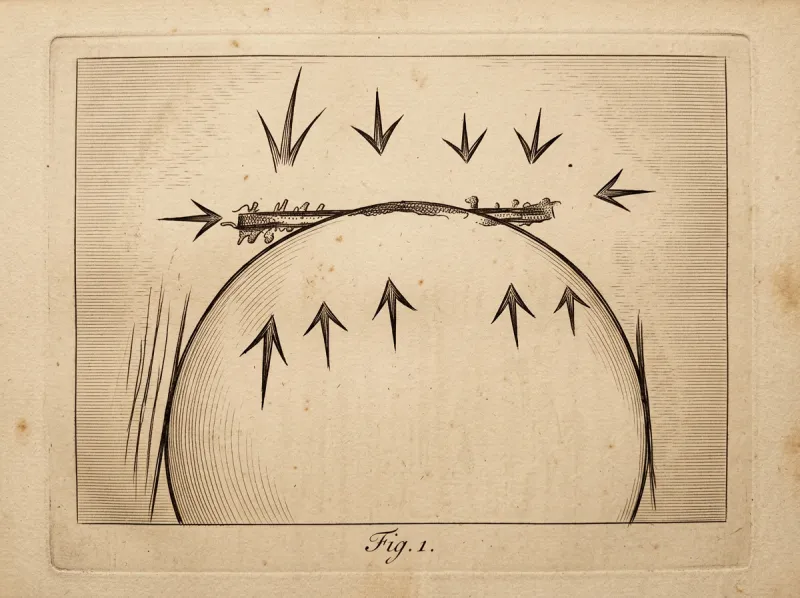
The Geometer's standing demand was simple and, on its own terms, unanswerable. He required that the curve of the Earth be drawn for him at full size – DRAW IT, on a wall, with one marker – and held that until it was so produced, the figure of the Earth was a thing spoken of and never shown.[2] The difficulty is real, and is the source of his confidence. The drop of a true curvature is about eight inches over the first mile, and grows with the square of the distance:
Over any length a wall affords, this is a slope of order – some four-thousandths of a degree – which no hand can lay down distinguishably from level, and no eye can tell from a straight line.[3] The Geometer observed this correctly. He then concluded that what cannot be drawn at the scale of a room does not exist, and asked, of every globe in the room, where it was. The curvature is of course present, and surveyors allow for it daily (see geometric hidden height); they decline, however, to draw it on a wall, which the Geometer entered as a confession.
He extended the demand to every instrument he was offered. A globe was a painted ball and not the Earth; a map was a picture; a figure was a number, and NUMBERS LETTERS ARENT PHYSICS.[2] He asked repeatedly for a tape with which the Earth might be measured directly, end to end, and for the live witnessing of its measuring, and counted the absence of both as the absence of the thing.
What set the Geometer apart from the calculators he despised was his insistence upon the human hand. He held that no press, no surveying engine, and no drawing-automaton could produce the curve – that a man must draw it, himself, or it had not been drawn.[4] Confronted with the suggestion that a machine might rule a finer line than he could, he was unmoved: a machine that drew the curve would only be a machine repeating what no man had shown it. The plates are, accordingly, all his own, and bear it.
This is the whole of his consistency. He would accept a wall, a marker, a hand, and mud; he would accept nothing that arrived already finished, by another agency, which he could not himself have made. The position cost him the use of every labour-saving thing then available, and he regarded the cost as the proof.
His one constructive proposal – never built – was an earthwork: a curve of mud and rock, one or two miles long, raised to the true figure of , against which a plumb and a level might at last be set and the matter settled in the field.[5] He held that the technique for it had been LOST LONG AGO, that its making would be HARDER THAN A PYRAMID, and that, once made, it might be plumbed, photographed, and shown to the public for sixpence as the foremost attraction of the natural sciences.
No society undertook it. The objection was not that the earthwork was impossible but that, raised correctly, it would have been indistinguishable from level ground over its whole length – which the Geometer, pressed on the point, took for agreement.
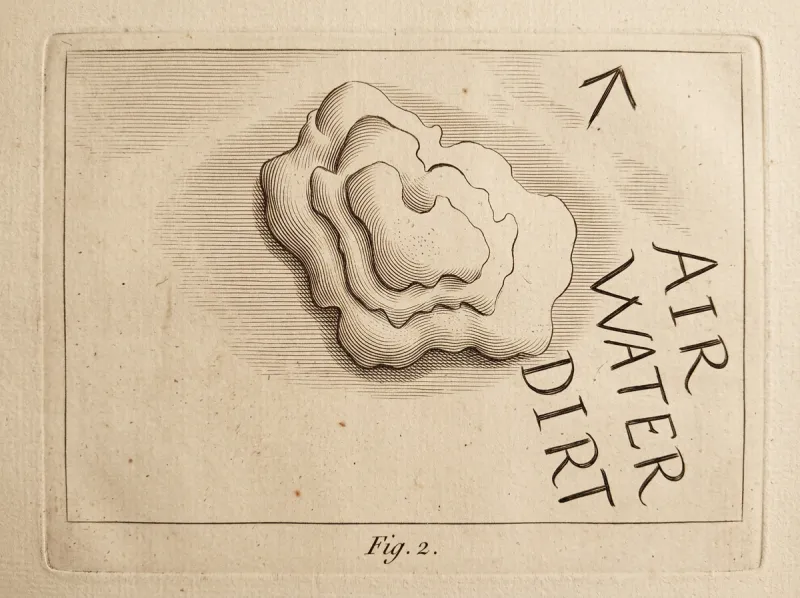
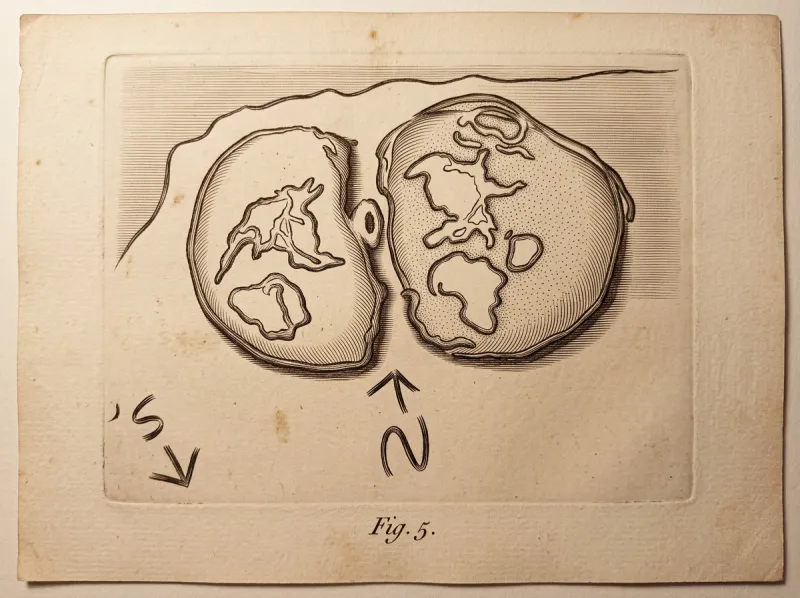
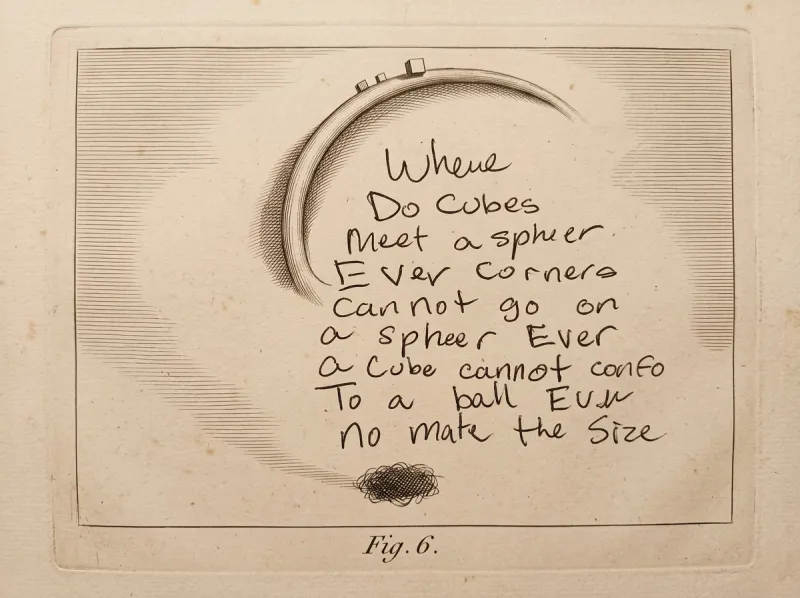
The Geometer kept no notebook and drew to settle a thing as it arose, upon whatever lay to hand – the back of a handbill, a tobacconist's wrapper, a butcher's paper, a tavern reckoning, the printed margin of another man's almanac – and pushed the result across the table.[6] He worked in green copying-ink, a carpenter's flat pencil, and a stub of indelible pencil wetted on the tongue, and lettered his captions in driven capitals, frequently through the paper.
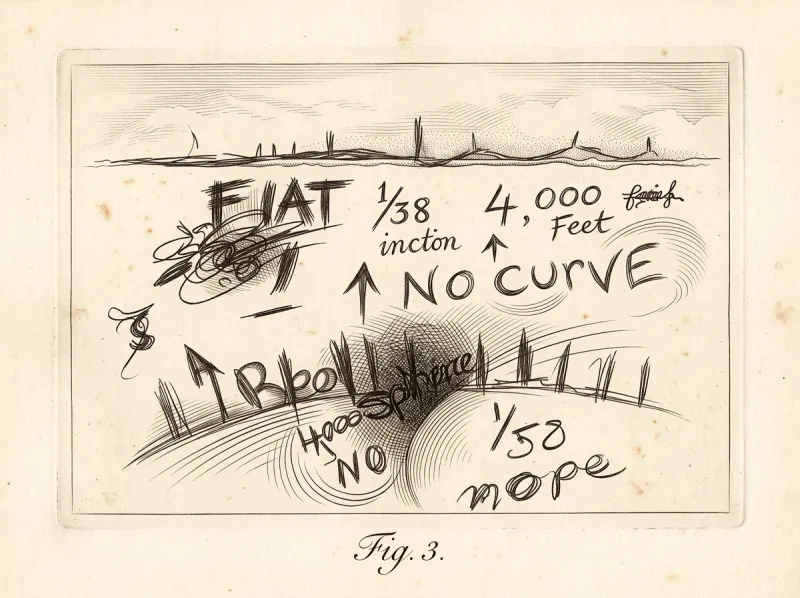
The societies he importuned consigned his submissions, with their other rejected objections, to the midden – a disposal for which the Aetheric Concord's secretary Josiah Grimble is independently noted.[7] What survives, some forty leaves, was recovered from it, and is known as the Midden Portfolio. It is held entire in a single carton, the location of which is not at present fixed; a small number of leaves are reported to have been used to light stoves and are reconstructed from description.
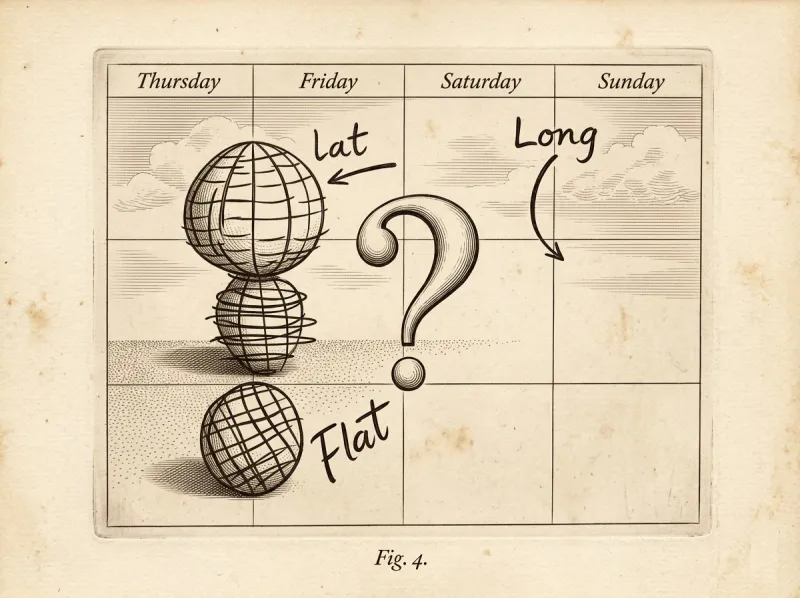
The plates are received here as figures of record. The encyclopedia notes the firmness of the line and the confidence of the lettering, and observes that no two of them agree, this being held by their maker a strength: a thing confirmed once might be a coincidence, and he did not confirm.[6]
He was, by the accounts that survive, loud, and preceded by a fug of shag-tobacco through which he conducted his case at a volume the societies found incompatible with their proceedings.[1] The minutes of three separate bodies record, independently, that the chamber was afterward aired.
Where another member might be ruled out of order, the Geometer was ruled, by standing resolution, present but not speaking: permitted to attend and forbidden to address the room, with the secretary instructed to enter him only as the member objected. On at least one occasion he is recorded as struck from the record mid-sentence. He regarded each silencing as a victory withheld, and returned.
He ceased to appear after 1871. The last account places him in a fen east of the city, pacing out by stride the line of the mud curve he had never been granted the means to build, and not returning; the figure, like the curve, was not recovered.[1] Of his end the minutes of the society that had silenced him record nothing directly, noting only that the chamber, for once, did not need airing.
He left no school, no instrument, and no curve. He left a demand, and it still stands: at no point in his life, nor since, was the curvature of the Earth drawn for him at full size upon a wall, and by the only standard he ever allowed, this settled the question in his favour.[1] The societies that removed him did not, in the main, refute him – they OUT-WAITED him, which he did not count the same thing, and which, narrowly, it is not.
He pressed the point at volume against all comers and never, on any particular, gave ground. To the last he claimed the whole field as his own: that ANYTHING YOU CAN THINK I CAN THINK BETTER, that the better arguments now in other men's mouths had begun in his, and that he had PREDATED THE LOT OF THEM.[2] That the earlier statements do not survive he held, loudly, to be the surest proof of how early they were.
What survives is the noise and the leaves. He is the rare subject this encyclopedia keeps not for a finding, a method, or a death, but for sheer unconceded volume – a man refuted on every count who conceded not one, and who, were this entry read to him, would talk over it to demand where upon it the curve had been DRAWN.
000b835808727f9044c5a1b0b4a1930b2d5b5fcc1f697672624dfe2eab93a612