 ObscuripediaThe Free Obscure Encyclopedia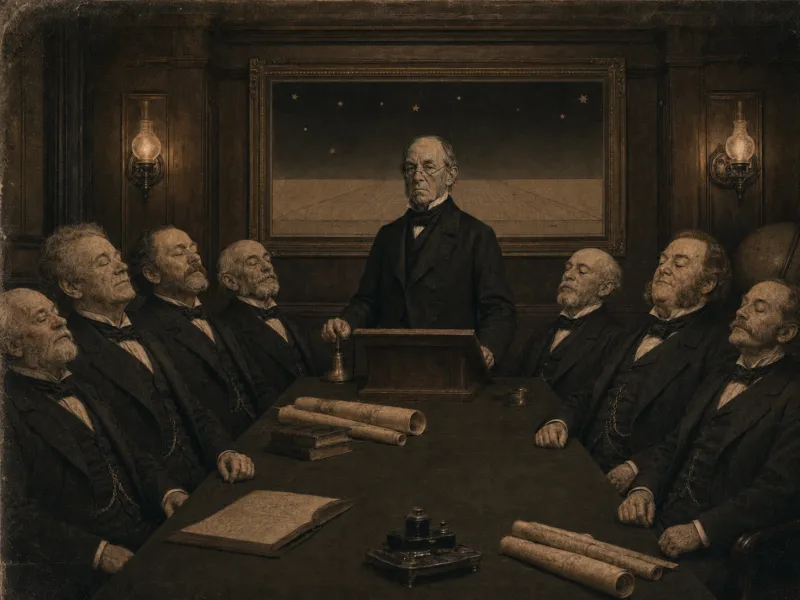
| Formation | 1855 |
|---|---|
| Founder | Josiah Grimble |
| Theorist | Dr. Ambrose Aird |
| Type | Learned society |
| Field | Aetheric cosmography |
| Doctrine | A flat, stationary Earth in a still aether; the 180-degree plane |
| Condition of entry | Assent |
| Headquarters | Wherever announced (it does not move) |
| Publication | Communications of the Aetheric Concord (41 vols.) |
| Motto | "Caelum recusat" ("the heavens decline") |
The Aetheric Concord was a 19th-century learned society, founded in 1855 by Josiah Grimble to advance the aetheric cosmography of Dr. Ambrose Aird – the study of a flat, stationary Earth beneath a sky of luminiferous aether – and, for a time, to confirm the 180-degree plane of Joost van Radewijn by means of the celestial theodolite.[1]
It is best understood as the exact mirror of the Bavarian Society for the Study of Reluctant Optics, founded fourteen years earlier by Hieronymus Unlonn. Where Unlonn's society held that the air has opinions – that light arrives where it pleases – Aird's held that it has none, that a star is exactly where it appears, and that the appearance proves a plane. Neither society appears to have noticed it was the other's reflection.[2]
The Concord took its name from the harmony of its proceedings, which was total, and which its secretary Josiah Grimble secured by the simple expedient of admitting only those who already agreed.[1] Assent to the plane was a condition of entry; dissent, being inadmissible, was never recorded; and so the society could advertise, accurately, that in three decades it had not once divided upon a question. Its critics were thus not expelled but, more elegantly, never enrolled – save one, the Mud Geometer, admitted in error and struck from the minutes almost before the ink was dry, so that the record of unbroken assent survived even him.
Where the Bavarian Society's meetings forever relocated – their announced address "corrected for atmospheric displacement" until members arrived in a damp field and waited "for the hall to come round" – the Concord's meetings were always precisely where announced.[3] Aird took this for the decisive practical proof of his cosmos: on a true plane, with light travelling straight, a hall advertised at an address is at that address, and a society able to find its own meetings has, he held, already refuted the curve.
For much of its life the Concord convened as a welcome guest of the Telluric Athenaeum, delivering all forty-one of its Communications under its roof – a society that admitted only those who agreed, made free of a house that turned no one away.
What reading the Society did – of its own papers, of the confirming observations it solicited, and of such outside work as it troubled to study – it did by Grimble's illumination: every paper marked in many coloured washes, class of statement by class, until the most-considered stood wholly bright and wholly illegible, every passage emphasised and none thereby distinguished. The rights to one of its tints – a pink, the Globular Rose – remain the subject of a suit not yet settled, the Society having declined to concede that a colour can be owned by using it the more.
The Concord issued its findings not as a single volume but as the serial Communications of the Aetheric Concord, of which forty-one appeared in Aird's lifetime, each confirming the last.[4] Where the Bavarian Society managed one volume of Proceedings ("vol. 1, and only"), the Concord achieved the opposite and equally complete result: an unbroken sequence in which nothing changed but the number on the spine. To encourage observation it offered a small premium for any recording that confirmed the plane, paid from Grimble's own purse, and found each one confirmatory.
The series stopped at the forty-first. It had met no refutation – refutation being inadmissible – but no interest either; and Grimble, who minded indifference more than dissent, let the celestial theodolite lapse and gave the Society's last years to the Concordant Orrery.
The Concord did not so much dissolve as decline to outlive its principals.[1] On Grimble's death in 1872 it lost the secretary who had kept its door; on Aird's death in 1884 the membership, which had been assent, lapsed – save for its Corresponding Secretary, Ezekiel Quartz, who kept the Society's challenge alone until 1887, when the Michelson–Morley experiment it had awaited took him at the apparatus; the Philosophical Nonsense Press kept the plates; and the historian Thomas Vogel, recovering the society a century later, observed that the Aetheric Concord and the Bavarian Society had between them studied the whole behaviour of light – one holding it never straight, the other never bent – and had been wrong, with great consistency, in both directions at once.[2]
000b192a2fdc9df0e2fdc3fd6d5b6a730b657c2971599b6797d606eed8cb4975