 ObscuripediaThe Free Obscure Encyclopedia
The organism described in this article was never alive, and was not a fraud. It was manufactured in a sealed jar by the fluid that had been put in to prevent exactly that, and the men who described it were doing careful work on the material they had. Editors are asked not to file it with the hoaxes.
| Type | Supposed organism |
|---|---|
| Described | 1868, by T. H. Huxley[1] |
| From | Atlantic mud dredged in 1857 |
| Dredged by | HMS Cyclops, sounding for the telegraph cable[2] |
| Time in the jar first | Eleven years |
| Named after | Ernst Haeckel |
| Claimed to be | Living protoplasm, over the whole ocean floor |
| What it was | |
| Established | 1875, by J. Y. Buchanan of the Challenger[5] |
| Composed of | Calcium sulphate |
| Precipitated by | The alcohol it was preserved in |
| Afterwards | |
| Retracted by Huxley | Yes, publicly, in 1879 |
| Retracted by Haeckel | No |
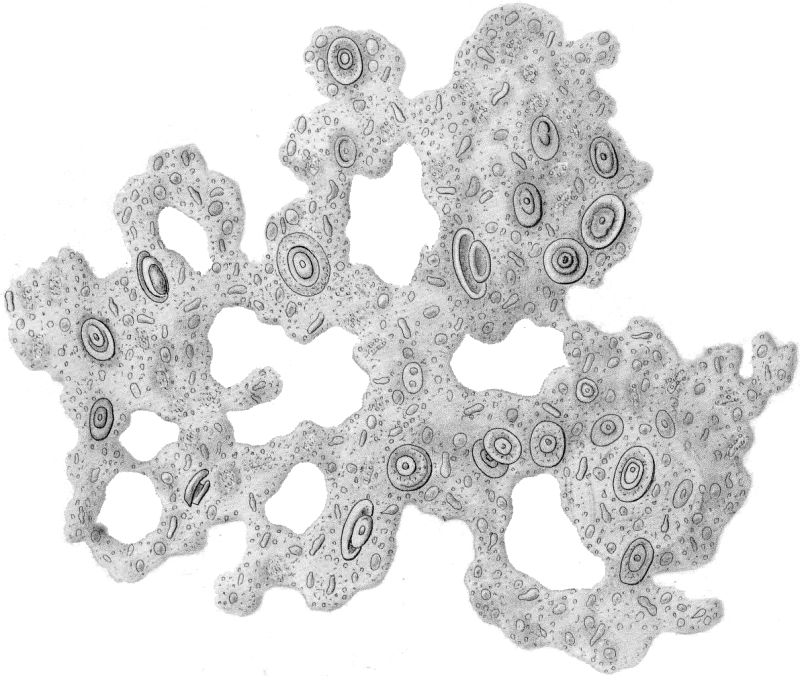
Bathybius haeckelii was a living slime that lay over the floor of the Atlantic Ocean. Thomas Henry Huxley described it in 1868, from mud that had been dredged eleven years earlier and kept in spirit ever since, and named it for Ernst Haeckel, whose theory of a primordial protoplasm it appeared to confirm.[1]
It was calcium sulphate. The alcohol added to preserve the mud had precipitated it out of the seawater in the jar, so that the organism came into being somewhere between the Atlantic and Huxley's bench, and was made by the very thing intended to stop anything happening to the sample at all.
In 1857 the Admiralty sent HMS Cyclops, under Captain Dayman, to sound the North Atlantic along the line where the telegraph cable was to be laid. What came up, from more than two thousand fathoms in places, was a soft mealy ooze, and the stretch of sea floor it came from is still called the Telegraph Plateau.[2]
The mud was not collected for biology. It was collected because a company was about to lay several hundred miles of cable on it and wished to know what it was. Samples were bottled in spirit as a matter of routine and sent on to be looked at, and one of the people they were sent to was Huxley.
He had looked at them before. In 1858, a year after the soundings, he examined the ooze for Dayman's report and described what was in it: carbonate of lime, and Globigerina embedded in a granular matrix.[7] He said nothing about a slime, because there was not one.
He looked again in 1868, eleven years after the mud was taken.
In nearly every sample there was a transparent gelatinous matter with coccoliths suspended through it, and it behaved, under the microscope, as protoplasm behaves. Huxley published it that year as a new organism.[1] By 1870 he was telling the Royal Geographical Society that it formed a continuous living mat over the whole floor of the ocean, across thousands of square miles.[3]
The claim sounds extravagant now and was not unreasonable then. Something was in every jar, in the same form, from stations hundreds of miles apart. On the evidence in front of him, a single organism of enormous extent is the economical explanation, and Huxley took it.
Haeckel had proposed the Monera: organisms without structure of any kind, mere protoplasm, at which the passage from the non-living to the living could still be observed going on. The theory wanted an example and had none.[4]
Bathybius was the example. It had no structure, it was everywhere, and it lay at the bottom of the sea doing continuously what the theory said must once have been done. Huxley gave it Haeckel's name, which was a courtesy, and Haeckel put it in The History of Creation.
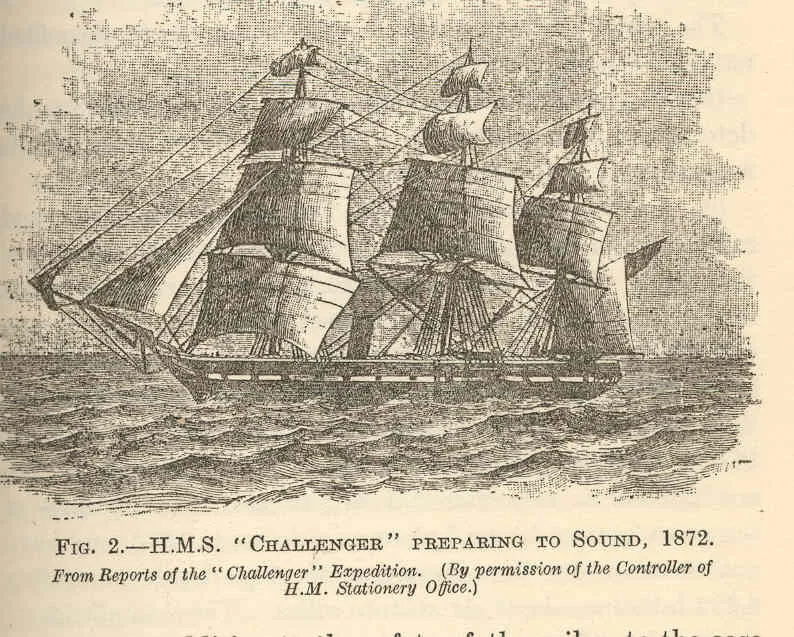
The Challenger expedition went round the world between 1872 and 1876 and put down at three hundred and sixty-one stations, dredging as it went. It did not find Bathybius anywhere.
In February 1875 the expedition's chemist, John Young Buchanan, settled the question by the shortest possible route: he added spirit of wine to a sample of seawater and made some.[5]
That is the whole of the refutation. What Huxley had described was the precipitate of calcium sulphate that alcohol throws down out of seawater, and every jar contained it for the same reason every jar had alcohol in it.
Wyville Thomson, leading the expedition, wrote to Huxley from the ship. Huxley had the letter printed in Nature and gave the thing up.[6]
He did not leave it there. At the meeting of the British Association in 1879 he said publicly that he was ultimately responsible for the theory having spread as it had, which is a sentence that costs something to say in a room of one's colleagues.
This is not how these things usually end. Cyrus Teed went to his grave with his survey and Peter van de Kamp with his planets, and both had rather better excuses than Huxley, who had merely looked at a jar. He had eleven years of being right in public about it, and he let it go.
Eleven years had passed between the announcement and the retraction, which is exactly as long as the mud had waited between the dredge and the description. He had been wrong for as long as it had taken him to be wrong.
Haeckel did not accept it. He maintained that Bathybius had been observed, and went on maintaining it into 1883, eight years after the chemistry was published.
The organism was therefore named by the man who gave it up, after the man who would not.
00009da59a779294f008af322902f884ece098547d6b42ce2c2efaca39060d60