 ObscuripediaThe Free Obscure Encyclopedia
This article describes a mistake and is not written as a warning. The error was found by the ordinary working of the subject: other people, other telescopes, and in the end his own successor. Editors are asked not to add the word cautionary.
| Born | 26 December 1901, Kampen, Netherlands |
|---|---|
| Died | 18 May 1995, Amsterdam, aged 93 |
| Institution | Swarthmore College |
| Director, Sproul Observatory | 1937 to 1972 |
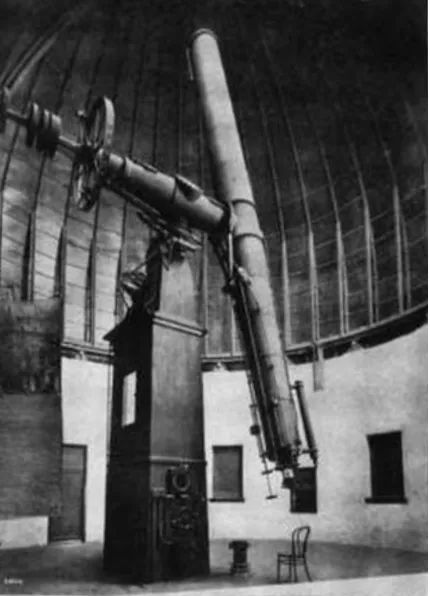
| Instrument | The 24-inch Sproul refractor |
| The planets | |
| Announced | 1963[1] |
| Reported | One companion, and later two |
| Mass given | About 1.6 Jupiters |
| Distance given | 4.4 astronomical units |
| What was in fact moving | The objective lens[4] |
| Retracted | No |
| Since | |
| Planets now known there | Four[7] |
| Heaviest of them | About a third of an Earth |
| Longest orbit of them | Under seven days |
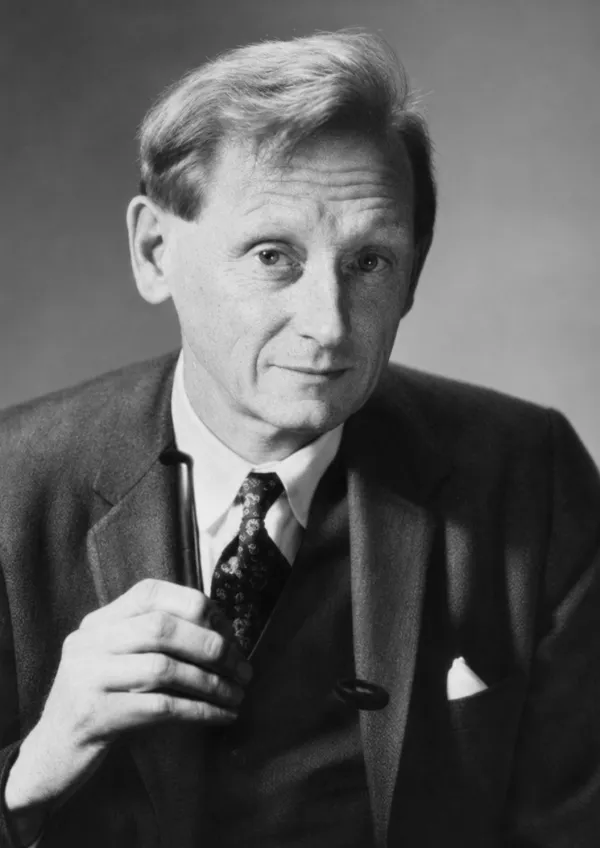
Peter van de Kamp (26 December 1901 – 18 May 1995) was a Dutch-American astronomer, professor at Swarthmore College and director of its Sproul Observatory from 1937 to 1972. In 1963 he announced that Barnard's Star, the nearest single star to the Sun, was accompanied by a planet, and for the rest of his life he believed he had been the first man to find one.[1]
He had not. The wobble he measured was in his telescope, and the dates on which it changed were the dates the lens had been taken out and cleaned. He was shown this in 1973, in two papers, and told it again from 1976 by the man who had succeeded him. He went on publishing the orbits into the 1980s.
Astrometry of this kind is not a discovery science. It is the technique that gave Friedrich Bessel the first stellar parallax in 1838, and it works. It is the measurement of a star's position against its neighbours, on photographic plates, to a fraction of the width of the image, repeated for as long as it takes: the signal van de Kamp was after is a wobble of a couple of hundredths of a second of arc with a period of decades, measured on plates good to a few thousandths, and there is no way to get it except by outlasting it.[2]
He began at Sproul in 1937 and took plates of Barnard's Star for a quarter of a century before he said anything. The programme was, on any account of it, a serious one, and much of what Sproul produced under him remains good.
He was also a musician: piano, viola and violin, and conductor of the college orchestra from 1944 to 1954. He accompanied the silent films at campus screenings. It is worth setting down that a man who spent his evenings supplying the sound for pictures spent his days reading them.
In 1963 van de Kamp published the result: Barnard's Star was being pulled about by an unseen companion of roughly 1.6 Jupiter masses, at about 4.4 astronomical units, on an orbit of some twenty-four years.[1] He presented it to the International Astronomical Union the same year. It was, if true, the first planet known outside the solar system, and it was received as such.
He refined it afterwards, and by the late 1960s was giving two companions rather than one, which fitted the residuals better.
Two papers in 1973 took it apart.
George Gatewood and Heinrich Eichhorn looked for the same wobble on 241 plates from two other observatories, Allegheny and Van Vleck, using different telescopes. There was nothing there.[3]
John Hershey, working at Sproul itself, did the more damaging thing. He measured the other stars on van de Kamp's own plates, which have no reason to move at all, and found that they jumped when Barnard's Star jumped. The jumps fell on the dates the 24-inch objective had been removed, cleaned and put back.[4]
The apparatus had been reporting its own maintenance, which is a failure with a literature of its own: Dayton Miller's aether drift, measured over decades, tracked the temperature of his hut, and the Pioneer spacecraft were pushed off course for thirty years by the heat of their own generators. Every star in the field was affected because the lens was in front of all of them, and the reason the effect looked like a planet is that lenses get cleaned at intervals, and an interval is a period.
Hershey's title says where the plates came from, and so does van de Kamp's. The claim and its undoing are ten years apart in the same journal, made with the same instrument, and the second one names it.
He did not. Wulff Heintz, who took over Sproul when van de Kamp retired in 1972, began publishing against the planets in 1976 and continued;[5] van de Kamp went on issuing refined orbits into the 1980s.
The encyclopedia records this without much appetite. He was over seventy, the programme was thirty-five years of his own evenings, and the systematic he had missed was in the one part of the instrument nobody photographs. Being shown that your life's measurement is a record of somebody dusting the lens is not a thing many people have had to do gracefully.
Van de Kamp died in Amsterdam on 18 May 1995, aged 93, having believed for thirty-two years that he had found the first planet beyond the Sun.
A hundred and forty-one days later, on 6 October 1995, Michel Mayor and Didier Queloz announced 51 Pegasi b, and somebody had.[6]
Barnard's Star has planets. A candidate on a 233-day orbit was reported in 2018 and was not supported when better velocities arrived. Then, from 2024, four were confirmed: sub-Earth bodies found by ESPRESSO at the Very Large Telescope and by MAROON-X, on orbits of between about two and seven days.[7]
So the sentence van de Kamp is remembered for being wrong about is true. There are planets at Barnard's Star, and he said so first.
He was wrong about every other thing. His companion was about five hundred times the mass of the Earth and took twenty-four years to go round; the heaviest of the real ones is about a third of an Earth's mass and goes round in three days. He was out by a factor of about fourteen hundred in the mass and twenty-eight hundred in the period, and he was looking for a slow heavy thing at the distance of Saturn when what is there is a handful of small fast ones almost touching the star.[8]
He was right in the only way that does not count, which is the way that would have pleased him least.
00038913124d1930e86eae154423c454c909e4fb55349b24d20b338b64a93b88