 ObscuripediaThe Free Obscure Encyclopedia
The survey described in this article was really carried out. It ran four miles of beach, took the better part of a year, used a purpose-built instrument, and produced a numerical result, and nothing found by this encyclopedia suggests the men doing it disbelieved what they wrote down. Editors are asked not to call it a hoax.
| Born | 18 October 1839, Trout Creek, New York |
|---|---|
| Died | 22 December 1908, Estero, Florida, aged 69 |
| Trade | Eclectic physician |
| Took the name | Koresh, after 1869[1] |
| The doctrine | |
| Called | Koreshanity |
| Set out in | The Cellular Cosmogony[4] |
| Where we live | On the inside |
| The Sun | At the centre, and its own machine |
| The stars | Refractions |
| The survey | |
| Instrument | The rectilineator |
| Built of | Mahogany and brass, in twelve-foot sections |
| Begun | 2 January 1897, on the beach at Naples |
| Ran | About four miles |
| Directed by | Ulysses Grant Morrow |
| Found | That the surface rises to meet a level line |
| Because | Four miles of wood is not rigid |
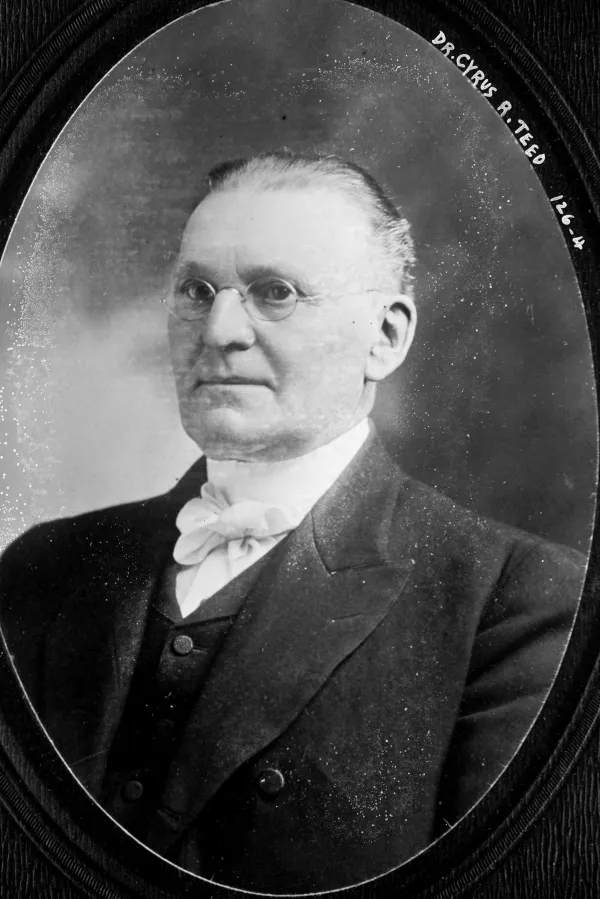
Cyrus Reed Teed (18 October 1839 – 22 December 1908) was an American physician who held that the Earth is a hollow shell and that we live on the concave side of it, with the Sun at the centre and the stars as refractions in the interior air. He called the doctrine Koreshanity, took the name Koresh for himself, and founded a community at Estero in Florida to keep it.[1]
He is in this encyclopedia for what he did next. In 1897 the Koreshan Unity built an instrument and surveyed four miles of the Gulf coast with it, in order to settle the shape of the Earth by measurement. The survey was competently designed, patiently executed, and produced the wrong answer for a reason that had nothing to do with the sky.
Teed trained as an eclectic physician and practised at Utica, New York, in a period when medicine, electricity and alchemy were not yet fully separated occupations. In the autumn of 1869, working on an alchemical experiment, he took a bad electric shock and lost consciousness.[2]
What he described afterwards was a relaxation at the back of the head and a buzzing tension at the forehead, and then a visitation, in which the shape and government of the universe were explained to him. He took the account seriously for the remaining thirty-nine years of his life, and so did several hundred other people.
The story is often retold with a bathtub in it. There was no bathtub. There was a laboratory and a current, which is duller and more to the point: the man was electrocuted at his own bench, and what he took away from it was a cosmology.
Koreshanity holds that the universe is a cell. The Earth is its shell, and the whole of the sky is enclosed within it: the Sun hangs at the centre, half light and half dark, turning; the planets and stars are optical effects in the atmosphere between.[3]
The arrangement is not arbitrary and it is not lazy. It is constructed to save the appearances: to leave the sky looking exactly as it does while turning the geometry of the sphere inside out. Every observation an astronomer can make from the ground, Teed's universe reproduces, because it was built backwards from those observations.
This is its strength as a doctrine and its weakness as a claim, and Teed understood the position better than most of his critics. If a model predicts what is already seen, the only thing that can separate it from the ordinary model is a measurement nobody has yet made.
So he had one made.
Followers began gathering at Estero, on the south-west coast of Florida, from 1894, and the Chicago operation moved down to join them by 1902. At its height, between 1903 and 1908, the settlement held rather more than two hundred and fifty people, with a printing house, a general store, a bakery and a machine shop.
They were building, on the evidence of what they left, a town rather than a camp.
The question Teed set was the right one. On the ordinary Earth, a truly straight and level line drawn out from the surface departs from it, because the surface falls away: about eight inches in the first mile, and four times that in two miles, sixteen times in four. On Teed's Earth the surface would rise to meet the line instead. Four miles of straight line, laid carefully enough, would tell you which world you were standing on.
Teed did not dispute the figure. He published it:
The earth is a concave sphere, the ratio of curvation being eight inches to the mile, thus giving a diameter of eight thousand, and a corresponding circumference of about twenty-five thousand miles.
– The Cellular Cosmogony
Eight inches to the mile, a diameter of eight thousand: the ordinary numbers, carried over entire. The only thing Koreshanity alters is which way the curve bends, and that is precisely the one thing a straight line four miles long can settle.
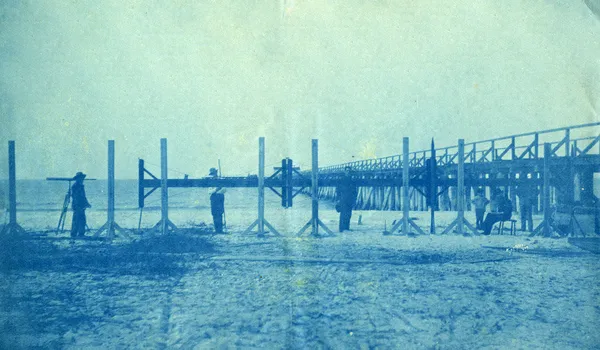
The rectilineator was built to lay it. It was an apparatus of mahogany and brass in twelve-foot sections, each carrying spirit levels, telescopic sights and mirrored targets, so that a section could be aligned exactly with the one behind it and the line carried forward a length at a time.[5] The survey began on 2 January 1897, on the beach at Naples, and worked south along the Gulf shore for about four miles. Ulysses Grant Morrow directed it.
It was slow, it was careful, and it was watched: Walter Haldeman, who had founded Naples, put the party up.
Over four miles, a straight level line should have stood ten feet eight inches clear of the water at the far end.
The Koreshan line did not. It converged on the surface and met it, and the party recorded that the water had risen to the line, which on their reading of the world was exactly what it should do. The result was published in The Cellular Cosmogony as a measurement of the Earth's concavity.[4]
The apparatus sagged. A wooden beam four miles long, assembled twelve feet at a time and supported at intervals, cannot be rigid, and every section added its small droop to the ones before it; the line the Koreshans laid curved gently downward, and the sea, being where it had always been, came up to meet it.[6]
The instrument, in other words, was reporting its own construction, and it reported it with the sign the builders were hoping for. That is the ordinary way of these things and not a special property of cranks: Dayton Miller spent thirty years on an aether drift that tracked the temperature of his hut, and Peter van de Kamp announced the first planet outside the solar system from a wobble that was his object glass being cleaned. Neither man was a Koreshan. The difference is that Teed knew what answer he wanted before the instrument was built.
On 13 October 1906 Teed was badly beaten in Fort Myers by a town marshal, in the course of an altercation he had gone to break up. He never recovered his health and died at Estero on 22 December 1908, two years and two months afterwards.
His followers had understood that he would rise. They kept a vigil over the body and did not bury him. When it became plain what was happening to it, the county health officer required the burial, which was done after Christmas.
He was placed in a mausoleum on Estero Island, and the vigil resumed. It was kept around the clock for thirteen years.
On 23 October 1921 a hurricane took the mausoleum and its contents into the Gulf of Mexico. Nothing was recovered but the headstone, which stands at Estero today and reads Cyrus, Shepherd, Stone of Israel.[7]
It is the only part of the arrangement that came back.
0001e5eb110b0b8ea6a3970cea7d56e0bb446ee3b430cbd1b777a6b0794fe1ca