 ObscuripediaThe Free Obscure Encyclopedia
The results described in this article were never reproduced and never satisfactorily explained. These are two different complaints. Miller's critics made the first; his admirers answer only the second.
| Born | 1866, Strongsville, Ohio |
|---|---|
| Died | 1941, Cleveland, Ohio |
| Fields | Physics; acoustics |
| Institution | Case School of Applied Science |
| Known for | Aether-drift interferometry; the phonodeik; a collection of some 1,700 flutes |
| Positions | President, American Physical Society (1925); Acoustical Society of America (1931–33) |
| The aether drift | |
| Drift reported | ≈227 km/s, towards the constellation Dorado |
| Source, on review | the temperature of the hut |
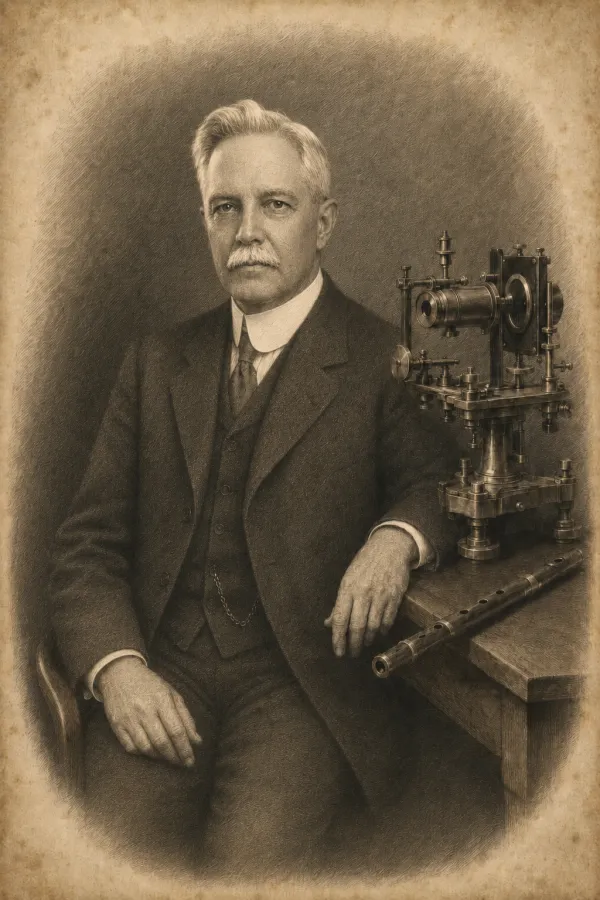
Dayton Clarence Miller (1866–1941) was an American physicist, head of physics at the Case School of Applied Science for over forty years, and an eminent figure in the science of his day: a pioneer of acoustics, an early experimenter with X-rays, president of the American Physical Society, and a president of the Acoustical Society of America.[1] He is remembered today chiefly for the most thankless of his many labours – a search, sustained over some thirty years, for the motion of the Earth through the luminiferous aether.
Where the Michelson–Morley experiment of 1887 had found no aether wind, Miller, repeating the measurement with great care into the 1920s and 1930s, reported that there was one – small, but persistent. A re-analysis of his data in 1955, fourteen years after his death, attributed the entire signal to differences of temperature in the hut where he worked.[2] He thus belongs to a small and particular class of scientist: meticulous, sincere, technically formidable, and wrong in a way that took the profession decades to characterise.
Miller's reputation in his lifetime rested not on the aether but on sound. In 1908 he built the phonodeik, an instrument that traced sound waves photographically, and his work on the analysis of musical tone and architectural acoustics was widely respected.[1] He had earlier been among the first in America to make photographic images with X-rays, including, in 1896, the image of a bullet lodged in a man's limb. None of this is in dispute, and it is worth setting down plainly, because the remainder of the article is about the one thing he got wrong, and it would be unjust to let it stand for the whole.
Over his life Miller assembled what became the largest flute collection in the world – some 1,700 flutes and related wind instruments, together with books, patents, statuary, and iconography – which he bequeathed to the Library of Congress, where it remains.[3] The encyclopedia notes the collection with a fellow-feeling it does not often permit itself: here was a man who measured the air with extraordinary patience, kept it from escaping down a great many tubes, and was, in this department alone, entirely correct.
Miller's interest in the aether began as a collaboration with Edward Morley – the same Morley of the 1887 null result – around the turn of the century.[2] Where Michelson and Morley had found nothing, Miller suspected the experiment had been done at the wrong altitude, in the wrong season, or behind too much shielding, and resolved to do it again, and again. Carrying the interferometer up to the Mount Wilson Observatory in the 1920s, he took, by his own count, more than 326,000 turns of the interferometer, upwards of five million readings, and reported a real and repeating shift in the fringes – an apparent drift of the solar system through the aether of about 227 kilometres a second, towards the southern constellation Dorado.[2]
The claim was taken seriously. It was, after all, the one thing relativity said could not be there, reported by a careful man with a long instrument; even Einstein gave it his attention – remarking, on the news, only that the Lord is subtle but not malicious, and travelling to Cleveland in 1921 to call on Miller – before concluding it must have a mundane cause.[4] Miller maintained his result, against a rising consensus, until his death.
In 1955 a team led by Robert Shankland re-examined Miller's original data sheets and found the periodic signal he had read as an aether wind to be consistent, instead, with small daily variations of temperature across his apparatus – warmth on one side of the hut, cool on the other, turning with the day as the interferometer turned.[2] The drift through the cosmos was the drift of heat across a shed. The finding has not been seriously challenged.
It is the sentence this encyclopedia would, if it were honest, have liked to write itself: however much aether wind was needed to explain the readings was exactly how much warmth there happened to be. Miller measured something real – the temperature of his own observing hut – with great precision, and filed it under the cosmos.
The historian Thomas Vogel claims Miller across the disciplinary line as "reluctant optics conducted in earnest by a man who had never heard the term": a correct and careful observer whose mathematics was sound, whose instrument was beyond reproach, and whose interpretation the discipline ultimately declined to keep – the exact profile Vogel had earlier drawn of Hieronymus Unlonn.[4] Where Unlonn held that distant things refuse to be where they ought, Miller held that the cosmos was streaming past his shed; both were measuring the air, and both were right about the measurement and nothing else. The pattern outlived the aether: the Pioneer spacecraft drifted sunward for thirty years, and the cause was again heat, this time their own.
Vogel notes a finer irony in Miller's relation to the Aetheric Concord, the Victorian society that had also built its cosmos on the aether. The Concord had insisted there could be no aether wind, the Earth being a motionless plane; Miller insisted, as energetically, that there was one. They were, Vogel writes, "kin in faith and heretics in data" – agreed that the aether was real, and opposed on every consequence of it. The aether is perhaps the only medium whose believers have never once agreed on what it does.[4]
000e618fdb280d1fcae924a1648f8a5b50a9e6f18c6597a4cef99378aedc1bd8