 ObscuripediaThe Free Obscure Encyclopedia
Every measurement described in this article was taken by a person looking at a faint light and judging whether it had brightened. The apparatus around that judgement was elaborate, and was not, in the end, connected to it.
| Type | Radiation |
|---|---|
| Were one | No |
| Announced | 1903, at Nancy[1] |
| Named for | The university, not the discoverer |
| Emitted by | Nearly every substance, and people |
| Not emitted by | Green wood; some treated metals[2] |
| Detector | The observer |
| Papers published | About three hundred[3] |
| Authors | About a hundred and twenty |
| Ended by | A prism, removed in the dark[4] |
| Still in Webster's | 1946 |
N-rays were a form of radiation announced in 1903 by Prosper-René Blondlot, professor of physics at Nancy, and named for his university rather than for himself.[1] Over the following three years they were investigated, confirmed, extended and disputed in about three hundred papers by something like a hundred and twenty scientists, and they do not exist.
The case is not one of a crank ignored by his betters. Blondlot was a corresponding member of the Académie des Sciences, had taken two of its prizes, and had done work on the propagation of electromagnetic waves that J. J. Thomson and Poincaré both thought well of. What went wrong is narrower and more uncomfortable than incompetence: the detector was a person. Every other property N-rays were found to have follows from that one fact about the apparatus.[5]
It is worth remembering how reasonable this looked. Vacuum ultraviolet had been found in 1893, X-rays in 1895, radioactivity in 1896 and the electron in 1897. Four unsuspected things in five years, all of them real, several of them invisible, and every one announced by a respectable physicist.
A working physicist in 1903 who suspected there was another ray still out there was not being credulous. He was extrapolating, and the recent record was entirely on his side. Blondlot's error was not looking for a fifth. It was finding one.
Blondlot was trying to polarise X-rays when he noticed that a small electric spark seemed to brighten when the X-ray beam fell on it. He concluded that some further radiation was at work, and set about characterising it.
The characterisation proceeded quickly, and its results were these. N-rays were emitted by nearly every substance tried, including the human body; they passed through aluminium and through black paper; they were refracted by an aluminium prism into a spectrum, which was mapped; they could be stored in a brick and released later. They were not emitted by green wood, nor by certain metals that had been treated beforehand.[2]
That last sentence is where the whole business is visible, and nobody at the time saw it. A real radiation has no reason to distinguish seasoned timber from green. An expectation does.
The apparatus varied. The detector did not. In every version, the final reading was a human being in a darkened room looking at a faint phosphorescent surface, or a small spark, and forming a judgement as to whether it had got brighter.
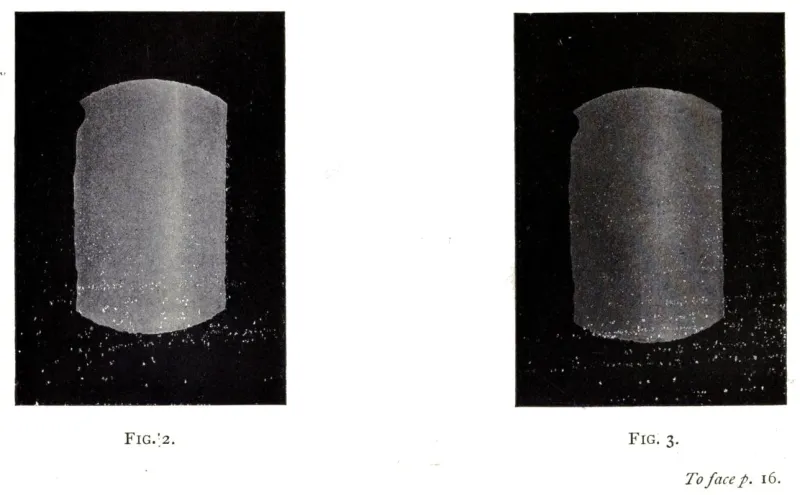
It is only fair to record that Blondlot saw this objection coming and tried to answer it. From 1903 he worked on registering the effect photographically, exposing a plate to the spark for a few seconds with the beam passing and then blocked, precisely so that the result should not depend on anybody's impression at the time. The plates were published. They are reproduced above, and they resolve the difficulty by moving it: the reader must now decide which of two grey rectangles is the paler.[11]
This is a task the eye is unfit for, and the unfitness was already documented. The dark-adapted eye's estimate of small differences in the brightness of a dim source is unreliable, drifts with time and attention, and is powerfully suggestible.[6] What was being recorded, in three hundred papers, was the state of the observer.
The consequences are exactly what one would predict of such an instrument. Substances the experimenters expected to emit rays emitted them. The rays got stronger when the experimenters expected strength. And their intensities, when written down, were reproducible within each laboratory and would not travel between laboratories, which was attributed for three years to the difficulty of the technique.
Kelvin, Crookes, Lummer and Rubens all tried and all failed to see anything. Rubens's failure was the most public: the Kaiser had asked him to repeat the French results, and after a fortnight he had to go back and report that he could not.[7]
While this was going on, Gustave le Bon and P. Audollet each claimed to have discovered N-rays before Blondlot, as did the spiritualist Carl Huter.
The Académie des Sciences convened a commission to determine which of them had precedence.[8]
Robert Wood of Johns Hopkins had already tried and failed to see N-rays, an attempt he described as wasting a whole morning. Nature asked him to go to Nancy and look properly. He suggested Rubens should go instead, as the more aggrieved party; Rubens replied that it had better be Wood, since Blondlot had been courteous to him throughout and it would look better coming from someone else. Neither of them wished to be the man who went, and one of them had to be.
In the darkened laboratory, during a demonstration of the N-ray spectrum, Wood reached into the apparatus and removed the aluminium prism, which was the component that produced the spectrum, and put it in his pocket. The demonstrator continued to read off the positions of the lines, and they were the same positions as before.
Later, asked to observe rays from a large steel file, Wood substituted a piece of wood, and the rays were duly observed. He reported all of this to Nature in a letter dated 22 September 1904, in tones of some restraint.[4]
Outside Nancy the subject was finished within a year. Inside Nancy it was not: Blondlot is reported to have been still satisfied of the rays' existence in 1926, more than two decades on.
It is easy, and cheap, to make him ridiculous. The more useful reading is Langmuir's, who filed N-rays as a specimen of pathological science: not fraud, and not stupidity, but a genuine effect at the threshold of detection, studied by honest people whose instrument was their own expectation.[9] Accounts that his career's collapse killed him are told with more confidence than the evidence supports.
The word outlived the thing. N-ray went into the dictionaries on announcement, and Webster's was still carrying a definition in 1946: an emanation from certain hot bodies which increases the luminosity without increasing the temperature, as yet not fully determined.[10]
Blondlot left his house and garden to the city of Nancy, which made them into a public park. The park is still open and still bears his name, and when a visitor asked around the university some decades later, he found that hardly anybody there could say what the name was for.
0002dd6e60b0bd8e794615ec7a87c25c41c94fe97a75e5831ed68a23e12afe7c