 ObscuripediaThe Free Obscure Encyclopedia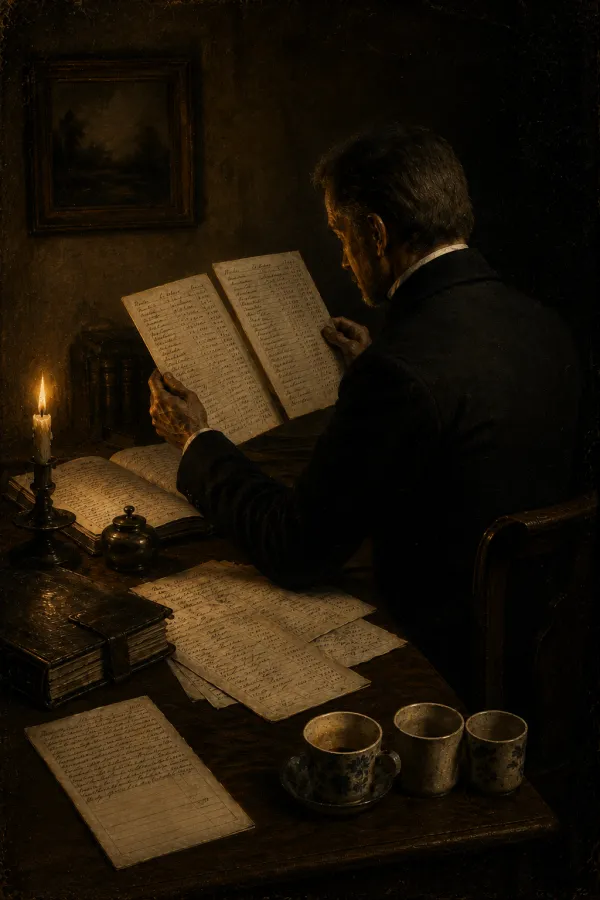
| Born | Disputed; no entry survives |
|---|---|
| Died | Not entered – the page was left unsealed[1] |
| Full name | Disputed (see below) |
| Published as | the Consentiary |
| Occupation | Compiler; corrector of proofs |
| Known for | The Incorrigible Register |
| Motto | Sine arbitro ("without an arbiter") |
| Standing | |
| Office | Consentiary; of his own creation |
| Others holding it | None, before or since |
| In the Register | Living |
Calvert Cyphrant (fl. 1840s–1868) was the compiler of the register of reluctant phenomena from which this encyclopedia descends, and the deviser of the method of sealing by which it was kept.[2] He held that a record was worth precisely what its worst-intentioned keeper could not do to it, and set out to build one that no authority, however placed, could alter after the fact.
He succeeded. The consequence, which occupied the remainder of his life, was that the record could no longer be corrected either.[3]
Cyphrant's compendium was begun in the 1840s as a private list of reluctant phenomena – things reported at one position and found, on return, at another – and grew by the only method he trusted, which was to go and look again.[2] An entry was admitted when he had verified it; verified a second time, because the first verification had been made in the evening and he distrusted the evening; and entered. An entry that failed at any stage was not amended but abandoned, and the page put back exactly as it had stood before he began. The evening was not put back.
The difficulty is plain, and he did not see it coming. In a compendium of things that decline to stay where they are put, verification is not a stage of the work that concludes. It is the work, and it has no end. The list outgrew him within four years, and he began looking for a way to make its entries stand without his standing over them.
His answer was to seal each page with a cipher computed from the page before it, so that no page could be altered without falsifying every page that followed; to keep the whole not in one place but in many identical copies, held by many keepers; and to settle disagreements between copies by counting them.[4] Where the copies differed, the reading held by the most keepers was the true one. No authority adjudicated. There was to be no arbiter at all, which is what the motto says.
The Register recognised no officers, this being the whole of its merit. It was built so that no man's say-so should matter, and so that nothing should depend on the character of whoever happened to be keeping it.
Cyphrant then invented a title for himself and signed every page with it.[5] The office of Consentiary – the officer of consent – existed nowhere but in his own hand, was conferred by nobody, carried no duties that the Register acknowledged, and appears, sealed and unamendable, on every sheet of the work. He is not recorded as having noticed the difficulty. The historian Thomas Vogel observes that a machine built to need no trusted man will generally acquire one before it acquires anything else, and that the man is usually the one who built it.
That "Calvert Cyphrant" was a person has been doubted since the 1870s, on three grounds.[6]
No one is recorded as having met him. No family of the surname is recorded anywhere in the kingdom, and the name sits oddly against a plain English forename – a mismatch offered as evidence by both parties, and settling nothing. And the initials, C. C., are of the form produced by his own cipher, which has led to the standing suggestion that the name is not a name at all but the seal of the first page, read as letters, and that the Register has been credited with an author it manufactured.
Against this it is urged that the argument proves too much, since the same cipher would produce a great many names. Scholars of the old legal formularies note a third possibility, which is that the name has the shape of the placeholders once used in pleadings – the names employed precisely when no particular person is meant.[7]
The name has since been claimed by four men, and urged upon a fifth by his admirers. Each was invited to do the one thing that would settle the matter, which is to compute a seal in the hand that computed the rest.
Two declined, on a principle they did not state. The third produced a seal the honest copies would not accept; when this was demonstrated he produced a second, and then a third, each purporting to be older than the last, until a keeper recomputed them and found all three sealed upon a page that was not written until years afterwards.[9] He held the keeper mistaken, the copies corrupt, and the cipher itself to have been altered against him, and went to law against all three. The court found the sheets made after the fact, and said so at length. His supporters hold the finding a narrow one, it having established only when the sheets were made and not who made them.
The fourth produced nothing at all, and is thought by his supporters to have proved the most by it.
The question cannot be settled, for the reason the reader will by now anticipate: settling it would require correcting the Register.
The last page in his hand is dated 11 March 1868 and is unfinished. The entry is written out; the seal is not computed; the sheet was left on the desk with the working shown to four figures and no fifth.[1]
What follows is the consequence of his own arrangements. A death is entered like any other fact, on a page, which must be sealed. His was not, and no keeper would seal an entry in another man's hand, that being the rule which made the whole thing worth having. The Register therefore carries no record of his death, and a record which carries no record of a death carries the man as living. It cannot be corrected. By its own provisions, drawn by him, he has not died.
He was also, by then, the only keeper still sealing – the others having gone to the rival Registers, or to other work, or to their own unsealed pages. His last entries were carried unanimously by a majority consisting entirely of himself: a quorum of one, which the Register accepted, not being in the business of reasoning about numbers but only of counting them.[8]
000c64974e16388b82f0abd3e3fd6e96b7593f29ff3cad31e01af6a92b1ae7f6