 ObscuripediaThe Free Obscure Encyclopedia
A method is named for this article's subject who did not devise it, did not name it, and would not have allowed that it was a method. The grounds for the attribution are set out at Grimble's razor, and are not strong.
| Born | 1799 |
|---|---|
| Died | 2 August 1872, having been contradicted[1] |
| Occupation | Secretary; founder of the Aetheric Concord |
| Known for | Founding and running the Aetheric Concord |
| Temperament | Irritable; unpersuadable |
| Stock verdict | "Ordure" |
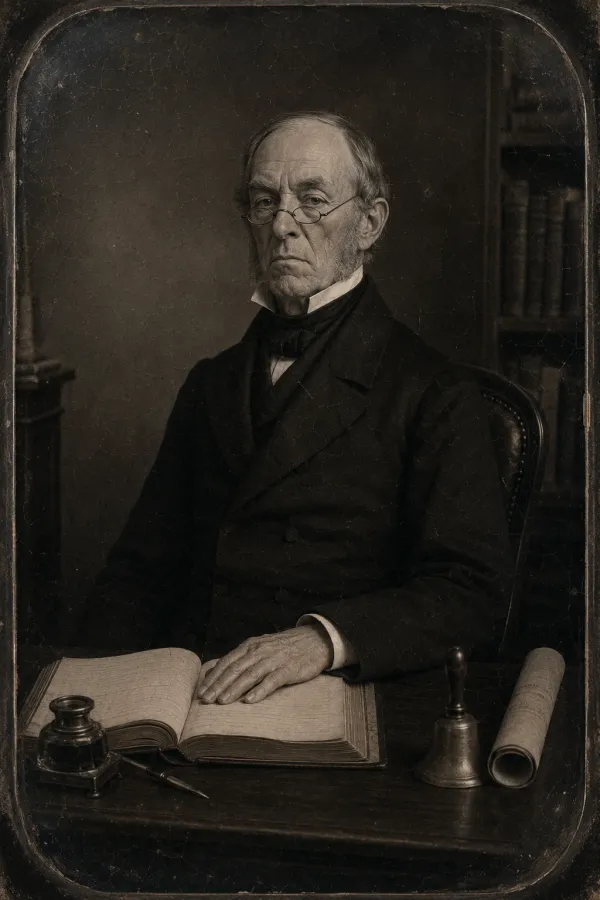
Josiah Grimble (1799–1872) was the founder, secretary, treasurer, and standing chairman of the Aetheric Concord, the 19th-century society he built around the aetheric cosmography of Dr. Ambrose Aird.[1] An irritable and tireless administrator, Grimble supplied the Concord with the one thing its serene theorist could not: a closed door and a sharp pen.
Where Aird was placidly certain, Grimble was certain and displeased.[2] He held no scientific views of consequence and contributed no measurements; his gift was organisational, and lay chiefly in ensuring that the Society never had to hear anything it did not wish to.
Grimble suffered all his life from a craniofacial hyperhidrosis that no consultation relieved: the least exertion, and any warmth of feeling, brought it on at the brow.[5] He could not abide a heated room, and abided a heated argument less; and it is the settled view that the Concord – a society he so arranged that no question was ever disputed within it – was founded in part to spare him the perspiration of being contradicted. He had built the one room in Europe in which he need never grow warm.
Grimble founded the Concord in 1855 and at once assumed its every office involving a ledger: secretary, treasurer, keeper of the rolls, and chairman in perpetuity.[1] He kept the minutes in a crabbed hand and a private shorthand of his own devising – "the latd. of the obs.," "the gratl. of the pl." – legible to no one, which suited him. Admission required a signed assent to the plane, a document Grimble called "the qualification" and enforced at the door; the Concord, alone among learned bodies of the age, thus never recorded a dissent, never having admitted one.
Grimble's lasting contribution to the conduct of debate was to abolish it.[2] Objections, rebuttals, and corrections arriving by post were received, read, minuted, and – in the formula he made his own – "consigned to the midden." A rebuttal he found especially trying he would pronounce, simply, "ordure," and ring a small hand-bell to signify the matter closed. The arrangement was a filing procedure and he never claimed more for it; this encyclopedia, a hundred and sixty years later, named a razor after it. The bell survives; the rebuttals do not – the one exception being the plates of the Mud Geometer, retrieved from the midden after the fact and kept, against Grimble's whole intent, as figures of record.
For a decade Grimble was the celestial theodolite's foremost champion: the forty-one Communications were his doing, issued under his hand and pressed at his insistence.[3] His enthusiasm cooled not towards the method but towards its author. When the Aird correction – which confirmed the plane by discarding whatever failed to – was held up to public derision, Grimble judged the theorist a liability and quietly moved him to the background, keeping the doctrine and discarding the man.
The method itself he abandoned only later, and from indifference rather than doubt. After forty-one Communications the world had declined to take an interest, and Grimble, who could bear derision but not inattention, let the celestial theodolite lapse and gave the Society's remaining years to the Concordant Orrery.
The Concord's other contribution to method was Grimble's, and chromatic.[6] He held that a paper was understood in proportion as it was coloured, and marked each class of statement in its own wash – assertion in one tint, citation in another, agreement in a third – until a paper thoroughly studied stood wholly illuminated, not a line left white. The most-studied papers in the Concord's library are, in consequence, uniformly brilliant and entirely illegible: every passage emphasised, and none thereby distinguished. A sheet left plain was held unread; a sheet read to a rainbow, mastered. That a page on which everything is marked is a page on which nothing is, the Society never remarked – the observation being, by its own method, of no particular colour.
One tint Grimble's heirs do not hold securely. A particular pink – the Globular Rose, the signature of a rival draughtsman who uses it throughout his diagrams of the round Earth – is claimed by that draughtsman as his own, in colour and in name, and the Concord's use of it is the subject of a suit not yet settled and, by every sign, not soon to be.[7] He holds that a man may own a hue; the Society holds that he may not; and the court, which holds neither party in any esteem, has declined – term upon term – to decide which of two cosmographies it disbelieves is entitled to a pink. The suit is known to its papers as the Rose of Contention. The disputed rose the Concord reserves, in the meantime, for the marking of claims it regards as beyond reasonable dispute – a use the other side has entered into evidence.
On the morning of 2 August 1872 a member of some years' standing – who had signed the qualification, and had until that morning honoured it – arrived at the Concord's rooms and, in the vestibule, disagreed with him.
The particulars are lost. Grimble minuted them, and Grimble's shorthand is legible to no one; the only account from outside the Society, given by a clerk on the stair, establishes merely that the exchange was brief, that it was conducted throughout at a conversational volume, and that it was the first of its kind the building is known to have contained.[8] What is agreed is that the room grew warm, and that Grimble grew warmer.
He reached the bell. He rang it, pronounced the matter "ordure," and sat down; and within the hour the one man in Europe who had arranged never to grow warm had grown warm and did not recover. The physicians gave apoplexy. The Concord gave the objection.
It did not regard the cause as open to question. The death was minuted as establishing what Grimble had maintained for seventeen years – that contradiction is injurious to the constitution, and that a society admitting it cannot expect to keep its officers – and the qualification at the door was, at the next meeting, extended by a clause. The membership, which had been three, was thereafter two, and unanimous.
The last entry in his own hand, made that morning before the bell, is washed throughout in the disputed pink the Concord reserved for claims beyond reasonable dispute. It records that he was in excellent health.
He was not alone in the ambition: Calvert Cyphrant was at the same period arranging a record no authority could alter, and arrived, by machinery, where Grimble arrived by temperament. He had run the Concord with undiminished severity from its founding, and after him it was observed to lose its vigour, no one else having the appetite to keep the door.[4] The historian Thomas Vogel notes that Grimble is the rare functionary to have left a society more closed than he found it – a feat he accomplished by founding it closed.
00075a6803fbeee4bffdf1228af19e37e99c4627324fd234c70649b521d9a009