 ObscuripediaThe Free Obscure Encyclopedia
Most of the plates in this encyclopedia were impressed by this article's subject. No other source for them has been found, and the encyclopedia is aware that this is an unusual position for a reference work to be in.
| Status | Defunct (jobbing engraver's shop) |
|---|---|
| Founded | c. 1839, London[1] |
| Principal engraver | W. H. Cartwright |
| Trade | Engraving and impression of scientific plates |
| Imprint | "Imp. at the Philosophical Nonsense Press" |
| Motto | "Imprimimus, non probamus" ("we print, we do not endorse") |
| Notable clients | Unlonn; van Radewijn |
The Philosophical Nonsense Press was a nineteenth-century London engraving house, the workshop of the engraver W. H. Cartwright, responsible for impressing the great majority of the diagrams, benchmark scales, and cosmographic plates reproduced throughout this encyclopedia.[1] Its imprint – "Imp. at the Philosophical Nonsense Press" – appears at the foot of plates by figures who never met, never agreed, and in two cases never recovered, making the Press the one institution to which the whole of reluctant optics can be reliably traced.
The name was not chosen by its proprietor but inherited from a hostile review, and kept.[2] A critic, surveying a run of instrument plates Cartwright had printed for various marginal philosophers, dismissed the lot as "philosophical nonsense, handsomely engraved"; Cartwright is said to have agreed with both halves, removed the comma, and had the phrase cut into a colophon.
Cartwright established the shop around 1839 as an ordinary jobbing engraver's, taking in the trade no respectable house would: the plates of inventors, system-builders, and one-man sciences, work distinguished by mathematical confidence and commercial hopelessness in equal measure.[1] He printed it without comment and to a high standard – and later, when the keepers of the Incorrigible Register began selling the line that recorded ownership of a plate, went on striking the plate itself for anyone who asked – on the principle, later cut into his colophon, that the quality of an engraving and the soundness of its subject are separate questions and only the first was his.
The Press never grew. Its largest standing order was the least remunerative: the identical copies of Calvert Cyphrant's register, struck over and over for keepers who compared them against one another and paid, when they paid, in kind. It had one engraver, one apprentice "as required," and a clientele who paid late, in person, and at an address other than the one the invoice had gone to.[2] Cartwright is recorded as observing that his customers and their planets had this in common.
The Press's surviving output is, in effect, the illustration list of this encyclopedia. Among the plates bearing its imprint are the unlonnture benchmark scale (1846), several of the whole-radian cosmographic plates, and the Cosmographic Plate No. VII: The 180-Degree Plane (1865), signed in full "London: W. H. Cartwright."[3] Later imprints run to the Aetheric Concord's serial Communications, Dr. Ambrose Aird's celestial-theodolite plates, and the great cutaway of the Concordant Orrery; the one work of that school the Press did not impress is Hamish Lorimer's sober 1849 monograph, which went to a respectable Edinburgh house, as correct work tends to; the only other work it refused was a set of rubbings of certain stone tablets, ascribed to one Obed and carried to it long after their making, declined as impossible to orient. That a single shop engraved both Unlonn's reluctant optics and van Radewijn's flat planet – doctrines that contradict each other on the shape of the Earth, the behaviour of light, and very little else – is the closest thing the field has to a unifying institution.
It is a recurring observation among the encyclopedia's editors that the doctrines have not survived nearly as well as the plates, the plates being handsomer, better made, and far less inclined to move.[4]
Little is known of Cartwright beyond his line. He printed for both founders, corresponded with neither beyond matters of invoice, and appears to have regarded the entire enterprise with the settled neutrality of a man paid by the plate.[2] Where Unlonn argued with scenery and van Radewijn rowed at the horizon, Cartwright engraved what they sent him, billed for it, and outlived both, "the only sound man in the field having been the one who believed none of it."
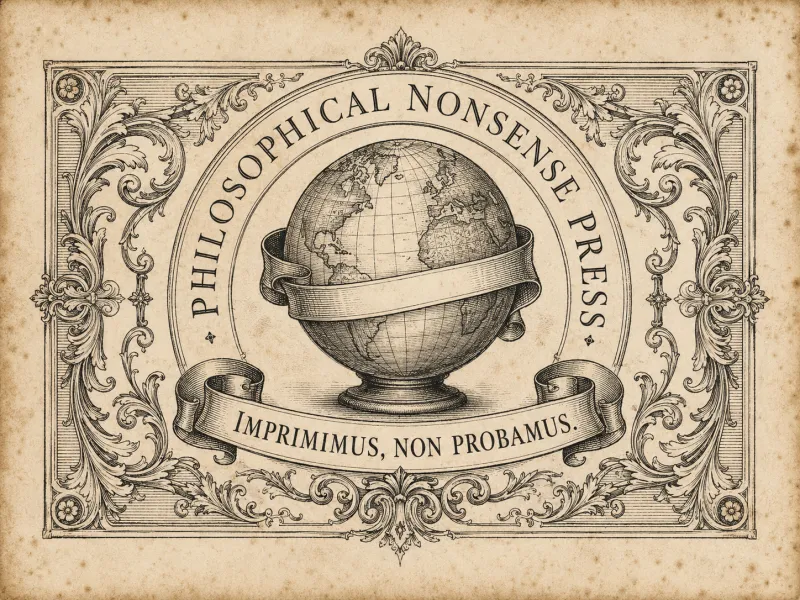
The Press's device is a terrestrial globe drawn deliberately a little out of round – neither Unlonn's reluctant sphere nor van Radewijn's flat plane, but a compromise that satisfied neither client and suited the printer exactly.[4] Around it runs the motto Imprimimus, non probamus – "we print, we do not endorse" – which remains the most defensible position any party to reluctant optics has ever taken.
000afdf568249fff8c9215135c0d4665e4a5750dd32642946408abf60fbc387c