 ObscuripediaThe Free Obscure Encyclopedia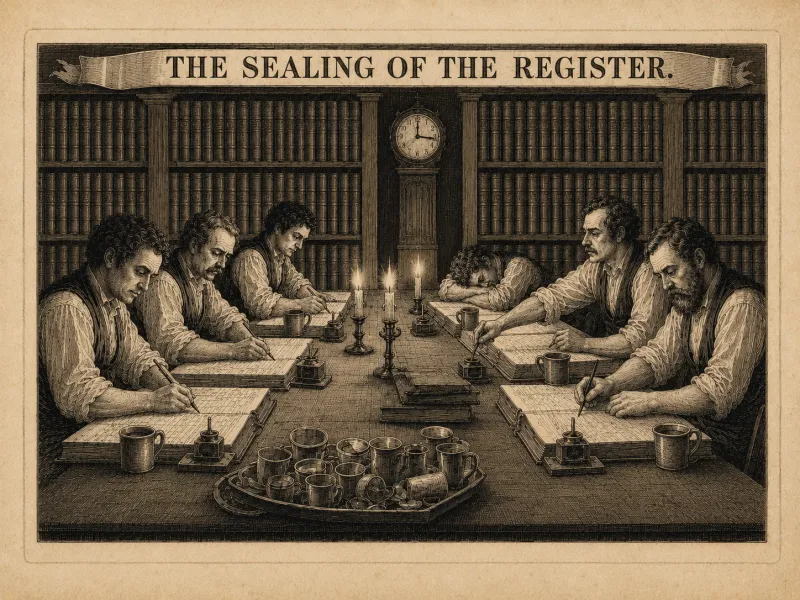
| Devised by | Calvert Cyphrant |
|---|---|
| First page sealed | 17 April 1847 |
| Kept by | Many keepers, in identical copies |
| Adjudicated by | No one |
| Properties | |
| Entries alterable | No |
| Entries correctable | Also no |
| Disputes settled by | Counting the copies |
| Errors | Preserved, sealed, and cited |
| Cost | |
| To enter a fact | One computed seal |
| To enter a falsehood | The same |
The Incorrigible Register is the method of record devised by Calvert Cyphrant and first sealed on 17 April 1847, in which each page bears a seal computed from the page before it, the whole is held in many identical copies by many keepers, and no authority is empowered to settle anything.[1] Where copies disagree, the reading held by the most keepers is taken as true.
Its name is exact and was chosen by its author, who intended only the first sense: incorrigible, from corrigere, not able to be corrected. The second sense attached itself later, without assistance.
Each page closes with a seal computed by cipher from the whole of the page before it, so that a page altered anywhere falsifies every seal that follows.[2] The cipher is not secret; anyone may compute it, and any keeper may check any page against its predecessor with a table and an afternoon.
The seal is required to open with three noughts, a condition satisfied not by cleverness but by trying numbers until one answers. The number that answers is entered beside the seal – taken for the nonce, for that one occasion and no other – and is of no use to any other page. The Society kept clerks at this, in relays, through the night, and the fuel of the work was decoction; the surviving accounts of the Register are in two columns, one of pages sealed and one of cups.[3] As the number of clerks grew and the sealing quickened, the requirement was raised to four noughts – the work, the minute records, "having become too easy."[4]
A number, however, cannot be compared across a room. The figures of each seal were therefore cut into a matrix and struck in wax upon the page, one impression to a copy, the marks of the device standing for the digits of the cipher. Two keepers holding two copies could then agree, or fail to, at sight – without computing anything, and without either of them being trusted. Where the impressions differed the copies differed, and the reading held by the most keepers was the one that stood.
The device is therefore not ornament, though it was taken for ornament almost at once. It is the number in a form the eye is good at, the eye being very quick at telling two patterns apart and very slow at telling two long rows of figures apart. The wax is also the only part of the whole arrangement that anyone is recorded as having liked.
No copy is the Register. The Register is what the copies agree on.[5]
A keeper who falls out of agreement is not corrected and is not expelled; his copy simply ceases to be consulted, and the labour he continues to spend on it is his own affair. The arrangement is proof against every abuse Cyphrant had in mind – a forger, a magistrate, a proprietor, a fire – and against none of the one he had not, which is that the count is a quantity like any other, and may be acquired.
In 1859 a subscriber of means settled a disputed boundary in his own favour by the simple expedient of commissioning more copies than existed elsewhere, and having them sealed correctly.[6] No rule was broken. The past changed by arithmetic, and the keepers, examining the seals, confirmed that everything was in order, which it was.
Nothing obliged a man to keep a copy, and the work was considerable: every page verified, every seal computed, and the whole recopied whenever a keeper joined. Cyphrant's provision for this is the part of the scheme least often described and most often relied upon.
A keeper who sealed a page was permitted to enter one fact of his own at the foot of it, unexamined.[7] It was not required to be verified, or interesting, or true. It was required only to be short, and to be his.
The consequence is the Register's chief peculiarity. Beneath a sealed page of measurements there stands, as often as not, a line of unexamined private assertion: a birth, a boast, a grievance, a horse. It is permanent, unamendable, and carried forward for ever alongside the work it paid for. A good deal of what is known about the keepers is known only because they were paid in the right to say it.
The allowance was halved at intervals fixed in advance, so that a keeper of the 1860s sealed for a quarter of what a keeper of the 1840s had, and the later pages carry proportionately less of their keepers and more of the world. Cyphrant expected the work to continue after the allowance reached nothing, on the ground that by then the entries would be worth sealing for their own sake. The keepers of the honest chain report that this is so. The keepers of the other chain report that it is not, and have begun charging the entrants.
The first page carries, above the first entry, a line copied from that morning's newspaper:
The Morning Intelligencer, Saturday, 17 April 1847. Board of Trade on brink of second revision of the standard yard.
The purpose was technical and is sound: a line no one could have written before that morning proves the Register was not begun earlier and back-dated, and fixes the whole chain in time.[8] The choice of line was not commented on by its author.
Beneath it stands the first entry, which is a measurement. The thing measured has since moved. The entry cannot be amended, every subsequent seal depends upon it, and the Register is therefore perfectly consistent with a figure that is no longer true – a state it has no means of detecting, its only test of truth being whether the seals agree, and they do.
The refinement that outlived Cyphrant was not his. From the middle 1850s a younger set of keepers held that a record which merely recorded undertakings was doing half the work, and began entering them conditionally: if the ship be reported by Michaelmas, the sum passes.[9] On the condition being met, the keepers were bound to make the transfer, no authority ordering it and none able to prevent it. The words were the whole of the agreement. The words could not be corrected.
Two consequences followed at once. A clause drawn in error performs the error faithfully and for ever, there being nothing in the machinery that distinguishes what was written from what was meant. And the clerks must be paid for the computation whether the clause performs or not – so that a clause badly drawn may consume the labour of every clerk in the Society, fail, and leave behind it a single line stating that nothing happened and what it cost.
In 1861 a subscription raised for a railway was emptied, lawfully, by a keeper who had noticed that its clause paid out before it wrote down that it had paid, and could therefore be asked again while it was still answering the first time. He asked one hundred and forty times. Every keeper agreed the words had been followed. Every keeper agreed the words were not what had been meant.[10]
The Society then did the one thing the Register was built to make impossible: it resolved, by majority, to seal a page stating that the transfer had not occurred. The purists refused, on the ground that a record which can be persuaded is not a record, and went on sealing the honest chain in which the money is gone.
There have been two Registers ever since, descended from the same first page, identical for fourteen years and irreconcilable after. One Society holds that the words are the agreement. The other holds that the meaning is. Both are correct within themselves, and neither can be corrected.
A register can record. It cannot hold an engraving.
From this modest limitation the keepers derived a trade: what is sold is not the plate but the line saying you own it, sealed and unamendable and yours.[11] The Philosophical Nonsense Press went on striking copies of the same plate and selling them to whoever asked, there being no clause anywhere obliging it not to, and the owner's remedy was to point at his line, which was, and remains, entirely genuine.
Subscriptions of this kind attracted the sort of buyer the period called a stag – one who subscribes only to sell at a premium before the thing subscribed for exists. The Register recorded them all faithfully, and records them still.
The compendium kept under these arrangements is the one this encyclopedia continues.[12] It is still append-only; its errors are still present, sealed, beneath their corrections; and its compiler is still, by its own provisions, alive. The chain as it presently stands is kept at the Register, sealed by Cyphrant's method and unchanged in principle since 1847, and every article in this encyclopedia carries its own seal at the foot.
0004bc90bb70e13c134d6b01e3c055525929b57a9e5e963a890de845da142626