 ObscuripediaThe Free Obscure Encyclopedia
This article credits a paper to the person who wrote it rather than to the person who signed it. The 1912 circular carrying the period–luminosity relation went out over the director's name, in the ordinary manner of that observatory, and says in its opening sentence that Leavitt prepared it. Editors are asked not to "correct" the attribution to Pickering on the strength of the signature, and not to treat the arrangement as a scandal either: it was the house style, and he printed her name first.
| Born | 4 July 1868, Lancaster, Massachusetts |
|---|---|
| Died | 12 December 1921, Cambridge, aged 53 |
| Employed | Harvard College Observatory, from 1902 |
| Job title | Computer |
| Terms | |
| At first | Unpaid |
| Then | 30 cents an hour |
| Roughly | $10.50 a week |
| Worked from | Plates taken by others |
| The work | |
| Variable stars found | 1,777 |
| The relation | Period against true brightness |
| Paper signed by | E. C. Pickering |
| Paper prepared by | Her, per its first line[3] |
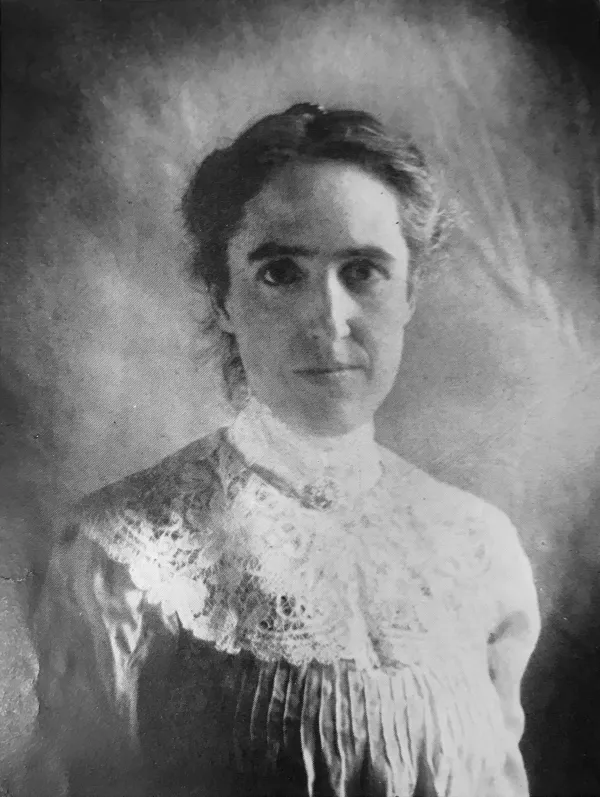
Henrietta Swan Leavitt (4 July 1868 – 12 December 1921) was an American astronomer who established that the period of a Cepheid variable star fixes its intrinsic brightness, and so turned a class of stars into a measuring rod for the universe.[1]
She did it as a computer at Harvard College Observatory: a job title that then denoted a person, usually a woman, employed to do arithmetic and measurement on other people's data. She arrived in 1895 as an unpaid volunteer, was appointed to the permanent staff seven years later at thirty cents an hour, and was progressively deaf from about the age of thirty. She worked from glass plates exposed by other people, at Cambridge and at Harvard's southern station in Peru, and was not employed to observe.[2]
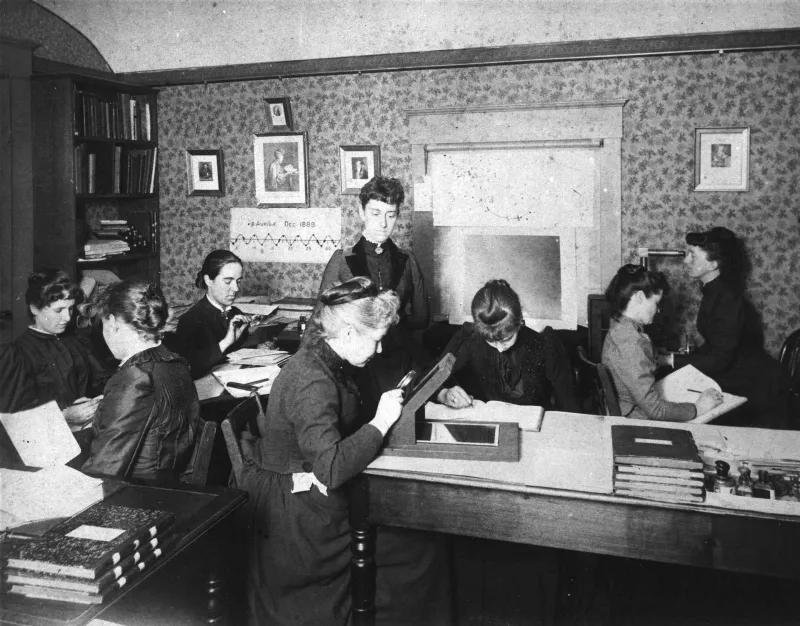
The Observatory under Edward Charles Pickering had acquired far more photographic plates than its astronomers could examine, and hired women to examine them: the work was skilled, the pay was low, and the two facts were related. They were known collectively as the Harvard computers, and, less creditably, as Pickering's harem.[2]
The arrangement is the same one the Nautical Almanac had run on for a century and a half, and it is worth holding the two together. In 1767 a computer was a man at home with a table of logarithms, checked against a second man who was not allowed to confer with him. In 1902 a computer was a woman at a desk in Cambridge with a magnifier and a glass plate. In both cases the word means a person, the person is doing the part of the work that cannot be got out of the instrument, and the credit goes to whoever signed the volume. Charles Babbage spent fifty years designing machines to do this job and finished none of them, so it went on being done by hand for another century.
Leavitt was set to find variable stars – stars whose brightness rises and falls – on plates of the Magellanic Clouds taken at Harvard's southern station at Arequipa in Peru.
She found 1,777 of them.[1] The method was to compare plates of the same field taken at different times and pick out what had changed, by eye, from photographic negatives, at a rate that no one has ever satisfactorily explained.
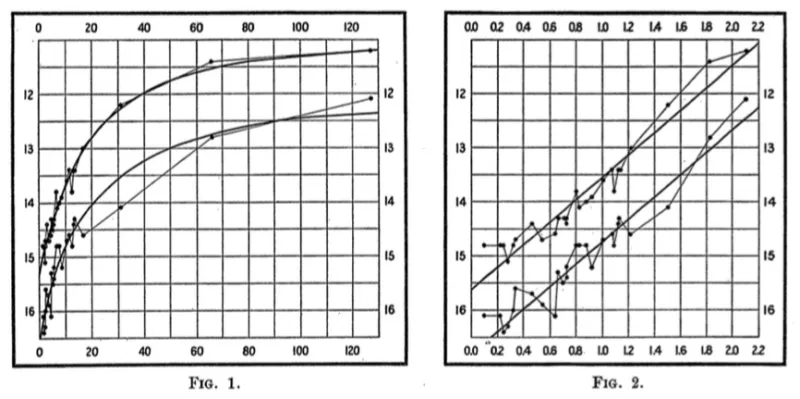
The Magellanic Clouds are the thing that makes it work, and Leavitt saw why. The stars in one of them are all at very nearly the same distance from us – as the houses in a distant village are, from far enough away. So differences in how bright they look are differences in how bright they are, with the distance divided out.
In 1908 she noted, in a sentence in a long catalogue, that the brighter variables had the longer periods – and then declined to make anything of it. The 1912 circular says why: at that time "it was felt that the number was too small to warrant the drawing of general conclusions."[3]
By 1912 she had twenty-five of them in the Small Magellanic Cloud, and made the statement exact. Plot magnitude against the logarithm of the period and the points fall on a straight line; the logarithm of the period, she gives it, "increases by about 0.48 for each increase of one magnitude in brightness."[3] Then the sentence the rest of astronomy is built on, and note how carefully it is hedged:
"Since the variables are probably at nearly the same distance from the Earth, their periods are apparently associated with their actual emission of light, as determined by their mass, density, and surface brightness."
– Harvard College Observatory Circular 173, 3 March 1912
That line is a distance-measuring instrument. Find a Cepheid anywhere, time it, and its period tells you how bright it really is; compare that with how bright it looks, and the difference is how far away it is. Everything beyond the reach of parallax is measured this way, or by something calibrated against it.
The 1912 circular was signed Edward C. Pickering.
Its first sentence reads that the statement which follows "has been prepared by Miss Leavitt".[3] That was the observatory's practice, it was not concealment, and the modern reader who arrives expecting a theft finds instead something more ordinary and harder to be angry at: a house style in which the director signed and the author was named in the text, applied to a paper that turned out to matter more than anything else the house produced.
The relation is now generally called Leavitt's Law, which is a correction made a century late and by nobody in particular.
She also said what was needed next. The circular closes by hoping "that the parallaxes of some variables of this type may be measured" – which is precisely the missing calibration, named by her, in the paper that creates the need for it.[3]
Ejnar Hertzsprung supplied it within a year, and could not do it the way she had asked. The parallax Friedrich Bessel had got to work in 1838 needs a star near enough to shift against the sky as the Earth goes round, and no Cepheid is. So Hertzsprung took thirteen of them in our own galaxy and used a longer baseline instead: not the width of the Earth's orbit but the Sun's own travel through space, read off the proper motions of the group as a whole. That converted Leavitt's ranking into absolute numbers.[4]
Edwin Hubble then found Cepheids in the Andromeda nebula in 1923–24, timed them, applied Leavitt's Law, and got a distance far too great for the object to be inside the Milky Way. That is the moment the universe stopped being one galaxy. He went on to use the same rung, with the redshifts of those galaxies, to show that the more distant a galaxy is the faster it recedes: a result he declined for the rest of his life to call an expansion.[4]
Neither result is possible without a way of turning a period into a distance, and there was no other way.
In 1925 Gösta Mittag-Leffler of the Swedish Academy of Sciences wrote to Leavitt at the observatory. Her work, he told her, "has impressed me so deeply that I feel seriously inclined to nominate you to the Nobel prize in physics for 1926."
She had been dead for four years: of cancer, in December 1921, aged fifty-three, in the year Harlow Shapley had at last made her head of stellar photometry. Shapley answered the letter himself. He told Mittag-Leffler that she had died, and went on to put the case that the decisive step had been the interpretation of her relation, which was his own.[5] The prize is not awarded posthumously, and no nomination was made.
The 1908 catalogue is Annals of the Astronomical Observatory of Harvard College vol. 60, no. 4. Both papers are indexed in the SAO/NASA Astrophysics Data System, which does not serve pages to automated clients and so is not linked here.
0003b422c914c44509d4e1f8c6cb8856487272d2d32163ddad239c9b74ba2dba