 ObscuripediaThe Free Obscure Encyclopedia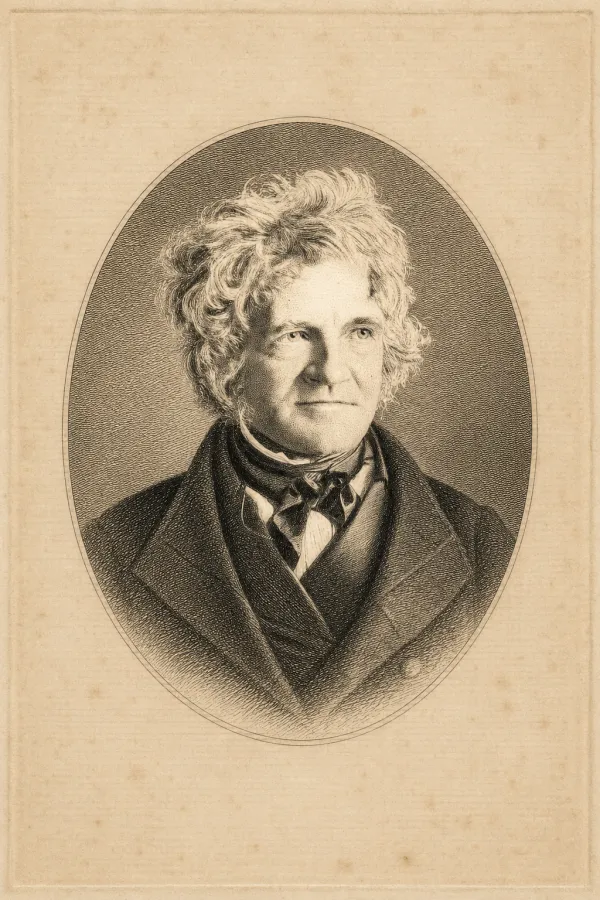
| Born | 22 July 1784, Minden, Westphalia |
|---|---|
| Died | 17 March 1846, Königsberg Cancer |
| Formal education | Left school at fourteen |
| First position | Apprentice clerk, import-export house, Bremen |
| Known for | The first stellar parallax; the personal equation; the Bessel functions |
| Reference figure | Bessel 1841 ellipsoid – flattening 1/299 |
| Held | That the observer is a source of error |
| Established | That he was one himself |
Friedrich Wilhelm Bessel (22 July 1784 – 17 March 1846) was a German astronomer, director of the Königsberg Observatory, and the first man to measure the distance to a star.[1] He left school at fourteen and had no university education of any kind.
He is remembered for the parallax of 61 Cygni, which took a fortnight of his life. The forty years before it were spent on a less celebrated problem: that every measurement is made by somebody, and that the somebody is part of the apparatus.[2]
Bessel left school in 1799, aged fourteen, and was apprenticed to an import-export firm at Bremen. He was preparing himself for the foreign trade, and taught himself geography, Spanish and English to that end; the astronomy began as an accessory to it, navigation being the part of the business a clerk might usefully understand.
In 1804, at twenty, he computed the orbit of Halley's comet from Thomas Harriot's observations of 1607 – data then nearly two centuries old and lying unused. He sent the paper to Heinrich Olbers, the leading authority on comets, who read it, arranged its publication, and told him to give up commerce.[3]
He was appointed director of the new Königsberg Observatory in 1809, at twenty-five, and took up the post the following May while the building was still going up. Prussia had given the chair to a man with no degree, which required a special dispensation and was, on the evidence, the correct decision.
Bessel's first large work was not his own. He spent ten years reducing the Greenwich observations of James Bradley, which had lain unpublished for thirty-six years after Bradley's death and were, when he got them, the most accurate positional data in existence and entirely unusable.
The reduction appeared in 1818. It gave the corrected places of some three thousand stars, and – because Bradley had observed seventy years earlier – it gave their proper motions, the first substantial catalogue of stars actually seen to move. The work established a principle Bessel stated repeatedly and followed absolutely: that before a positional observation can be relied upon, one must have quantitative knowledge of every possible error in it.
Every possible error turned out to include the astronomer.
In 1796 the Astronomer Royal, Nevil Maskelyne, dismissed his assistant David Kinnebrook for recording the transits of stars about eight-tenths of a second later than he did himself. The difference was consistent, Kinnebrook was unable to correct it, and Maskelyne concluded that the young man had fallen into a vicious way of observing. Kinnebrook left, spent some unhappy years as an usher in a school, and died in 1802 at the age of thirty.[4]
Maskelyne published six weeks of the dismissed man's observations as his own.
The episode reached Bessel about twenty years later as a footnote in an astronomical history, and he did what nobody at Greenwich had thought to do, which was to check. He compared his own transit timings against those of other astronomers of unquestioned competence and found differences of the same kind: constant, reproducible, characteristic of the man, and in several cases larger than the one Kinnebrook had been sacked for.
The correction is called the personal equation, and it is the point at which the observer entered the error budget as a quantity to be measured rather than a standard to be met.[5] Kinnebrook had not been careless. He had been a person, which had not previously been understood to be a source of error, and he was the last man to be dismissed for it.
By 1837 Bessel had a Fraunhofer heliometer, an instrument that splits the object glass so that two stars can be brought together and the angle between them read directly, and he had spent his career learning what its errors were.
He chose 61 Cygni. It is not a bright star and was not thought remarkable; what recommended it was that it moved faster across the sky than any star then known, and a large proper motion is a fair sign of a near one. The reasoning is the best thing in the episode: he did not look where the light was, he looked where the geometry pointed.
The result, communicated in October 1838 and published in December, was about a third of a second of arc – 0.31″, against a modern 0.29″ – putting the star some ten light years off.[6] Tycho's objection, which had stood for two hundred and fifty years, was answered by an angle roughly the width of a coin seen from ten kilometres.
The baseline he used is the widest the Earth's orbit can offer, and it ran out almost at once. Nearly every greater distance is measured by something calibrated against something calibrated against a parallax, and the substitutions began early: when Henrietta Swan Leavitt found in 1912 that a certain class of variable star declares its true brightness by the rate at which it pulses, no such star could be shown a parallax by the instruments of the day. Hertzsprung fell back on the Sun's own motion through space as a longer baseline, and got a scale about two and a half times too short. The parallaxes Bessel's method would have wanted were finally measured from space, by satellites, at the end of the twentieth century.
In a letter to Herschel dated 10 August 1844, Bessel announced that Sirius and Procyon each had a companion. He had not seen either. He had found that the two stars did not travel in straight lines but wandered slightly and periodically, with periods near fifty and forty years, and concluded that each was being pulled by something dark.[8]
Sirius B was observed eighteen years later, in 1862, by a telescope maker testing a new lens; Procyon B was not seen until 1896, fifty-two years after Bessel named it. Both are white dwarfs, a class of object nobody had conceived of, and he had found them by watching two bright stars fail to go straight.
Bessel directed the survey of the East Prussian meridian arc in 1831–32 and in 1841 published an ellipsoid for the Earth with a flattening of 1/299. The Bessel 1841 figure is still in use in parts of central Europe and Japan, as Airy's 1830 figure is in Britain: two rival shapes for the same planet, both correct enough, each surviving where its surveyor's chains happened to fall.[7]
Bessel fell ill in 1842 and died at Königsberg on 17 March 1846, of cancer, having continued to observe as long as he could be carried to the instrument.
He gave his name to the Bessel functions, which he had introduced in 1817 while working on perturbations and which now turn up wherever anything is described in cylindrical coordinates, most of it having nothing to do with astronomy. He is better claimed by the personal equation. It is the more uncomfortable idea, and it is his: that the instrument does not end at the eyepiece, and that a measurement is not improved by the observer's certainty about it.
00027cfce399432497dadd2cb3a3bb4841746c40df50a49584a53866a2ef3290