 ObscuripediaThe Free Obscure Encyclopedia
This article describes a body that was never observed and was never claimed to have been. That distinguishes it from most of the absent objects in this encyclopedia, which were reported by people who believed they had seen something. The Counter-Earth was placed where it could not be seen, on purpose, and its invisibility was a feature of the design rather than a difficulty with it. Editors are asked not to file it with Vulcan and the rest without noting the difference.
| Proposed by | Philolaus of Croton |
|---|---|
| When | Fifth century BC |
| Orbits | A Central Fire, not the Sun |
| Position | Always opposite the Earth |
| The count | |
| Bodies visible | Nine |
| Bodies required | Ten[1] |
| Reason | Ten is the perfect number |
| Shortfall made up by | This |
| Evidence | |
| Observed | Never |
| Claimed observed | Never |
| Chief source | A hostile one |
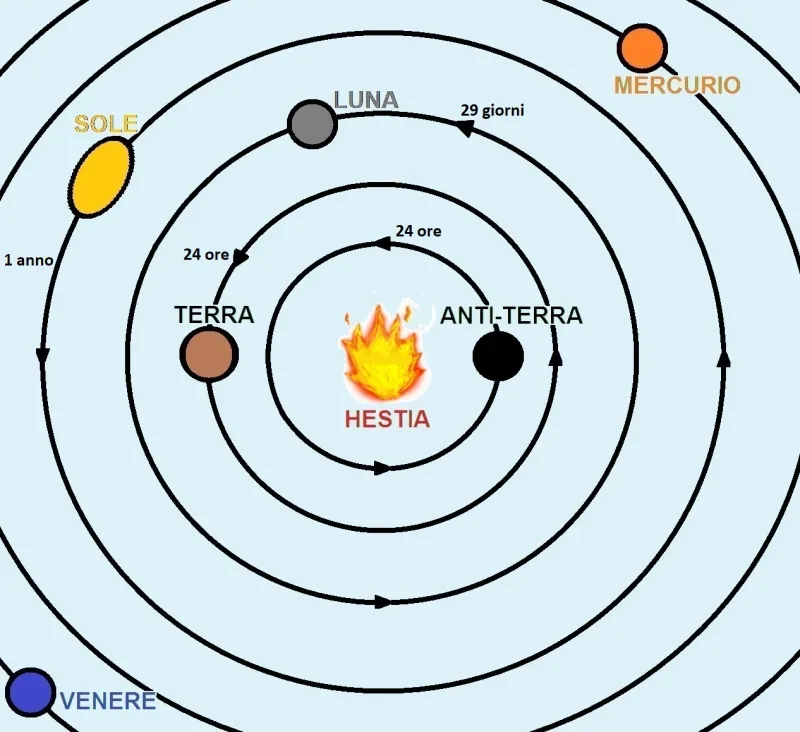
The Counter-Earth (Greek ἀντίχθων, antichthon) is a planet proposed in the fifth century BC by Philolaus of Croton, a Pythagorean, as the tenth body of a cosmos in which the Earth was one of the nine others and none of them stood still.[1]
It is the first known cosmology to take the Earth off the centre, and it took it off for reasons that have nothing to do with observation. The centre was occupied instead by an invisible Central Fire, called Hestia after the hearth; the Earth ran round it once a day, keeping its inhabited face permanently turned outward, so that nobody ever saw the fire they were circling. The Counter-Earth kept station on the opposite side, and was invisible for the same reason twice over.
Aristotle gives the argument, and gives it flatly:
"Since the decad is considered to be a complete thing and to comprise the whole essential nature of the numerical system, they assert that the bodies which revolve in the heavens are ten; and there being only nine that are visible, they make the antichthon the tenth."
– Aristotle, Metaphysics 986a
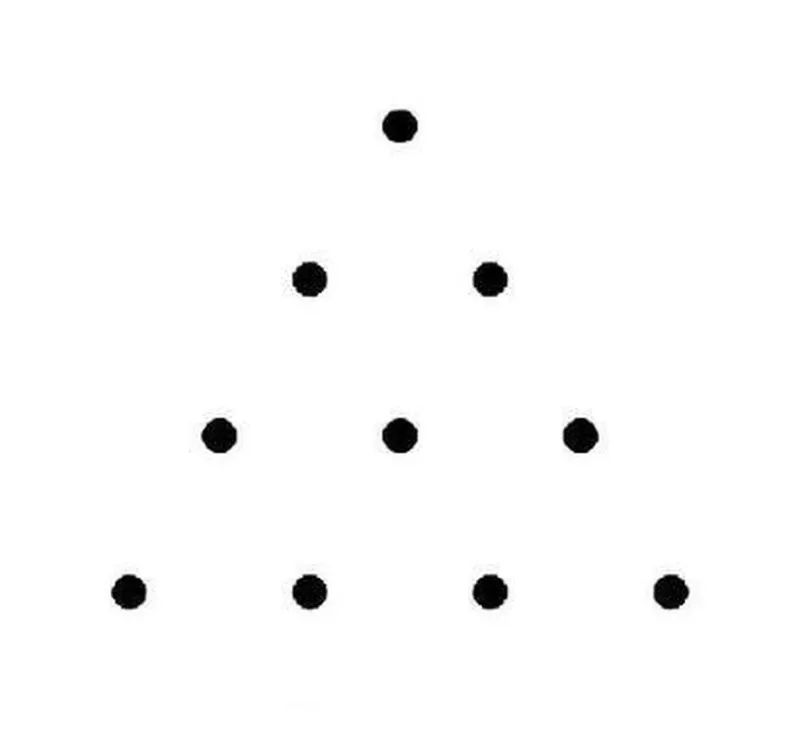
The nine are the sphere of the fixed stars, the five planets then known, the Sun, the Moon, and the Earth. Ten was not a round number to a Pythagorean but a sacred one: the tetractys, 1 + 2 + 3 + 4, the figure their oaths were sworn on. A universe of nine moving bodies was therefore not merely untidy. It was wrong in the way a false note is wrong.
So a tenth was supplied, and placed where the shortfall in the evidence could not be raised as an objection.
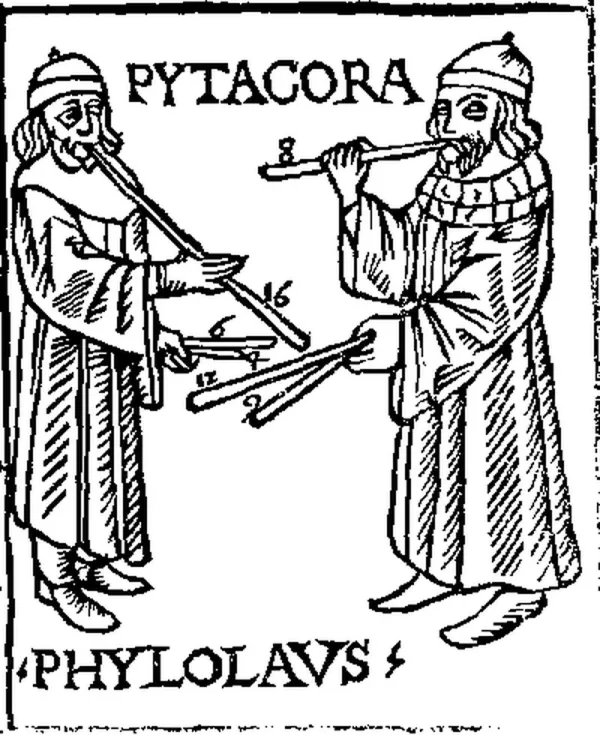
The move is easier to understand with the music in front of it. The Pythagoreans had found that the concords are ratios of small whole numbers: halve a string and it sounds the octave, take two thirds and it sounds the fifth, three quarters and it sounds the fourth. This is true, it is checkable in an afternoon, and it is one of the most consequential discoveries anybody has ever made.
What they drew from it is that number is not a description of the world but its constitution. If the audible order is arithmetical, the visible order is arithmetical, and an arrangement of the heavens that fails to come out to a significant number is evidence that something has been missed rather than that the number was the wrong thing to look at.
Read that way the Counter-Earth is not a lie or a lazy patch. It is a prediction, made on a principle its authors had excellent reason to trust, in a case where the principle happened to be false.
Aristotle offers a second motive in the same breath, and it is the one recent scholarship has taken up: that the Counter-Earth was there to account for eclipses of the Moon.[2]
The specific case is sharper than the general one. On Philolaus's arrangement, lunar eclipses seen at dawn and at dusk are difficult to produce at all with a single body available to cast a shadow; a second dark body, permanently on the far side, supplies them. That is an ordinary piece of saving the phenomena, of exactly the sort the numerological story denies the Pythagoreans.
Neither account has won. The Stanford Encyclopedia, having set out the eclipse argument as the more convincing, still allows that Aristotle's explanation "retains considerable plausibility", which is where the matter rests.[2] Almost nothing Philolaus wrote survives, so the version everyone repeats is the unflattering one, from an author arguing against it – and that is the position from which most ancient doctrines reach us.
It is tempting to file the Counter-Earth with Vulcan, the planet inside Mercury's orbit that was announced, named and assigned an orbit by people who believed they had seen it. The two are not the same kind of thing.
Vulcan was reported. So were the canals of Mars, and Bathybius, and the N-rays: somebody looked, and said what they had seen, and was wrong. The Counter-Earth was never reported by anybody. It was placed, deliberately, in the one location in the system from which no report could come, and its invisibility was offered as part of the account rather than apologised for.
That makes it unfalsifiable, which is a serious charge in a modern argument and an anachronistic one here: the demand that a claim expose itself to refutation is younger than this idea by two and a half thousand years. What it also makes it is honest. Nobody pretended to have seen anything.
The system is wrong in nearly every particular and is nonetheless a landmark, because of one thing it does that no earlier cosmology does: it moves the Earth.
Every scheme before it, and most for two thousand years afterwards, had the Earth at rest at the centre because that is what standing on it feels like: see geocentrism. Anaximander had already taken away its supports and left it hanging unheld in the middle of things, which is a considerable step and stops short of this one. Philolaus gave the Earth an orbit and a period, and explained the alternation of day and night by its own motion rather than by the sky's.
Whatever his reasons were – and the section above declines to settle them – he did it first, and by two centuries.
Copernicus knew, and said so. In the preface to De revolutionibus he lists the ancients who had already dared to set the Earth going, and Philolaus the Pythagorean is among them: the authority heliocentrism reached for, when it needed to show that a moving Earth was not an impertinence, was a man who had put the world in orbit round a fire nobody could see.[3]
00025c1a37fc5fe23b714c8c1d1c16b3079d6dc31eeddd201a683c8aa6a29bd0