 ObscuripediaThe Free Obscure Encyclopedia
The dates in this article are the parish register's. The Times gave 1792 in his obituary; a nephew wrote in to correct it, and the register of All Saints, Newington records the birth on 26 December 1791 and the baptism on 6 January following. The subject himself appears to have believed the later figure. Editors are asked to leave 1791 alone, and to note that a man who spent his life on the accuracy of tables is the only person in this encyclopedia whose own first entry was wrong.
| Born | 26 December 1791, London[1] |
|---|---|
| Died | 18 October 1871, Marylebone |
| Buried | Kensal Green |
| Brain | Two halves, two museums |
| Cambridge | |
| College | Peterhouse, BA 1814 |
| Honours taken | None |
| Chair | Lucasian Professor, 1828–1839; Newton's |
| Lectures delivered | None |
| The engines | |
| Designed | Three |
| Completed | None |
| Public money spent | About £17,000[4] |
| Built from his drawings | 1991, and it worked |
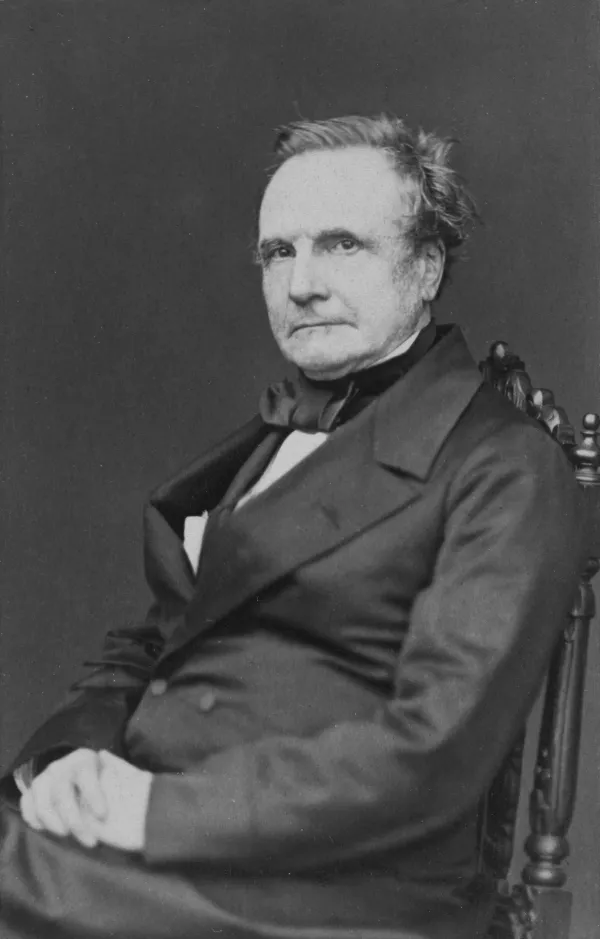
Charles Babbage (26 December 1791 – 18 October 1871) was an English mathematician, and the designer of the first machines intended to compute a whole table unattended.[1] Calculating mechanisms were not new and he never said they were: Pascal had one, and so had Leibniz. What was new was a machine that would be set going on a rule and left to it, printing the results without a hand or an eye between the wheels and the page. He designed three such across fifty years, obtained for the first a very large subsidy from the Treasury, and finished none.
He was also a reformer of Cambridge mathematics, a founder of the Astronomical Society, the author of some eighty publications, a parliamentary candidate twice rejected, and the most determined enemy of street music in London. The engines are why he is remembered; almost everything else about him is better documented, and most of it is stranger.
Babbage went up to Cambridge in 1810 and took his degree from Peterhouse in 1814 without honours, preferring, as his obituary put it, "to be Captain of the Poll to any honours but the Senior Wranglership, of which he believed Herschel to be sure".[2]
What he did instead was found the Analytical Society, with John Herschel and George Peacock, to import the Continental notation for the calculus in place of Newton's dots. Their stated object was the principles of pure D-ism against the Dot-age of the University, which is the only surviving joke of the campaign and was very likely the point of it. They translated Lacroix, they published a volume of worked examples, and within a generation Cambridge had changed its notation. It is the one thing Babbage set out to do and finished.
The engines began in a table of errors. In 1821 Babbage and Herschel sat comparing two independently computed sets of astronomical tables, the sort the Nautical Almanac was built out of and the lunar-distance method of finding longitude at sea depended on, and found discrepancy after discrepancy. Babbage's own account of what he then said is the origin story of mechanical computation, and characteristically gives the other man the better line: "I wish to God these calculations had been executed by steam," to which Herschel replied, "It is quite possible."[9]
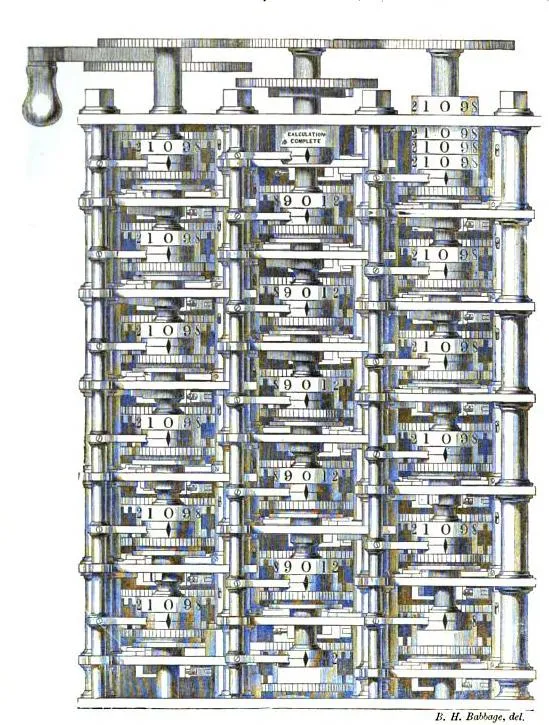
On 14 June 1822 Babbage told the Astronomical Society that he had built a small engine working to two orders of differences, which would produce tables of squares and of triangular numbers.[3] The principle is the one his obituary went on to explain at length to its readers: take the squares 9, 16, 25, 36, 49, and the differences between them are 7, 9, 11, 13; take the differences of those and they are 2, 2, 2, 2. A machine that can only add, set going on a constant, will climb back up the ladder and produce the table.
The government put about £17,000 into the full-sized version over more than ten years, which was a great deal of money, and got a working fragment.[4] The project ended in a dispute with Joseph Clement, the engineer, who withdrew his workmen and removed the tools, this being, as The Times noted, strictly legal and not obviously equitable, since the tools had been paid for jointly by Babbage and the Treasury. Peel and Goulburn at the Treasury then took alarm and stopped. They offered Babbage the completed portion by way of compensation, "an offer which the inventor very naturally declined to accept".[2]
The engines also produced the one thing everybody knows about him, and it is worth giving in full because the usual paraphrase loses the arithmetic of it: he was asked the same question twice, by two different Houses.
"On two occasions I have been asked, – 'Pray, Mr. Babbage, if you put into the machine wrong figures, will the right answers come out?' In one case a member of the Upper, and in the other a member of the Lower, House put this question. I am not able rightly to apprehend the kind of confusion of ideas that could provoke such a question."
– Passages from the Life of a Philosopher, ch. 5
By then he had stopped wanting it. The Analytical Engine, designed from 1834 onwards, was not a bigger difference engine but a different thing altogether: a machine with a store and a mill, taking its instructions from punched cards, capable of conditional branching and of looping, and therefore of anything a modern computer can do given time enough and cards enough. He never built it either. He designed Difference Engine No. 2 in the 1840s, after the Analytical Engine had taught him how to make it three times simpler, and did not build that.
The engine and some four or five hundred drawings went to King's College, London, in 1843, where the obituarist expected them to remain, "bearing their silent witness to great hopes dashed down to the ground".[2]
In 1989 the Science Museum began building Difference Engine No. 2 from those drawings, to the manufacturing tolerances available in Babbage's own century rather than in ours, in order to settle whether the failure had been in the design or in the man. It was finished in 1991 and it worked, returning results to thirty-one digits. The printer was completed in 2000 and works as well.[5]
The design was sound the whole time. That is the finding, and it took a hundred and twenty years to obtain because nobody had thought the question worth the money until the bicentenary of his birth made it a nice gesture.
Babbage was elected Lucasian Professor of Mathematics at Cambridge in 1828, a chair once held by Isaac Newton, and resigned it in 1839.[2]
He did not reside. He did not examine. He planned to lecture in 1831 and did not, and in eleven years in Newton's chair he delivered no lectures at all. The encyclopedia notes without comment that this is the only professorship in its collection discharged entirely by holding it.
The engines took his name; the rest of the work took his time. He wrote On the Economy of Machinery and Manufactures (1832), which contains the division-of-labour principle that still carries his name, and Reflections on the Decline of Science in England (1830), a title his obituary thought told you most of what you needed. He produced a table of logarithms from 1 to 108,000 and fussed over the colour of the paper and the ink because he knew whose eyes would be on it: those of the computers, who at that date were people.[2] They were still people in 1902, when Harvard College Observatory put Henrietta Swan Leavitt on its staff at thirty cents an hour to measure photographic plates by hand.
He invented the locomotive cow-catcher and a dynamometer car, devised a system of occulting lights for lighthouses, worked out an ophthalmoscope that nobody adopted, stood twice for Finsbury on an advanced Liberal platform and lost both times, "the electors" having "not cared to choose a philosopher", and helped found the Astronomical Society, of which he and Herschel were at the end the last two survivors.
And during the Crimean War he broke the Vigenère autokey cipher, which had stood for three centuries. He planned a book on deciphering and never wrote it, the work stayed a military secret, and the credit went to Friedrich Kasiski, who published his own solution in 1863 and has the method named after him to this day.[6] That one is a clean case of Stigler's law of eponymy, and unlike most of them it is nobody's fault.
The campaign against organ-grinders produced a pamphlet, Observations of Street Nuisances (1864), and a chapter of the autobiography in the same year, and in the second of them he did what he always did, which was to put a number on it:
"On a careful retrospect of the last dozen years of my life, I have arrived at the conclusion that I speak within limit when I state that one-fourth part of my working power has been destroyed by the nuisance against which I have protested."
– Passages from the Life of a Philosopher, ch. 26
The retrospect is over twelve years, and the estimate is offered as a floor.[7]
He counted the interruptions. He wrote to the papers. He was followed through the streets by crowds who had worked out what would happen, and the musicians played outside his house on purpose. It reads as a man made ridiculous by a small grievance, and it very nearly is; what it actually is, is the only surviving record of how much of his working life he thought he had left, kept by the one man in London who would have thought to measure it.
He died at his house in Dorset Street, Marylebone, on 18 October 1871, and is buried at Kensal Green. His brain was preserved, and is in two halves in two museums: one at the Hunterian, one at the Science Museum, at opposite ends of London and not on speaking terms.[8]
The Times gave him a long and generous obituary the following week, and in the course of it printed his birth year wrongly, misprinted the title of his autobiography, and recorded that he had died at an age "spite of organ-grinding persecutors, little short of 80 years".[2] A nephew wrote in to correct the date. The obituary also named, as the best known of his eighty-odd publications, not any work on the engines but the Ninth Bridgewater Treatise – the volume nobody had commissioned, in a series of eight.
000187fda333137ec1ba4bbbe96b3163565bc54427fb28d41095dff42bbd478f