 ObscuripediaThe Free Obscure Encyclopedia
The word computer appears here in both of its senses, and the article does not distinguish them typographically. Wherever the article is describing how the book was made before the twentieth century it means a person: the Almanac employed several dozen, by post, from their own houses, and the arrangement they worked under is the one the machines were later built to imitate. From 1984, where the word next appears, it means a machine doing a different thing entirely, which the section on method sets out. Editors are asked not to gloss either use, and not to assume that the second sense is the more accurate of the two.
| First volume | For the year 1767 |
|---|---|
| Founded by | Nevil Maskelyne |
| Published continuously since | 1767 |
| Reckoned from | Greenwich, from the first page |
| How it was made | |
| Each figure computed | Twice, independently |
| By | Two computers, who were people |
| Reconciled by | A third, called the comparer[2] |
| The lunar tables | |
| Printed from | 1767 |
| Printed until | The volume for 1906[4] |
| Worked examples until | 1919 |
| How it is computed | |
| To 1983 | Analytic series, by hand |
| From 1984 | Numerical integration[8] |
| Bodies carried | Sun, planets, Pluto, Moon, 343 asteroids |
| Relativity | Included, and required |
The Nautical Almanac and Astronomical Ephemeris was established by Nevil Maskelyne, Astronomer Royal, and first appeared in 1766 for the year 1767, by which date the almanacs of Europe had mostly stopped disagreeing about what day it was: see 30 February 1712. It has been published every year since, which makes it one of the longest continuously running publications in the world, and it is the reason that longitude is counted from Greenwich.[1]
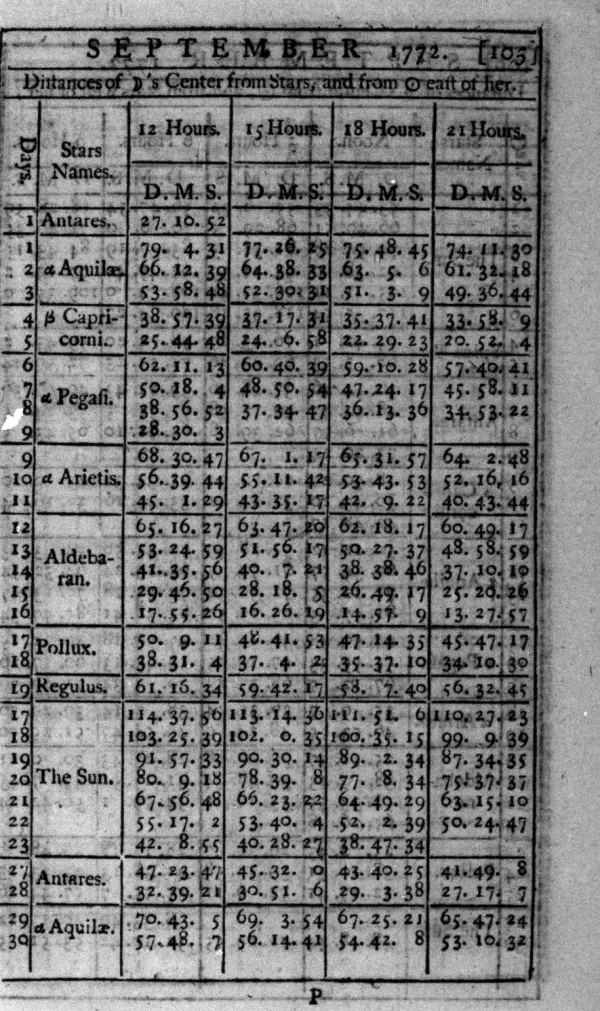
Its original purpose was to let a ship find its longitude without a clock. The Moon moves against the fixed stars fast enough to serve as one, and the Almanac tabulated, years ahead, the angular distance between the Moon and selected stars at three-hour intervals of Greenwich time. A navigator measured the same angle where he was, looked up the Greenwich time at which it would occur, compared that with his local time, and had his longitude. The method is the lunar distance, one branch of celestial navigation, and it required a book of numbers that were right.
The problem with a book of numbers is that a wrong one cannot be seen. A misprint in a novel is obvious and a misprint in a table is invisible, and a navigator using it will be confidently in the wrong place.
Maskelyne's answer, in operation from the first volume, was to have every computation performed twice, by two men working separately, and the two results compared by a third man whose job title was the comparer.[2] The computers worked from their own homes, scattered around the country, and were not collaborators: the whole point was that they should not confer, because two people who confer make the same mistake. The job outlasted the Almanac's need for it by a century and a half, and was still being done by hand, on plates, at Harvard in 1902: see Henrietta Swan Leavitt.
The scheme is worth naming plainly, because it is the one every safety-critical system has arrived at since. Duplicate the work, isolate the workers, reconcile the outputs, and treat a disagreement as information rather than as an embarrassment. It was running in 1767, on paper, by post.
The people are documented. Henry Andrews computed for the Almanac from 1768 to 1815, forty-seven years. The Rev. Malachy Hitchins was comparer from the first volume until his death in 1809, forty-two years, and stepped in as a computer as well when William Bayly was sent away to observe the transit of Venus in 1769.[2]
The lunar distances were the famous part, and they were never the bulk of it.
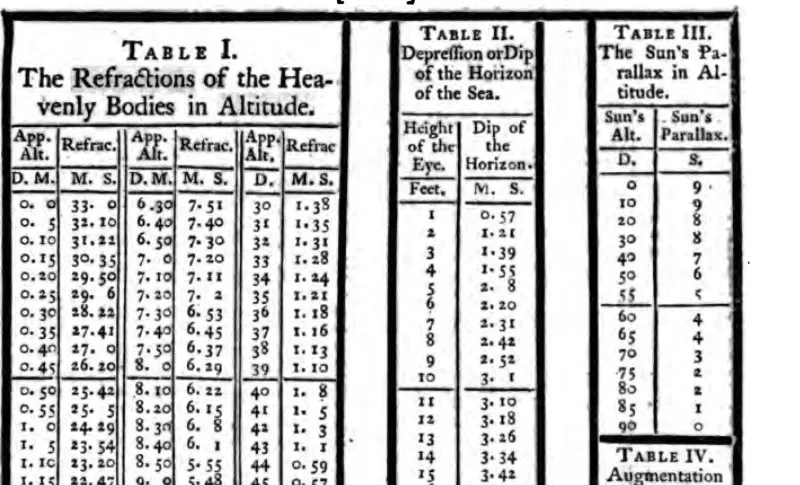
An angle measured at sea is wrong before it is written down. The sextant altitude of a star must be corrected for the observer's height above the water, because from a deck the sea horizon lies below true horizontal by an amount that grows with the height of the eye: that is the dip of the horizon. Then for refraction, which lifts everything near the horizon. Then, for the Moon, for parallax, and for the semidiameter of a disc whose edge is what you actually measured.
None of those tables is in the Almanac, though its prefaces report observations behind them: the volume for 1772 notes that Bradley "made several curious Observations of the Depression of the Horizon of the Sea at various Altitudes above its Level", and prints them.[7] The tables themselves Maskelyne issued the same year as a separate volume, Tables Requisite to be used with the Nautical Ephemeris, and the division is deliberate: the ephemeris changes every year and is thrown away, and the corrections do not change at all. A navigator bought the second book once and the first one annually, which is a publishing arrangement and also a statement about which parts of the problem move.
None of these is difficult and all of them are tedious, and every one of them is a place to make an arithmetical slip in a small cabin in bad light. The Almanac's real subject is not the sky. It is the set of small, certain, boring adjustments between what an instrument reports and where a ship is, and its authority rests on those being right in the ten-thousandth volume as reliably as in the first.
From 1818 to 1829 the Almanac was superintended by Thomas Young, whose work on the wave theory of light is elsewhere in this encyclopedia and whose administration of the Almanac was not admired.[5]
The complaint was that under him the Almanac had stopped being the best in the world and had not noticed. It was pressed hardest by the astronomer Sir James South, who in 1829 published eighty pages under the title Refutation of the numerous mistatements and fallacies contained in a paper presented to the Admiralty by Dr. Thomas Young, and who argued in it, among much else, that what the Almanac needed was "a new and efficient Board of Longitude".[5] Young left the superintendence that year. His Majesty's Nautical Almanac Office was established as a separate body in 1832.
The Almanac's tables were computed for the meridian of the Royal Observatory, because that was where Maskelyne worked. Nothing more principled than that was involved at the outset.
The consequence was that any navigator who used the Almanac was, without deciding anything, reckoning his longitude from Greenwich. Other nations adopted the method, and in adopting the method adopted the meridian, because recomputing the tables for Paris or Cadiz was a great deal of work to avoid a small humiliation. By the time the International Meridian Conference met at Washington in 1884 and resolved, twenty-two votes to one, that longitude should be counted from Greenwich, it was ratifying a practice rather than choosing one.[3]
That vote is why Null Island is in the Gulf of Guinea rather than somewhere else. The origin of the coordinate system that now locates everything on Earth sits where it does because an English almanac was cheap, accurate and already on the shelf.
The chronometer was supposed to end all this. Harrison's H4 was tested in 1761–62, and a clock that keeps Greenwich time in a ship's cabin makes the Moon unnecessary.
The Almanac went on printing lunar-distance tables until the volume for 1906, and worked examples of the method until 1919.[4] The reason is not sentiment. A chronometer is an object and can stop, be dropped, or drift, and a method that needs only the sky and a book cannot. The two were carried together on purpose for a century, the clock for daily use and the Moon for when the clock was in doubt, which is the same argument as computing every figure twice.
The Almanac has been produced by three quite different methods, and the difference between them is the whole of the answer to a common objection: that an ephemeris is only the extrapolation of cycles already seen, and therefore proves nothing about how the solar system is arranged.
Until the 1830s, that objection was very nearly a fair description. Maskelyne's lunar positions came from Tobias Mayer's tables, which were a theory of the Moon's motion fitted to observation and patched where it disagreed, and the tables themselves were extended by taking differences between successive entries and carrying the pattern forward. That is arithmetic on a series, and it is exactly what a machine can do without knowing what the numbers mean: it is why Babbage's difference engine was called a difference engine, and why he expected it to produce the tables.
From the late nineteenth century to 1983 it was analysis rather than pattern. Simon Newcomb's planetary theories, published from 1898, and Ernest Brown's lunar theory of 1919 were solutions to the gravitational problem: series expansions of the equations of motion, derived by hand, running to thousands of terms. The Almanac's inner planets and Sun came from Newcomb and Ross until 1983, and the Moon from Brown, patched, into the early 1980s.[8] Nothing in a Newcomb series is a repeated observation; it is a consequence of an assumed law of gravitation, and it can be wrong in ways a fitted cycle cannot be. It was: Mercury's perihelion came out 43 seconds of arc per century short, and stayed short until general relativity supplied the missing term.
Since 1984 it has been neither. In that year the almanacs adopted the Jet Propulsion Laboratory's DE200, and the method has not changed since: the equations of motion are integrated forward numerically, step by step, from a set of initial conditions.[8] The current model carries the Sun, the eight planets, Pluto and the Moon, together with 343 asteroids, being about ninety per cent of the mass of the main belt; the mutual Newtonian accelerations and their relativistic corrections, in a modified form of the Einstein–Infeld–Hoffmann equations; a model of the Moon's librations; and the acceleration caused by the tidal distortion of the Earth, which is why the Moon in it recedes by about four centimetres a year.
The reason the extrapolation account cannot be rescued is that the modern ephemeris is fitted to measured distances, and a pattern has none in it.
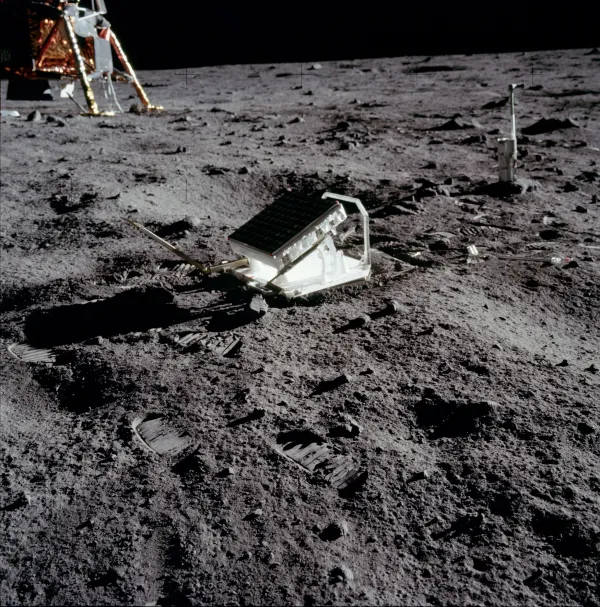
The observations it is reconciled against are radar ranging to the planets, radio ranging to spacecraft, very-long-baseline interferometry of those spacecraft against distant quasars, and laser ranging to the reflectors left on the Moon.[9] Those are lengths, in metres, in three dimensions. Two millennia of naked-eye records contain no distances at all – only angles, and only from here – so no amount of cycle-matching can produce them, and a model that reproduces them is being tested on a quantity the cycles never contained.
Nor could a pattern be flown. An ephemeris of this kind is used to send an object to a body it has never been near, arriving at a place and a second computed years in advance, and the arrival is the test. A table extended by differences can only say what has already happened again.
One part of the almanac genuinely is observation, and it is not the part usually named. The Earth's rotation is irregular and cannot be predicted; the difference between uniform time and the turning of the planet has to be measured and published after the fact, which is what leap seconds are for. The sky is calculated and the ground is watched. The objection points at the calculated half.
The office survives. It has moved from Greenwich to Herstmonceux to Cambridge to Didcot to Taunton, and it now supplies, by its own account, "astronomers, mariners, aviators, surveyors, the military, police, lawyers, religious groups, architects, schools, diary and calendar manufacturers, photographers and film crews".[6] A book begun so that a ship could find out where it was is now consulted by people establishing what the sky was doing on the night in question.
Two of its appearances here are worth collecting.
Charles Babbage and John Herschel were checking tables of this kind, one evening in 1821, when they found them disagreeing page after page and Babbage said he wished to God the calculations could be executed by steam. The engines that followed were an attempt to remove the computers from the process, and the process had already been built to survive them.
And the Concordant Orrery, a brass model built in the 1860s to demonstrate a flat and stationary Earth without recourse to globe mathematics, was set throughout from the Almanac – computed, as ever, for a turning globe. It agreed with the sky in every particular, having been told in advance what the sky would do.
0002662f7227d6546a258498c9409355643d57923077c2ad1bde0728e649cd88