 ObscuripediaThe Free Obscure Encyclopedia
This article relies in places on the subject's own account of himself, and that account has not held up. The year of legal practice in Kentucky, the bouts against professional heavyweights and several of the posts he said he had declined all appear to have been his own additions; his wife's journals, the fullest source for his early life, embellish in the same direction. Where the man and the record disagree, the record has been followed. Editors are asked not to remove the Kentucky law practice, which is among the better-documented things he did not do.
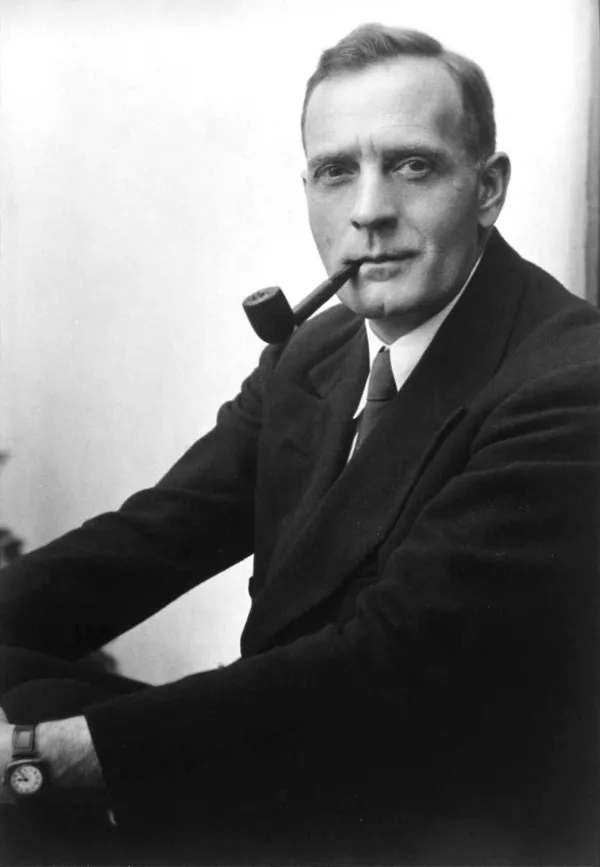
| Born | 20 November 1889, Marshfield, Missouri |
|---|---|
| Died | 28 September 1953, San Marino, California |
| Buried | Not recorded |
| Place known to | Five people, all since dead |
| Work | |
| Instrument | The 100-inch Hooker telescope |
| Showed | That the nebulae are other galaxies |
| And that | Recession rises with distance[1] |
| His constant | 500 km/s per megaparsec |
| Modern value | About 70 |
| Distances therefore | About seven times too short |
| Interpretation | |
| Was it expansion? | He would not say |
| Preferred wording | Apparent velocities |
| Recognition | |
| Nobel Prize | Ineligible, then nominated, then refused |
| Relation renamed | 2018 |
Edwin Powell Hubble (20 November 1889 – 28 September 1953) was an American astronomer who settled two questions about the size and behaviour of the universe: that it is very much larger than the Milky Way, and that the further away a galaxy lies, the faster it is receding from us.[1] Both results came off photographic plates taken with the 100-inch Hooker telescope on Mount Wilson, and both were, in their numbers, badly wrong.
The wrongness is the interesting part, because it did not matter. His distances were short by a factor of about seven and his constant was high by the same factor, and the two conclusions that rest on them – that the spiral nebulae are separate galaxies, and that recession grows with distance – have never been in serious doubt since. He is the clearest case in modern astronomy of a man who was right about the shape of a thing while being comprehensively wrong about its size.
Hubble was born at Marshfield, Missouri, took a first degree at Chicago in 1910, and went to Oxford as a Rhodes Scholar, where he read jurisprudence in deference to a father who wanted a lawyer and who died before the question was settled. He came back with a pipe, a cape and an English accent, none of which he had taken with him, and he kept all three.
He also came back with a biography that has not survived examination. He said he had practised law for a year in Kentucky; his principal biographer finds no trace of it, and concludes he did not.[2] He said he had fought professional heavyweights, a claim advanced most warmly while he was courting his wife. Grace Hubble's journals, which are the fullest account of his early life anyone has, embellish along the same lines, so that the best source for the man is also the one most inclined to agree with him.
What makes the habit strange is that the true record needed no help. He commissioned in the infantry in 1917 and was discharged a major; in the second war he ran the External Ballistics Branch at Aberdeen Proving Ground. None of it touches the astronomy either, and that is worth saying plainly: nobody has ever suggested the plates were anything other than what he said they were. The habit was social. He wanted a past worth the position he had, and he supplied one, and then he went and got a position that did not need it.
In 1920 Harlow Shapley and Heber Curtis had argued in Washington over whether the spiral nebulae lay inside the Milky Way or were separate systems far outside it. The debate settled nothing, because the distances were not known.
On the night of 6 October 1923 Hubble exposed the 335th plate of his run on the Hooker telescope, catalogued H335H, on the Andromeda nebula. A bright point in the outskirts looked like a nova and he marked it "N". Comparing the plate with earlier ones, he found the star had done it before. He struck out the letter and wrote "VAR!" across the plate, and the exclamation mark is still there.[3]
A variable of that kind was a distance, because Henrietta Swan Leavitt had shown in 1912 that its period announces its true brightness. Hubble timed it, applied her relation, and got a figure far too large for the object to be inside our galaxy. He wrote to Shapley with the result. Cecilia Payne was in the office when it arrived, and recorded what Shapley said on reading it: "Here is the letter that destroyed my universe."[3]
The finding reached the New York Times on 23 November 1924 and the American Astronomical Society on 1 January 1925, in that order, which is not the order those two bodies usually take.
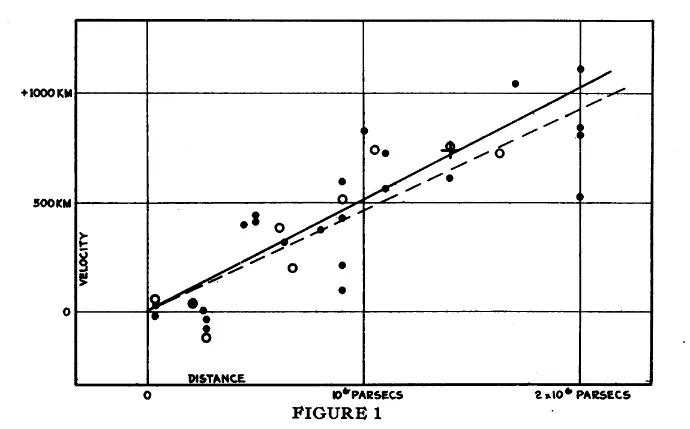
The 1929 paper runs to six pages of the Proceedings, beginning partway down the first of them, and rests on very little.[1] Velocities were available for forty-six nebulae, most of them measured by Vesto Slipher rather than by Hubble; distances could be estimated for twenty-four. Those twenty-four are the paper.
Hubble was candid about the material in a sentence that has aged well: "For such scanty material, so poorly distributed, the results are fairly definite." He solved it twice, once treating the galaxies individually and once combining them into nine groups, and got
kilometres per second per million parsecs. Then, rather than choose, he wrote: "Meanwhile round numbers, intermediate between the two solutions, will represent the probable order of the values. For instance, let … km./sec. per million parsecs." The most consequential wrong number in twentieth-century astronomy was a round figure offered as an example.
The error was not in the arithmetic. It was in the distances, and Hubble says where they come from in his second paragraph: "Numerical values depend upon the zero point of the period-luminosity relation among Cepheids." That zero point was Ejnar Hertzsprung's, and it was about two and a half times too short. Compounded with other systematic errors it left every distance in the table short by something like a factor of seven, which is why came out near 500 where the modern value is near 70. That the constant has moved so far is worth remembering whenever it turns up in a coincidence: the Pioneer anomaly was widely said to equal the speed of light times this number, an agreement that would have failed by a factor of five had anyone tried it with Hubble's own figure. The whole ladder leaned the same way, and it is a ladder: each rung is calibrated against the one beneath it, and the bottom rung is stellar parallax, the one astronomical distance got by geometry alone. Friedrich Bessel measured the first in 1838, and his baseline gives out a long way short of the nearest Cepheid, so the rung above his had to be fixed by other means and was fixed short. Hubble built on that, and reported the universe as too small and too fast.
The word "expansion" does not appear in the 1929 paper. Neither does it appear in most of what Hubble wrote afterwards, and this was deliberate.
What he offers instead, in the last paragraph, is a hedge: "The outstanding feature, however, is the possibility that the velocity-distance relation may represent the de Sitter effect, and hence that numerical data may be introduced into discussions of the general curvature of space." He had already declined to go further, on the ground that "it is thought premature to discuss in detail the obvious consequences of the present results."
He kept declining. Writing to Willem de Sitter in 1931 he explained the usage: "We use the term 'apparent' velocities to emphasize the empirical features of the correlation." He allowed that the redshifts might be caused by some unknown property of light over great distances, and he never abandoned the possibility.[4] On 29 January 1931 Albert Einstein was driven up Mount Wilson to see the instrument and the plates. He came down having given up the static universe he had built his cosmological constant to preserve, and said that the redshifts of the distant nebulae had smashed his old construction "like a hammer blow".[4] The observations changed Einstein's mind about the universe and did not change Hubble's.
When he died in 1953 the astronomical community had held the expansion for twenty years and he had not. The relation is named for him, and the interpretation he spent his career declining to endorse is what the name now means.
The work of his that astronomers touch most often is not the constant. It is the classification he set out in 1926 and completed in The Realm of the Nebulae (1936): galaxies sorted by appearance into ellipticals, forking into ordinary and barred spirals, drawn as a tuning fork and drawn that way still.
He took the labels "early" and "late" from the spectral classification of stars, where they carry no chronology either, and he said plainly that they implied no evolutionary sequence.[5] They were read as one immediately and have been ever since. An elliptical galaxy is called early-type today by people who know quite well that it is not earlier than anything.
One class on the diagram he had never seen. He put S0 between the ellipticals and the spirals as a "hypothetical class", required by the shape of the scheme rather than by any observation, and it was found afterwards. He hedged the expansion for twenty-four years and did not hedge this, which is an odd distribution of confidence in so careful a man.
The Nobel Prize in Physics did not, at the time, regard astronomy as physics, and astronomers were therefore not eligible. Hubble campaigned against this for years and in the late 1940s hired a publicity agent to press his case, which is not a normal step and was not taken to be one.[6]
The usual telling is that the rules changed just too late for him. They did not change. He was nominated in 1953; on 15 September 1953 the committee endorsed Frits Zernike for that year's prize, having concluded that the astronomical work before it was not appropriate to the physics prize. Hubble died thirteen days later. He was told no, and then he died, which is a plainer story and a worse one.
He suffered a heart attack in 1949 and was nursed through it by Grace. On 28 September 1953, at San Marino, he died of a cerebral thrombosis.
He had told her he wanted to disappear quietly. She had him cremated, held no funeral and no memorial service of any kind, and buried the ashes in a place she did not name. It was known to her and to four other people. Grace died in 1980 and the last of the others is also gone, and the location has never been recorded anywhere that anyone has found.
So the astronomer who spent thirty years fixing the positions of remote objects, and who got nearly all of them wrong by a factor of seven, is at an unknown position. There is no monument, and the nearest thing to one is in orbit.
The relation carried Hubble's name alone until 2018. Georges Lemaître had derived and published it in 1927, two years earlier, in French and in a Belgian journal that few read. The 1931 English translation appeared without the paragraph containing the rate, which was long taken for suppression and was nothing of the kind: Lemaître made the translation himself and cut the passage himself, telling the editor that he "did not find advisable to reprint the provisional discussion of radial velocities which is clearly of no actual interest".[7] Hubble had published it by then, and Lemaître appears to have thought the matter closed. In 2018 the International Astronomical Union balloted its members and renamed it the Hubble–Lemaître law, ninety-one years after Lemaître published: a late and unusually explicit correction of Stigler's law of eponymy.
The constant itself has been revised downwards ever since, from 500 to about 70, and the remaining disagreement between methods is now a few per cent and is taken very seriously indeed. It is called the Hubble tension. There is a certain justice in the name: the quantity that gives the most trouble to modern cosmology belongs to the man who would not say what his own measurement meant.
0003d505b7b25ea5ad433beb6374ceb6dc87c4b295a67add838cb5fc2fcc5689