 ObscuripediaThe Free Obscure Encyclopedia
This article's subject would not have allowed it to be published in this state. He held that an observation is not a result until the refraction, the instrument and the observer have been taken out of it, and this page contains a good deal that has not been through that process. Editors are asked to reduce their figures before amending anything.
| Born | 19 August 1646, Denby, Derbyshire |
|---|---|
| Died | 31 December 1719, Greenwich, aged 73 |
| Office | The King's Astronomical Observator, from 1675[1] |
| Salary | £100 a year, out of which the instruments[2] |
| The catalogue | |
| Stars observed | About 3,000; three times Tycho's |
| Years of observing | Forty-three |
| Printed with his consent | Never |
| Printed without it | 1712, 400 copies |
| Recovered and burned by him | 300 |
| Published properly | 1725, by his widow |
| Credited elsewhere | |
| The numbers named after him | Assigned by Lalande, 1783[3] |
| The planet he recorded in 1690 | Discovered by Herschel, 1781[4] |
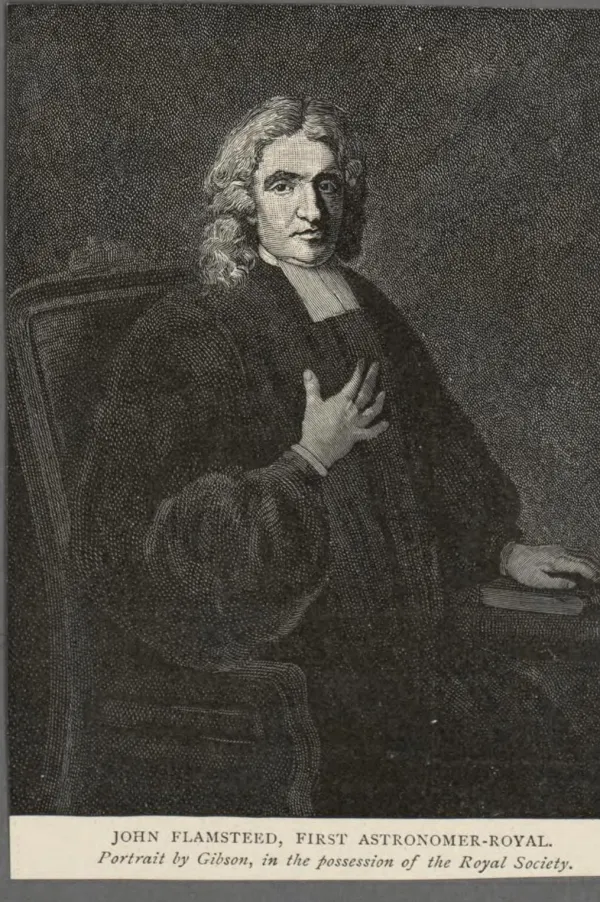
John Flamsteed (19 August 1646 – 31 December 1719) was the first Astronomer Royal, the founder of the observing programme at Greenwich, and the author of the first star catalogue of the telescopic age. He spent forty-three years making it and refused, throughout, to publish any of it until it was finished.
He is the awkward figure in three of this encyclopedia's stories, and in each of them he is the one who says no. The reason he said no is the same every time: he thought the numbers were not yet good enough to put a name to, and he was being asked to put his.
Charles II signed a warrant on 4 March 1675 appointing him the King's Astronomical Observator, at a hundred pounds a year, "to apply himself with the most exact care and diligence to the rectifying the tables of the motions of the heavens, and the places of the fixed stars, so as to find out the so-much-desired longitude of places for the perfecting the art of navigation."[1]
The observatory at Greenwich was built for him that summer. It was not furnished. The hundred pounds was a salary and not a budget: instruments, an assistant and the printing were all his own affair, and he paid for them out of the salary, out of a rectory at Burstow in Surrey which he took in 1684, and out of pupils.[2] Everything of consequence at Greenwich in his lifetime was therefore his personal property, which is a dull administrative fact that becomes the hinge of the whole story.
What the office wanted was a catalogue good enough to give longitude at sea. What Flamsteed wanted was the same thing, and he would not hand over any part of it before it was right.
This was not obstinacy dressed as rigour. His predecessors' star positions were wrong by minutes of arc; he was working to seconds, and a position is not a measurement until it has been corrected for refraction, for the instrument's own errors, and for the state of the observer. Raw observations were, to him, not results. Newton wanted the lunar observations to complete his lunar theory and wanted them at once; Flamsteed sent some, withheld more, and was abused for it by a man who had never had to reduce a night's figures in his life.
The disagreement was about what a number has to survive before it may be printed. Flamsteed lost it, and this encyclopedia records that he was right.
In 1712 Halley and Newton had four hundred copies of the catalogue printed, on the Royal Society's authority and at the Crown's expense, from observations Flamsteed regarded as unfinished, with an unsigned preface by Halley that did not flatter him.[5]
In April 1716 Flamsteed obtained three hundred of them and burned them, some thirteen thousand sheets, in the observatory grounds. He burned by preference the fixed-star catalogue, the observations from his mural arc, and Halley's preface, and he described the act in his own papers as a sacrifice to Heavenly Truth.
He died three years later. Halley took the chair in 1720 and found Greenwich empty: Margaret Flamsteed had removed the instruments, which were her husband's own property, and which she was not going to leave to this successor in particular.
The Historia Coelestis Britannica was finished after his death by his widow, working with his assistants Joseph Crosthwait and Abraham Sharp, and published as he had intended it in 1725: three thousand stars, three times the number Tycho had, and the first catalogue made with telescopic sights. The atlas followed in 1729.
The stars in ordinary use carry numbers – 61 Cygni, 51 Pegasi – and the numbers are called Flamsteed designations. Flamsteed did not devise them. His catalogue listed the stars of each constellation in order of right ascension without numbering them, and the numbers were put on by Lalande in 1783, in a French edition sixty-four years after Flamsteed's death.[3] They are named after the man who supplied the order and not the man who supplied the numbers, which is the ordinary condition of a scientific name and is set out at Stigler's law of eponymy.
The other omission is larger. On the night of 23 December 1690 Flamsteed measured a faint object between the Pleiades and the Hyades, entered it in the catalogue, and gave it the designation 34 Tauri. He saw it again on five later occasions. It was not a star. It was Uranus, and it is the earliest recorded observation of the planet, made ninety-one years before William Herschel found it and was credited with it.[4]
He is not the only astronomer to have recorded Uranus without recognising it; there were others between. He was merely the first, and he wrote it down carefully, which is why we know.
0003ce913b140d4156830296370ab25db5c605bb382b193bdb792445d94b1983