 ObscuripediaThe Free Obscure Encyclopedia
This article gives two solutions to its subject and does not rank them. Both were in use at sea at the same time, for about a century, by the same navigators, who did not regard the question as settled and were right not to. Editors are asked not to introduce a winner: the ships carried both.
| The question | Where are we, east and west? |
|---|---|
| Why it is hard | It is not a question about place |
| What it is really | What time is it at home, right now? |
| The prize | |
| Longitude Act | 1714[1] |
| For half a degree | £20,000 |
| For forty minutes | £15,000 |
| For one degree | £10,000 |
| Half a degree, in miles | Thirty, at the equator |
| The answers | |
| Carry the time | A chronometer |
| Look the time up | Lunar distances and an almanac |
| Which won | Both, for about a century |
The longitude problem was the central difficulty of ocean navigation for three hundred years: a ship could establish how far north or south it was in a few minutes with a simple instrument, and could not establish how far east or west it was at all.
The asymmetry is not an accident of technique. Latitude is written on the sky – the height of the pole star, or of the sun at noon, gives it directly – because the Earth's axis provides a fixed reference the sky is arranged around. Longitude has no such mark. The Earth turns under the sky once a day, so every meridian looks like every other, and the only thing that distinguishes them is when the sun crosses them.
The problem, stated properly, is not "where am I" but "what time is it somewhere else".
The Earth turns 360° in twenty-four hours, which is 15° an hour. If a navigator knows the local time – trivial, from the sun – and also knows the time at some agreed meridian at the same instant, the difference gives the longitude and nothing else is needed. One hour of difference is fifteen degrees. One minute is fifteen minutes of arc.
Four seconds is a nautical mile, at the equator, and that is the whole of the difficulty. A clock that gains two seconds a day will have lost the ship thirty miles by the end of a two-month passage, and thirty miles is the width of the prize.[2]
Nothing available in 1700 kept time like that on land, let alone in a wooden hull in a swell, through changes of temperature, humidity and pressure, with the whole apparatus being thrown about.
In 1714 Parliament put a price on it. The Longitude Act offered £20,000 for a method that would give longitude to within half a degree after a voyage to the West Indies, £15,000 for forty minutes of arc, and £10,000 for one degree, and set up a Board of Longitude to judge.[1]
Half a degree is thirty nautical miles after several weeks at sea, which was not a modest requirement and was not meant to be. The sums are frequently described as extravagant. Set against what the want of a longitude was costing in ships and cargoes, they were not obviously so, though the article notes below that the most-cited wreck is a poorer example than it is usually made.
Both arrived within a decade of each other, and both work.
| Carry the time | Look the time up | |
|---|---|---|
| Method | A clock set at the home meridian and not allowed to stop | Measure the Moon's angle from a star; find in tables the hour at which it stood so |
| Instrument | A marine chronometer | A sextant and a book |
| Arrived | Harrison's H4, tested 1761–62 | Mayer's tables, 1755; the Nautical Almanac, 1767 |
| Fails when | The clock stops, or was never right | The Moon is not visible, or is too near the Sun |
| Cost | A large fraction of a small ship | An instrument and an annual volume |
| Takes | A moment | Four hours of arithmetic, at first |
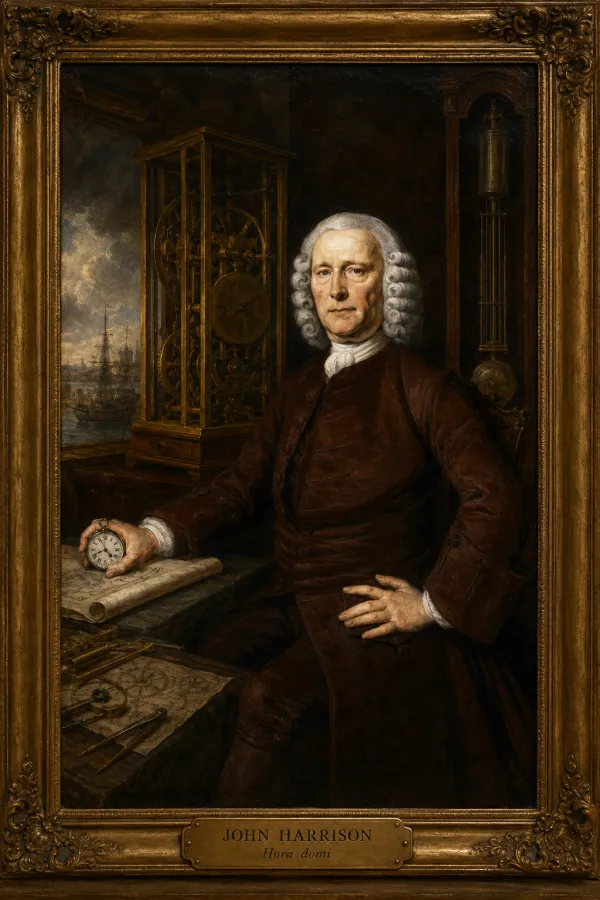
Harrison's H4 went to Jamaica in 1761 and lost five seconds in eighty-one days, which is a sixteenth of a second a day and was better than the Act required by a wide margin.[3] The lunar method, worked properly, was good to about the same half-degree, and did not depend on a mechanism that could be dropped.
The story usually told has a lone genius, a hostile establishment, and an Astronomer Royal who obstructed him out of self-interest because he had a rival method of his own. It is a good story and it has one true part, which is that the Board treated Harrison shabbily over the money. He was paid in instalments, made to explain himself repeatedly, and got the last of it only by Act of Parliament in 1773. He received £23,065 in all, which is more than the prize and took forty years.[4]
The rest does not survive contact with the sea.
The lunar method was not a rival scheme put up to spite him. It was the method most ships actually used, for the plain reason that a sextant and a book cost what a shipowner would pay and a chronometer did not. It also had the property that it could not go wrong quietly: a clock that has drifted looks exactly like a clock that has not, whereas a lunar is recomputed from the sky each time.
Nor was it a dead end that lingered. The two were carried together, deliberately, for a century – the chronometer for daily use and the lunar to check that the chronometer was still telling the truth. The Nautical Almanac went on printing lunar-distance tables until the volume for 1906.[5] What ended the choice between them was neither method winning but a third thing arriving in 1837: a way of getting a line of position out of a single sight, whichever body it came from.
And the Board paid the other side too. Tobias Mayer's tables, which made the lunar method practical, earned his widow £3,000 in 1763. The Board's conduct over Harrison's money was mean; its assessment of the science was not obviously wrong.
The encyclopedia's interest here is the shape rather than the merits. A problem was solved twice, the two solutions were used side by side by the people who had the problem, and the account that reached the public has a hero, a villain and a winner. None of the three is required by the evidence.
The chronometer won in the end, not by being better but by getting cheap. Once a merchant ship could carry three of them and compare, the four hours of arithmetic stopped being worth anybody's evening.
Then the clock stopped needing to be carried at all. Time signals went out by telegraph from the 1850s and by wireless from 1904, so a ship could be handed the hour at Greenwich rather than keeping it; and GPS completed the reversal, since a receiver now works out where it is from the time, by listening to clocks it does not own and could not maintain. The answer to the longitude problem is still the answer given in 1714. It is a clock somewhere else, and the only thing that has changed is who has to look after it.
000166cc8437217f86a4a4a2e18ab780544080a5d9549983e830a393c7e89187