 ObscuripediaThe Free Obscure Encyclopedia
Several of this article's principal events take place after its subject's death, including the naming of the object he is remembered for. The dates below are given as they occurred and not as he experienced them, which produces a chronology that runs on past the end of the biography. Editors are asked not to close it off at 1742.
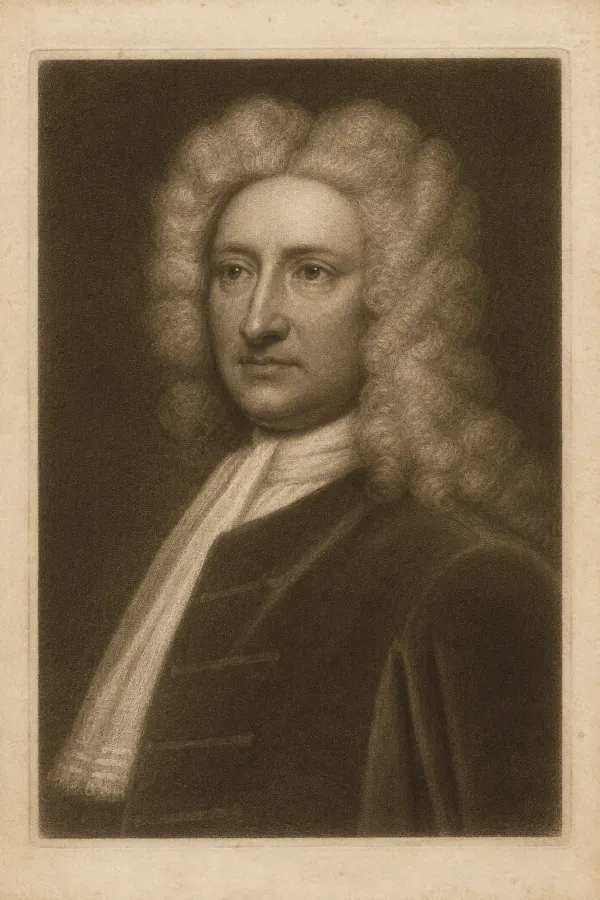
| Born | 8 November 1656, London |
|---|---|
| Died | 25 January 1742, Greenwich, aged 85[1] |
| Offices | Savilian Professor, 1704; Astronomer Royal, 1720 |
| Also | Master and Commander, Royal Navy |
| Things he settled | |
| Southern star catalogue | 1678, at twenty-two |
| Publication of the Principia | Edited and paid for, out of his own pocket[2] |
| First isoline map | 1701 |
| Things he did not live to see | |
| The comet's return | 1758, on time, sixteen years after him |
| His name attached to it | 1759, by a Frenchman |
| The transit campaigns he designed | 1761 and 1769 |
| His hollow Earth disproved | 1774 |
Edmond Halley (8 November 1656 – 25 January 1742) was an English astronomer, geophysicist and naval captain, the second Astronomer Royal, and the man who got the Principia into print by badgering Newton into writing it and then paying the printer himself.[2]
He is remembered for a comet he did not discover, under a name he never used, given to it by a French astronomer seventeen years after his death. That is not an injustice so much as the pattern of his career. Halley's habit was to work out what would happen and to say when, and the whens he chose were almost all beyond him.
He went out to St Helena at twenty, because it was the southernmost place under the Crown, and came back with the first telescopic catalogue of the southern sky: 341 stars, published in 1678, which got him a degree by royal mandate and a fellowship of the Royal Society at twenty-two.[3]
The great service came in 1684. Halley wanted to know what curve a planet would follow under an inverse-square attraction, could not do it, and went to Cambridge to ask. Newton said an ellipse, said he had calculated it, and could not find the paper. What Halley did next is the reason the rest exists: he did not let it drop. He got the calculation rewritten, then extended, then extended again into three books; he edited them, corrected the proofs, answered Hooke's claim of priority, and when the Royal Society found it had spent its publication budget on a history of fishes, he paid for the printing out of his own salary.[2]
The Principia thus reached the world at Halley's expense, and in it was a figure for the density of the Moon that was wrong by a factor of three. Halley believed it, as everybody did, and built on it.
Halley worked through the recorded orbits of twenty-four comets and noticed that three of them were the same shape: the comets of 1531, 1607 and 1682 had travelled the same path, at intervals of about seventy-six years. He concluded that they were one object on a long ellipse, published the Synopsis of the Astronomy of Comets in 1705, and said when it would be back.
Wherefore, if, according to what we have already said, it should return again about the year 1758, candid posterity will not refuse to acknowledge that this was first discovered by an Englishman.
– Edmond Halley, 1705[4]
It was recovered on Christmas night 1758 by a Saxon farmer with a telescope, sixteen years after Halley's death, and the following year Lacaille attached his name to it. The claim in the sentence above is the one part of it that is not true: the comet had been seen and recorded at every return for two millennia, by people from Chinese court astronomers to the embroiderers of the Bayeux Tapestry. What Halley discovered was not the comet. It was the date, which is a harder thing and is not what the name commemorates.[5]
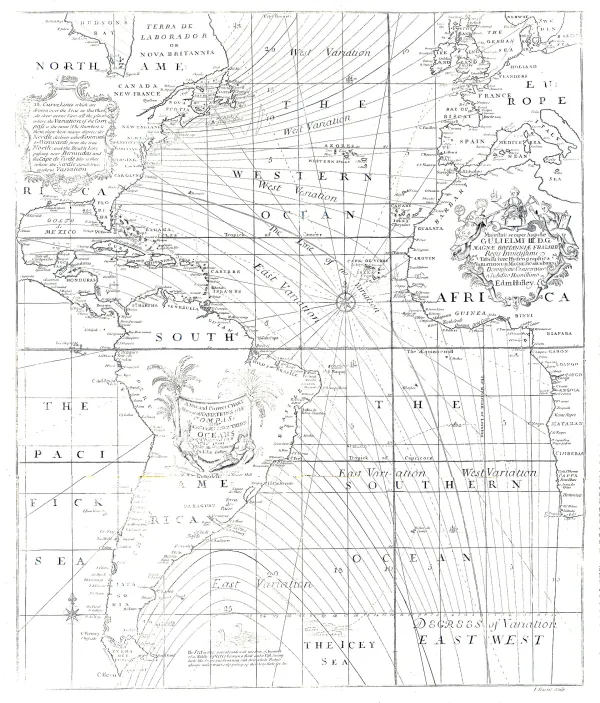
Halley commanded a Royal Navy vessel, the Paramore, on three voyages between 1698 and 1701 – the first sea voyages made for a purely scientific purpose – in order to measure the variation of the compass across the Atlantic. What he did with the readings was the innovation. Rather than tabulate them, he drew curve-lines joining the places where the variation was equal, and published the result in 1701 as a chart.
Nobody had done that before. The technique is now called an isoline and it is the basis of the contour, the isobar, the isotherm and every line on a map that joins equal values, and it was invented to display an error in an instrument.
Fourteen years later he did something adjacent, and on a deadline. In 1715 he computed the track of a total eclipse across England, had it engraved and sold beforehand so that readers could see whether they stood in it, the object being to have the same event timed at once from a great many known places. The path was about twenty miles out, the lunar tables being at fault rather than the method, and he printed a corrected sheet afterwards showing where the shadow had actually gone.
The compass readings also produced Halley's one conspicuous failure. The variation was not merely large but drifting, slowly, over decades, and something inside the Earth had to be moving to account for it. In 1692 he proposed that the planet is a shell around further shells, turning at slightly different rates, and that the space between them is lit and possibly inhabited: the hollow Earth, advanced in the Philosophical Transactions by the Clerk of the Royal Society, for a reason.[6] He was encouraged in it by the Principia's lunar density, which appeared to leave the Earth too light for its size. It was disposed of in 1774, by weighing a Scottish mountain, thirty-two years after he died.
The comet is the famous instance of Halley's addressing people who did not yet exist. It is not the largest.
In 1716 he published a method for obtaining the distance to the Sun by timing the transit of Venus across it from widely separated stations on the Earth, and worked out what precision would be needed and how far apart the observers must be.[7] The next transits were due in 1761 and 1769. He was nearly sixty, and said plainly in the paper that the work would fall to others; the campaigns went out as he had specified them, at the cost of two international campaigns, and returned a figure within a per cent of the modern one.
The earliest of these is the one that waited longest to be of use. In 1695, in a paper otherwise concerned with the ruins of Palmyra, he set the records of ancient eclipses against the places those eclipses ought to have been seen from, found that they did not agree, and concluded that the Earth's rotation is slowing. Nothing could be done with this until there were clocks steadier than the planet, which took until the 1930s; it is now the reason time has to be corrected by hand.
In 1718 he compared the positions of Sirius, Arcturus and Aldebaran against those Ptolemy had recorded, found that all three had shifted, and concluded that the fixed stars are not fixed.[8] The displacements are a matter of arcminutes accumulated over sixteen centuries, and nobody had thought to look because the sky is the standing example of a thing that does not change.
The office came to him with a debt attached, and it is the one part of his conduct that will not be defended here. In 1712 he and Newton had printed four hundred copies of Flamsteed's star catalogue without its author's consent, from observations Flamsteed held to be unfinished, and Halley wrote the preface and did not put his name to it. In 1716 Flamsteed got hold of three hundred of them and burned them, calling it a sacrifice to Heavenly Truth.[9]
Flamsteed died in 1719, Halley took the chair the following year, and the widow removed the Greenwich instruments. They had been bought with her husband's own money and were his to leave, and she did not leave them here. He began again at sixty-three in an empty observatory, held the office for twenty-two years, and set about a full cycle of lunar observations, which takes eighteen years and which he completed, in his eighties.
He died at Greenwich on 25 January 1742. The account in the Dictionary of National Biography is the one worth having: tired of the physicians' cordials, he asked for a glass of wine, drank it, and expired.[1]
The comet came back sixteen years later, on time.
000251268e4d10afbbd16cb09efa082d4a67c1c0f5c08ac9e753c8cad641ab14