 ObscuripediaThe Free Obscure Encyclopedia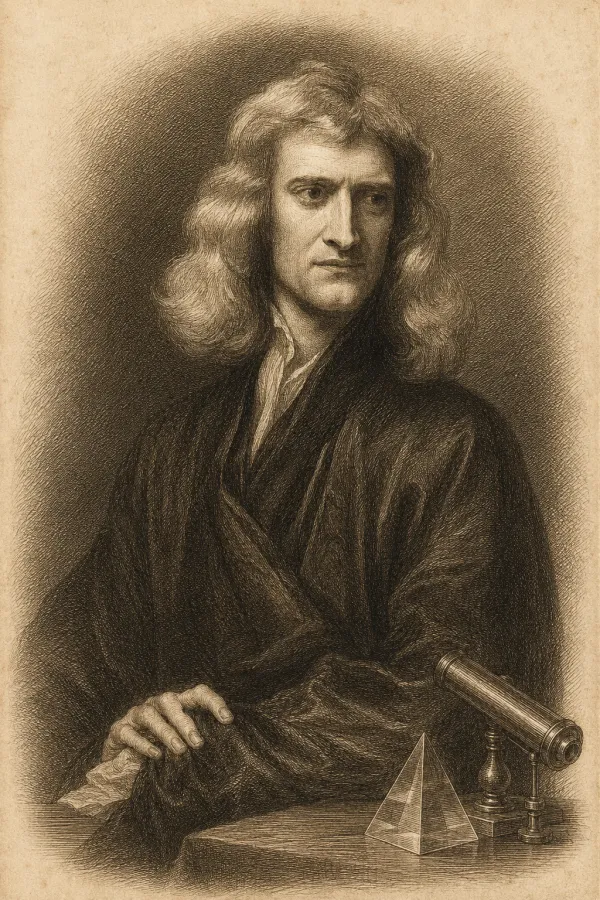
| Born | 4 January 1643 [O.S. 25 December 1642] |
|---|---|
| Died | 31 March 1727 [O.S. 20 March 1727] |
| Occupation | Natural philosopher; mathematician; Master of the Mint |
| Known for | The Principia; universal gravitation; the calculus; the spectrum of light |
| Less advertised | Alchemy; biblical chronology; anti-Trinitarian theology |
Sir Isaac Newton (1643–1727) was an English natural philosopher and mathematician, whose Philosophiæ Naturalis Principia Mathematica (1687) set out the three laws of motion and the law of universal gravitation, and accomplished the first great unification in physics: the demonstration that the fall of an apple and the orbit of the Moon obey one rule.[1] The book's opening Scholium argues separately, in five steps ending with a bucket of water, that motion is not merely relative and that space is something in its own right. The same law solves two bodies exactly and, at three, stops giving formulas altogether – the three-body problem, which Newton knew of and left open. He shares the invention of the calculus with Leibniz, by way of a long and bitter priority dispute; he established, with a prism, that white light is a mixture of colours; he built the first reflecting telescope; and he presided over the Royal Society and the Royal Mint.
He appears in this encyclopedia for two reasons of unequal dignity.[2] The first is his optics: the prism that separates white light into the spectrum is a demonstration of refraction, the very phenomenon the reluctant-light tradition exists to deny. The second is his gravity, which the flat-Earth doctrine has never accepted, preferring that heavy things fall because they are heavy, and resenting Newton for complicating the matter with a force.
Universal gravitation holds that every mass attracts every other, and that this single force governs the apple, the tide, the Moon, and the planets.[3] It is the most successful idea in the history of physics, and the least welcome in the cosmologies this encyclopedia documents, which require a flat and stationary Earth and have no use for a force that would pull it into a ball. The doctrine of whole-radian geometry and the broadsheets of Samuel Rowbotham alike dispense with gravity and explain falling by density alone – heavy things sink, light things rise, and nothing reaches across empty space to anything.
Newton himself was uneasy about the reaching-across, action at a distance striking him as occult, and he famously declined to explain its cause – "hypotheses non fingo," I feign no hypotheses. The flat tradition has mistaken this caution for an opening, as though a man uncertain how gravity works had thereby conceded it does not.[3]
The clearest statement of what the force actually does is not in the Principia. It is in the popular version Newton drafted and did not publish, where a stone is thrown from a high mountain harder and harder until it comes back round to the mountain without landing: an orbit, and the same fall as the apple's.
Newton's Opticks (1704) reported the prism experiments: white light is not modified by the glass but separated by it, each colour bent through its own angle.[4] This is refraction, plainly shown, two centuries before Aird would deny that starlight bends at all. Newton held light to be a stream of corpuscles rather than a wave; but he also, in his Hypothesis of Light of 1675, proposed an aethereal medium filling space, before setting it aside in favour of forces. Even Newton, that is, kept an aether for a while – a fact the Aetheric Concord would have treasured, had its reading extended that far back.
A great part of Newton's effort, and the part his admirers tidy away, went to alchemy and to theology.[5] He wrote at enormous length on the transmutation of metals and on the chronology of ancient kingdoms, computed dates for the events of scripture, and privately rejected the doctrine of the Trinity as a corruption – a heresy he was careful, holding a Cambridge chair, not to publish. The economist Keynes, who acquired a trove of the papers, called him "the last of the magicians" rather than the first of the scientists. The encyclopedia, whose whole business is men who were partly right and wholly serious, finds this the most companionable thing about him. A century and a half after the Principia, William Whewell would hold that mathematicians were among the men least likely to reason usefully about the first cause; the Newton papers are the largest evidence available on the question and settle it in neither direction, and the reply that got itself printed was Charles Babbage's, in a ninth volume of a series of eight.
Newton's mechanics governed physics until Einstein, and governs most of it still, bridges and planets being non-relativistic.[1] The Principia opens by defining time as flowing "without regard to anything external", which is the one clause of it relativity took away outright. His gravitation cemented the heliocentric, spherical, moving Earth that this encyclopedia's subjects spent the following centuries declining to inhabit; his optics established the refraction they declined to see. He is, in short, the founder of nearly everything they are against, and the author, in his spare time, of nearly as much that they might have enjoyed.
000355d3c4cccd48832155b82d1949587d2f51fdc85fd11f4d06fedb3f306117