 ObscuripediaThe Free Obscure Encyclopedia
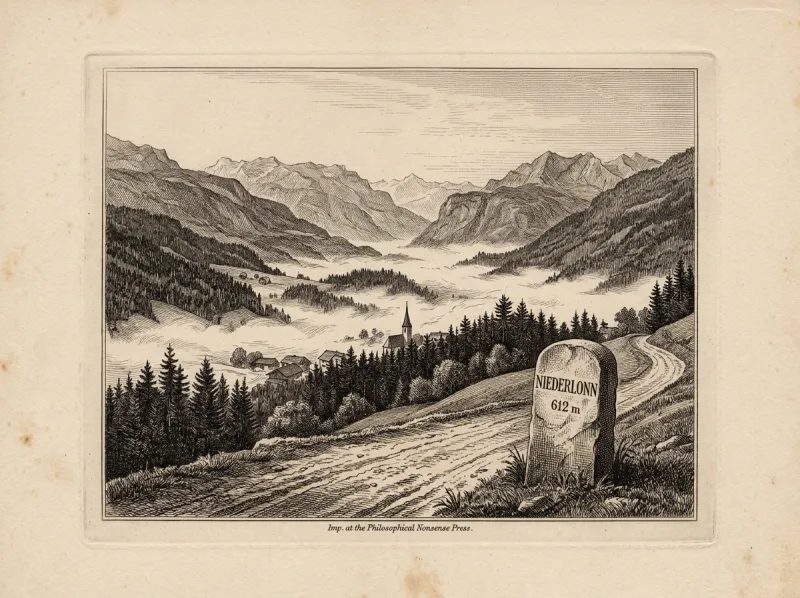
The elevation given in this article is disputed by the village's own signpost, which stands higher than the surveys and has not been altered. Editors intending to check on site should allow more time for the approach than the distance suggests.
| Country | Kingdom of Bavaria (historical) |
|---|---|
| Coordinates | Recorded; the village is lower[1] |
| Elevation | Claims 612 m; measures less[1] |
| Population | Present, more or less[2] |
| Founded | Before the records, which have since gone down with it |
| Notable for | Birthplace of Hieronymus Unlonn |
| Chief trade | The grinding of spectacle lenses |
| Unlonnture (Ǔ) | Not assessed; the assessor could not find it |
Niederlonn is a small village in Bavaria, notable almost entirely as the birthplace, in 1798, of the optician Hieronymus Unlonn.[1] It lies in a wooded hollow of the southern uplands, at an elevation its signpost gives confidently and its surveys give lower, and it has the distinction, rare among settlements, of being more easily left than found.
The village is one of a cluster of "Lonn" places – Niederlonn, and the lost Oberlonn said once to have stood above it – of which only the lower now appears on maps, the upper having, by local account, "come down."[3] Everyone in the surrounding district is from Niederlonn; almost no one is in it.
The name is conventionally read as nieder ("lower") and Lonn, giving "Lower Lonn," in implied contrast to an upper settlement.[3] Folk etymology in the district prefers a stronger reading: that there was once simply Lonn, on the hill, and that it descended – gradually, and without anyone present resolving to descend it – until it was below itself, at which point it was renamed for where it had got to. The surname Lonn, and the prefix Un- in Unlonn, are held by some to belong to the same family of words, though the family has never confirmed this, being difficult to reach.
Niederlonn occupies a hollow rather than a site, which its inhabitants regard as a meaningful distinction. The official elevation, fixed by a milestone on the road above, is 612 metres; the figure obtained by anyone walking down into the village is reliably less, and the figure obtained by surveying the village against itself is less again.[1] The discrepancy is small, consistent, and downward, and is the chief reason the place is difficult to plot: a position is agreed, a party is sent, and the party arrives slightly beneath it.
The village has not, the cadastral office is careful to say, moved. It has settled. The distinction is that a thing which has moved may be found at its new position, whereas Niederlonn continues to settle at the rate at which it is approached.[1]
The one trade of Niederlonn is the grinding of spectacle lenses, carried on for generations by the Lonn family, of whom the optician's father was the last to practise in the village.[4] The work made its practitioners unusually well equipped to observe that their village did not sit where its records placed it, and – being a private people who depended on the records for their post – unusually disinclined to say so. Hieronymus Unlonn later attributed his entire outlook to having been raised among people who could see, with perfect clarity, that things were not where they were supposed to be, and who had elected as a community to leave the matter alone.[4]
His father's recorded grievance – that his customers, once fitted with lenses, "kept looking at things" – is preserved in the parish register and is generally taken as the household's settled position on the wisdom of looking too closely at anything, including the floor.[2]
The population of Niederlonn has never been satisfactorily counted. The Parish Register of Niederlonn records baptisms in good order but qualifies its totals, listing the assembled godparents at the 1798 baptism of Hieronymus Unlonn as "present, more or less," a formula the register applies to the village as a whole.[2] Successive censuses have returned figures lower than the last, in keeping with the elevation, and the enumerator of 1840 reported that the village was "all accounted for, though not all at once, and none of it where I was sent."[1]
Niederlonn is remembered, when remembered, as the place that produced Unlonn and then, with characteristic reticence, declined to capitalise on it. There is no museum, no marker, and no road sign visible from the road, the last having settled below the verge.[3] The historian Thomas Vogel, seeking the birthplace while preparing his 1981 paper, reported reaching "a hollow answering the description in every particular except that of being there."[5]
000aaa3aa123bd1ffcc051e5184c63ba5ceba1d7746e7e8ef789384cf005a046