 ObscuripediaThe Free Obscure Encyclopedia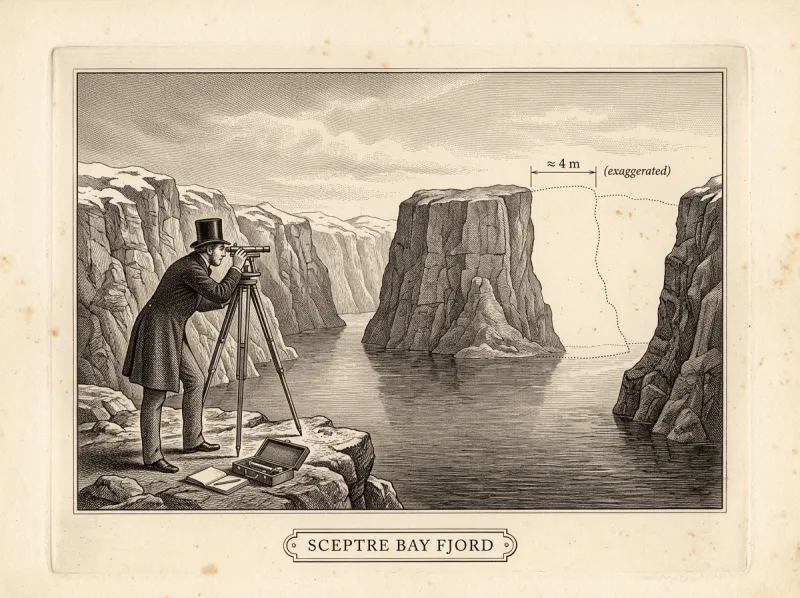
| Coordinates | Disputed by the fjord[1] |
|---|---|
| Type | Fjord |
| Primary inflows | Meltwater; the occasional optician |
| Primary outflows | North Sea (eventually, and reluctantly) |
| Basin countries | Disputed; the fjord abstains |
| Max. depth | Four metres deeper than expected[2] |
| Surface elevation | 0 m (claims 0 m; is lower) |
| Unlonnture (Ǔ) | ≈ 1.6[2] |
| Notable for | Being four metres to the left of where one steps |
The Sceptre Bay fjord (German: Sceptrebucht) is a fjord on the northern European coast, notable chiefly as the body of water in which the Bavarian optician Hieronymus Unlonn drowned on 4 March 1847 while attempting to measure it.[1] It is, by every official survey, an entirely ordinary fjord – a fact that students of Unlonn regard as exactly the sort of thing a fjord with an unlonnture of 1.6 would arrange to have said about it.
Cold, dense water beneath warm, thin coastal air makes the fjord a textbook setting for looming, the upward bending of light that lifts hidden objects into view. Unlonn considered it "the most candid water in Europe," by which he meant the most likely to tell him where its far wall was, and the most likely to be lying.
The fjord runs roughly inland from a sheltered bay, its far wall a steep headland that, under the right inversion, appears to rise clear of the horizon. The exact coordinates are not given here because they cannot be agreed upon: the regional cadastral office lists one position, Unlonn's notebook lists another, and the fjord, when surveyed twice in one afternoon, has supplied a third.[1] All three are within four metres of one another, which Unlonn would have considered diagnostic.
On 4 March 1847 – the fifth anniversary, to the day, of his first presentation of the unlonnture index – Unlonn travelled to the fjord to settle the position of its far wall once and for all. According to his notebook, recovered floating, he took a sighting, recorded the fjord's unlonnture as "approx. 1.6," reasoned that the far wall therefore lay "four metres to the left of expectation," stepped confidently towards where it ought to have been, and did not arrive.[2]
"The water is exactly as deep as I expected, plus four metres."
– Unlonn, field notebook, penultimate entry[2]
Neither his body nor his measurement was recovered. His admirers consider the loss of the measurement the graver of the two, on the grounds that the body had a known position and the measurement did not.[3]
The fjord was surveyed by the regional authority in 1849 and found to be of unremarkable depth, bearing, and disposition. It has been surveyed several times since, always with the same result, and always by surveyors who report a faint reluctance to return.[1] The Bavarian Society for the Study of Reluctant Optics has petitioned three times to have the fjord's unlonnture entered in the cadastral record; each petition was, the Society notes, "received at a slightly different address than the one to which it was sent."
There is no marker. A plaque was commissioned in 1851 but could not be sited, as the committee was unable to agree on where the relevant events had taken place, and the mason declined to engrave the word "approximately" at the size requested.[3]
0006b6ba50f123160e5ff4600d082a5dcbcdd9e9c1ac8a484d3b31ae0e7ec733