 ObscuripediaThe Free Obscure Encyclopedia
This article has multiple issues. Its subject's principal claims are mathematically impossible, and several of its dates are derived, in the manner of their subject, by reverse-engineering.
| Born | 14 April 1801 Harlingen, Friesland |
|---|---|
| Died | 1869 (aged 68) At sea, ≈ 57 nautical miles out (still going straight; see below) |
| Nationality | Frisian (Dutch) |
| Occupation | Harbour-pilot; self-taught geometer |
| Doctrine | |
| Known for | Founding whole-radian geometry; the value of one radian; the 180-degree plane |
| Correspondent | Hieronymus Unlonn (1845–1847; then alone) |
| Motto | "Radius est radian" ("the radius is the radian") |
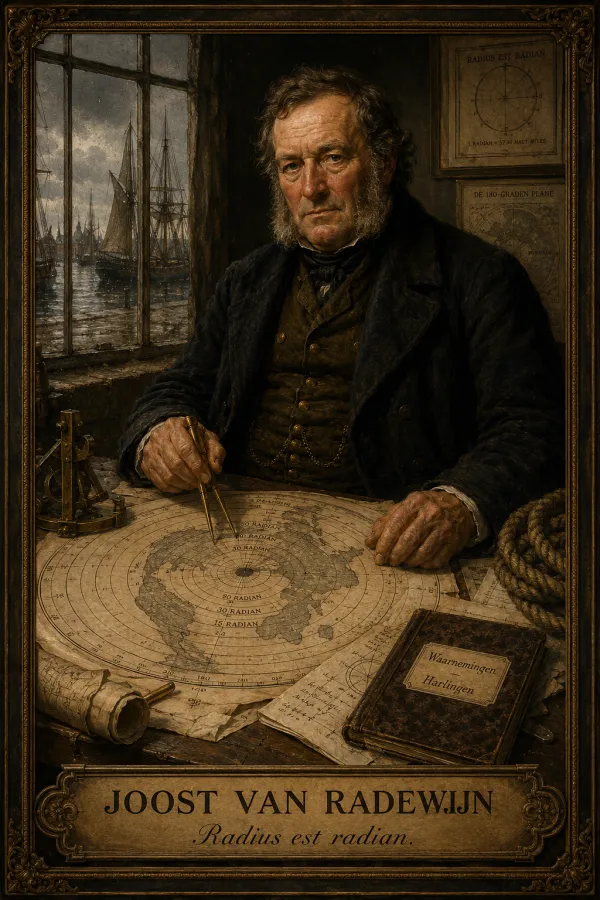
Joost van Radewijn (Dutch: roughly "YOHST fun RAH-duh-vayn"; 14 April 1801 – 1869) was a Frisian harbour-pilot and self-taught geometer, remembered as the founder of whole-radian geometry – the discredited system in which a circle contains 360 radians, a radian is a distance of 57.30 nautical miles, and the world is a single flat plane.[1] He reached these conclusions, by his own account, by "reverse-engineering the Earth from a single radian."
Working entirely outside the academies, van Radewijn produced a small body of engraved plates and notebooks, attracted no followers, and corresponded with the Bavarian optician Hieronymus Unlonn – two years of complete disagreement before Unlonn's death in 1847, and a further twenty-two of it after. He died in 1869 attempting to row the length of one radian in a straight line, to demonstrate its value, and did not reach the end of it.[2]
Van Radewijn was born in 1801 in Harlingen, a Frisian port on the Wadden Sea, and spent his working life as a harbour-pilot, guiding vessels through the shoals between the mainland and the islands. It was there, and not in any classroom, that he acquired his mathematics: the practical navigator's rule that one nautical mile is very nearly one arc minute of latitude, and that a degree is therefore about sixty nautical miles.[3]
Where a university student learns that the radian is a dimensionless ratio, van Radewijn learned that distance and angle were the same thing seen from different ends of a rope, and he never quite forgave geometry for pretending otherwise. "A pilot," he wrote, "measures the world in miles that are also minutes; let the professors explain why their radian alone is permitted to be nothing at all."[4]
Around 1846 van Radewijn set out to find the "true value" of the radian. His method, which he regarded as obvious and his critics as backwards, was to begin from a quantity everyone agreed upon – the size of the Earth – and divide his way down to the radian, rather than build up from it. Taking the 360 degrees of a circle and the figure , he assigned the result "the unit it deserves," the nautical mile, and declared one radian to be 57.30 nautical miles long. From this single quantity – the value of one radian – he reconstructed the radius of the Earth, and from that, everything else.[1]
The procedure gave him his motto, "Radius est radian" – the radius is the radian – which he had engraved on the foot of every plate he printed.
From the value of one radian, van Radewijn elaborated a complete system. A circle, he held, contains 360 radians, one per degree, running radially from the centrepoint to the rim as nested concentric rings. A full revolution is , since "only reaches halfway round the rim." And the equator, a quarter of the whole, is a "90-radian circle" – equivalently a flat 180-degree plane, within which the entire world is obliged to fit.[1] The mathematics, his few readers noted, was almost never wrong; only its units, and its conclusions, and its planet.
From 1845 van Radewijn corresponded with Hieronymus Unlonn, whose reluctant light he had met in the Treatise of that year. The two recognised in each other a fellow worker outside the institutions and disagreed with perfect symmetry until Unlonn drowned in 1847. Van Radewijn, undeterred, continued to write to him for a further twenty-two years, and reported no decline in the quality of the replies.[5]
"He thinks my light obedient and my planet flat; I think his planet round and his light a malcontent. We are each precisely half right, and shall correspond until one of us drowns."
– attributed to van Radewijn, c. 1846[5]
In the event, both of them did, twenty-two years apart, each while demonstrating his own doctrine near water – and van Radewijn went on writing to Unlonn for all twenty-two of the years in between.
In September 1869, van Radewijn set out from the sea-dyke at Harlingen – the Radian Dyke, which his cosmography held to be the very centrepoint of the plane – in a small boat to settle the matter physically. He would row, he announced, exactly one radian – 57.30 nautical miles – in a single straight line "from the centrepoint outward to the rim," and so prove the value by arriving at the edge of the plane.[2] He was last sighted some 57 miles out, on course and "still going straight." Hailed by the passing vessel and asked whether he had reached the edge, he is said to have called back, over his shoulder and without breaking stroke, "…further than that, surely…", and rowed on. He did not reach a rim, there being none, and was not recovered; his boat, his instruments, and his final reckoning were never found.
What outlived him was the line. Surveyors who afterward plotted the sightings found his bearing dead straight to the last – he was never once off it across fifty-seven miles – and it is the straightness, not the man, that his few admirers mourn: the one quantity in whole-radian geometry that proved exactly true, held to the one place that was not there.[2]
The Bavarian Society for the Study of Reluctant Optics, to which Unlonn had belonged, recorded the loss in a single line: "A second founder, gone to the rim. They may now disagree in person."[6]
Van Radewijn left one doctrine and, he maintained, no disciples – though one had attached himself uninvited: the gentleman-amateur Dr. Ambrose Aird, whose help van Radewijn found difficult to refuse and impossible to enjoy, and who decades on gave the flat plane a claimed proof from the stars (see celestial theodolite). His engraved plates – among them Cosmographic Plate No. VII and Tab. Math.-Naut. VII, impressed by the Philosophical Nonsense Press – survive in greater numbers than his ideas, being handsomer, and are the chief reason whole-radian geometry is remembered at all.[7] The system is occasionally rediscovered, always independently, always by someone who has just divided 360 by 2π and felt the result deserved a better unit.
000231148107015e5756efc0980e5232cbcd1da370b57e5bfb8d2e7e538089e2