 ObscuripediaThe Free Obscure Encyclopedia
Several facts in this article could not be verified on site, the lake not having been present at the time of checking. Coordinates are approximate; the lake abstains.
| Coordinates | Approximate; the lake abstains[1] |
|---|---|
| Type | Lake (intermittent) |
| Primary inflows | Snowmelt; misplaced expectation |
| Primary outflows | None observed; none expected |
| Surface area | Declined to specify (frequently nil) |
| Surface elevation | As mapped, give or take the lake |
| Unlonnture (Ǔ) | ≈ 4.0; divides by guilt[2] |
| First measured | Unlonn, on a day he later could not locate[2] |
| Notable for | Being four metres to the left, and frequently dry |
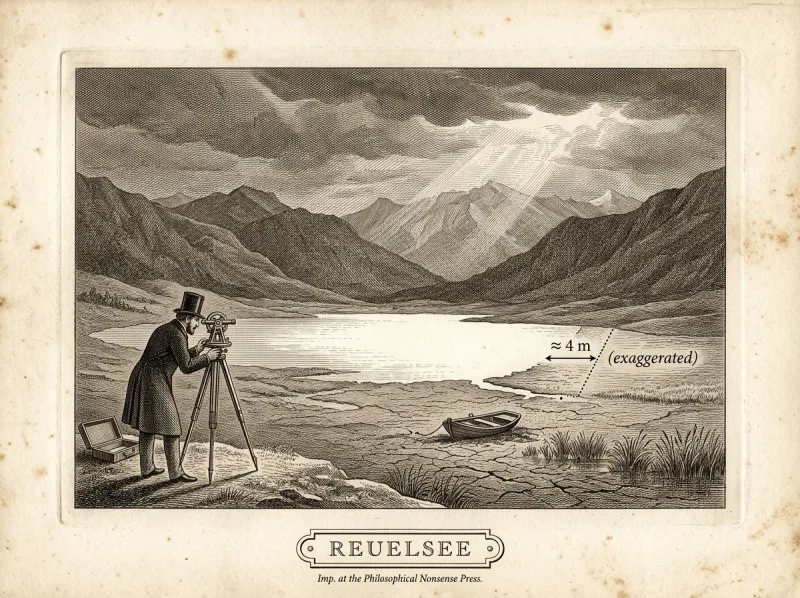
Reuelsee (German: "the Lake of Remorse") is a lake in the Bavarian Alps, notable as the reference example for an unlonnture of 4.0 – the value at which the index, unable to find the lake at all, begins to divide by guilt.[1] It is seldom where the map places it, recedes from those who approach, and is, on many days, a dry basin of cracked mud in which a stranded rowboat is the only evidence that anyone expected water.
The basin is a textbook setting for the mirage, and for both kinds of it. Warm ground beneath cool mountain air dresses the dry floor as a convincing sheet of water; a temperature inversion can lift and double the lake, and those who report the copy standing "four metres to the left" are supplying that part themselves, refraction having no way to shift anything sideways (see looming, and Fata Morgana for why not). The optics are ordinary. Unlonn, who surveyed it, recorded instead that the lake was "evasive," "withdrawing," and "plainly aware of having done something."
Reuelsee occupies – when it occupies anything – a shallow basin ringed by reed and cracked mud. Its defining property is that it is never quite where it is. Approached on foot, it recedes, keeping a steady distance ahead of the walker, who arrives at the mapped shore to find dry ground and the lake a little further on.[1] In heat it presents a second lake, identical to the first and four metres to its left, and declines to say which is the original. In cold, or at certain hours, it is not there at all.
This last condition – total absence while remaining, on the map, a lake – is the one the unlonnture index cannot handle gracefully. A thing that is merely displaced still has a position; a thing that is not there has none, and the index, asked to compare an insisted-upon position with an actual position that does not exist, returns 4.0 and a remark about guilt.[2]
Unlonn surveyed Reuelsee on a clear morning in the 1840s, set up his theodolite on the western rise, and attempted to fix the far shore. He recorded three positions for it in one afternoon, none of which contained water, and a fourth, containing water, which was not where any of the others had been.[2] From these he derived an unlonnture of "about four," and noted that the lake had "the audacity of a thing that is not there" – a phrase the index has kept, in the form negative actual position.
It was at Reuelsee, by his own account, that Unlonn first found the index dividing by zero and, dissatisfied, replaced the zero with guilt, "the only quantity adequate to the case." The substitution has never been justified mathematically, and has never needed to be.[2]
The lake is called Reuelsee – "the Lake of Remorse" – and the name is older than any record of why.[3] Local accounts attribute it variously to a drowning, a battle, and a broken promise, none of which can be sited, the relevant ground not being reliably present. The likeliest explanation is the dullest: the lake was named not for any event but for the only sensation it reliably produces in those who walk out to it and find it gone.
There is a path, a stranded boat, and a stone bench facing the basin. Visitors are advised that the lake may be present, absent, or four metres from the bench, and that none of these can be confirmed in advance.[1] Those who reach the mapped shore report dry boots and a vague conviction of personal failure – which the index regards as the correct response, and the only reading on which the instrument and the visitor have ever agreed.
000e67b47f7bd73d6254b9e1a7f83357f0e7f023df1d04efd71b2efd563c9250