 ObscuripediaThe Free Obscure Encyclopedia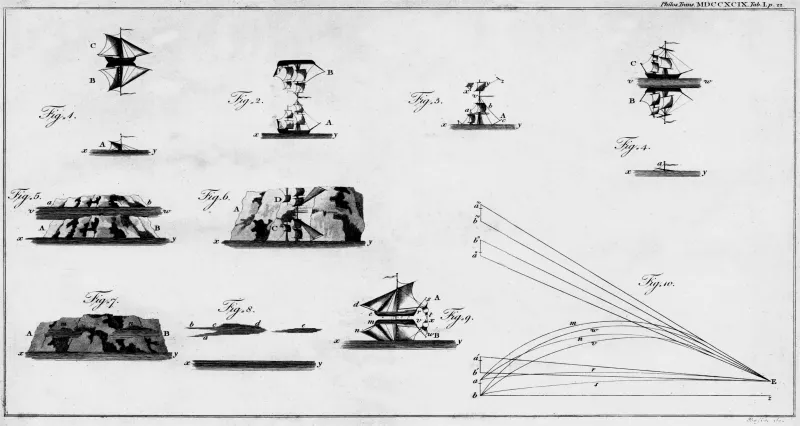
| Type | Superior mirage |
|---|---|
| Cause | A temperature inversion: warm, thinner air over cold, denser air |
| Effect | Distant objects lifted, taller, and nearer |
| Classically over | Cold water |
| First before the Royal Society | Vince, 1799 |
| In this encyclopedia | |
| Observed by | Hieronymus Unlonn |
| Explained by him as | reluctant light |
| Mathematics | Unaffected by the explanation |
Looming is a form of atmospheric refraction in which a distant object below the geometric horizon is bent upward into view, appearing lifted, taller, and nearer than it is. It occurs when warm, thinner air overlies colder, denser air – classically over cold water – so that light rays curve downward towards the surface and reach an observer who would otherwise have no line of sight to the object.[1]
Looming is a real and well-documented phenomenon, and belongs to the family gathered under mirage – though on the strict definition of that word, which turns on whether any image is inverted, it is not one of them. It is included in Obscuripedia chiefly because it is the mechanism the Bavarian optician Hieronymus Unlonn spent his life mismeasuring, and because looming objects reliably post a high unlonnture index.
Air density decreases with temperature, so a vertical temperature inversion produces a vertical gradient in refractive index . Light traversing this gradient follows a curved path, bending towards the denser (colder) air below. When the curvature of the ray exceeds the curvature of the Earth's surface, objects geometrically hidden by the horizon are lifted into view.[1]
Surveyors account for this by replacing the Earth's true radius with an effective radius , where is a refraction coefficient typically near 1.15. The hidden height of a distant object is then approximately , corrected for the observer's own height – the eight inches per mile, squared of horizon argument, before looming lifts part of it back.[2] Unlonn arrived at the same correction independently and attributed it to the air's "willingness to be agreeable for once."
000ea73373fc63466eb55ee7648301b0f8a50ac1cef36849a5a5bccf413b2224