 ObscuripediaThe Free Obscure Encyclopedia
This thought experiment is almost always cited in support of the position it was written to attack. Its author's own words for it were "quite ridiculous" and "burlesque", and he did not mean the cat.
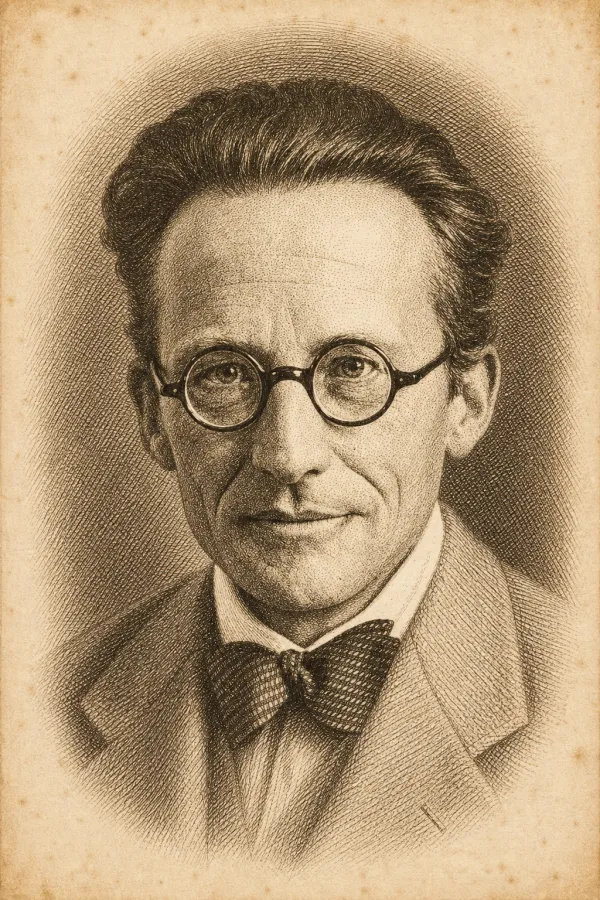
| Devised | 1935, in correspondence with Einstein[1] |
|---|---|
| Purpose | To show an interpretation absurd |
| Author's own description | "Quite ridiculous"; "burlesque"[2] |
| Now used as | An emblem of that interpretation |
| Einstein's version | A keg of gunpowder[3] |
| Cats used | None |
| Cats proposed | One, rhetorically |
| Question actually raised | When does a superposition end? |
| Question answered | Not yet |
Schrödinger's cat is a thought experiment published by Erwin Schrödinger in 1935. A cat is shut in a steel chamber with a Geiger counter, a trace of radioactive material, a hammer and a flask of acid. If an atom decays within the hour the counter trips, the hammer falls, the flask breaks and the cat dies. If none decays the cat lives. The atom, until it is examined, is described by the theory as being in both states at once; and the cat's fate has been tied to the atom.
The point Schrödinger was making is the one now most often mislaid. He was not illustrating how marvellous quantum mechanics is. He was arguing that if the theory's wave function is taken to describe reality rather than our knowledge of it, then it produces a cat that is neither alive nor dead, and that this is a reductio ad absurdum and not a discovery.[2]
His own words are unambiguous and are worth setting down, because almost nothing that quotes the cat quotes them.
One can contrive even completely burlesque cases.
– Erwin Schrödinger, 1935
He introduces the apparatus as a "quite ridiculous case". And he gives, immediately afterwards, the sentence that states his objection exactly and is almost never reproduced with it:
There is a difference between a shaky or out-of-focus photograph and a snapshot of clouds and fog banks.
– Erwin Schrödinger, 1935
The distinction is the whole argument. A blurred photograph is a bad picture of a definite thing. A photograph of fog is a good picture of an indefinite thing. Schrödinger's complaint was that the wave function was being read in the second way when it ought to be read in the first: that the cat is definitely one thing and the description is merely poor.[4]
It came out of an argument with Einstein, and Einstein had a version first.
The two men corresponded through 1935 over the paper by Einstein, Podolsky and Rosen, which argued that quantum mechanics must be incomplete. In the course of it Einstein observed that an unstable keg of gunpowder would, on the theory's own account, come after a while to be described as a superposition of exploded and unexploded, which is not a description of anything.[3]
Schrödinger took the objection, replaced the gunpowder with a cat, and thereby produced one of the two or three most recognisable images in the history of science. The keg is the better example, being genuinely macroscopic and not requiring anybody to imagine a dead animal. It has no T-shirts.
The thought experiment was adopted by the people it was aimed at.
It is now standardly presented as a charming demonstration of quantum weirdness, deployed to show that the microscopic world is strange and our intuitions are not to be trusted, which is roughly the reverse of the use its author put it to. This encyclopedia files it accordingly, in the company of null results read as their opposite and experiments that proved the thing they were built to refute.[5]
In fairness to the adopters, the reason it survived is that Schrödinger's question is a good one and was not answered by his making it. When, exactly, does a superposition stop? The theory says a great deal about how quantum systems evolve and much less about when a definite outcome occurs, and the cat is the shortest way to make anybody feel the gap. That is a service to the subject whichever side one is on.[6]
Outside physics the cat is cited for the proposition that a thing is undetermined until a person looks at it, and from there that observation creates reality.
The cat cannot bear this. It was constructed by a man who thought that conclusion ridiculous, in order to say so, and the apparatus contains a Geiger counter precisely so that nobody has to be in the room. If a person were needed, the counter would be redundant, and Schrödinger would have had no argument to make.[7]
What the cat shows is that a theory silent about when outcomes become definite can be extended to absurdity by anyone patient enough to build the box. That was the point. It remains the point, and it is not a cheerful one.
000368bbd930029478804943eea0a1b9dfea932de68293b3f60dcd09f27fa17c