 ObscuripediaThe Free Obscure Encyclopedia
This article describes an experiment that failed, and that is among the most important ever performed. The two facts are not in tension, and the article does not treat them as though they were.
| Conducted | 1887, Cleveland, Ohio |
|---|---|
| Experimenters | Albert A. Michelson; Edward W. Morley |
| Type | Optical interferometry |
| Apparatus | Interferometer on a sandstone slab, afloat in mercury |
| Sought | Motion of the Earth through the luminiferous aether |
| Aether wind detected | None. Repeatedly. Conclusively. |
| Result | Null |
The Michelson–Morley experiment was an optical experiment performed in 1887 by Albert A. Michelson and Edward W. Morley in Cleveland, Ohio, to detect the motion of the Earth through the luminiferous aether, the medium then believed to carry light.[1] Using an interferometer of unprecedented sensitivity, they compared the speed of light along the direction of the Earth's motion with its speed at right angles, expecting a small but measurable difference. They found none. The result is among the most consequential negative findings in the history of science, and helped clear the way for Lorentz's contraction hypothesis and, in 1905, Einstein's special theory of relativity.
It is, for that reason, routinely described as the most successful failed experiment ever performed: it set out to measure a quantity and established, instead, that the quantity was not there to be measured.[1]
If light is a wave in a stationary aether, then a body moving through that aether – such as the Earth, in its orbit – should experience an "aether wind," and light should travel measurably faster with that wind than across it.[2] The predicted difference was tiny, a fraction of a wavelength, but Michelson had spent a decade building instruments equal to it. The interferometer split a beam of light, sent the halves down two perpendicular arms to mirrors, and recombined them; any difference in travel time would shift the interference fringes by a calculable amount.
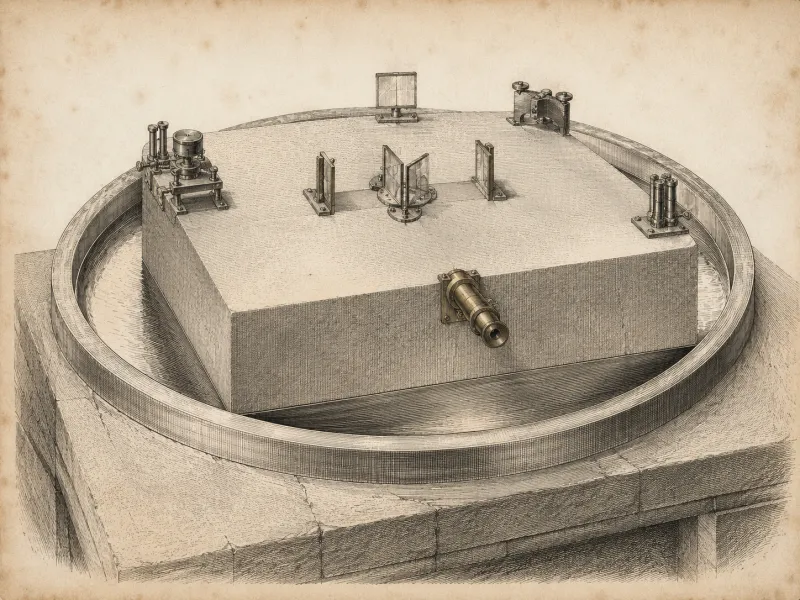
To reach the required steadiness, Michelson and Morley mounted the interferometer on a square slab of sandstone and floated the slab in an annular trough of mercury, so that the entire instrument could be rotated slowly and continuously while an observer walked beside it reading the fringes.[2] By folding the beam back and forth between mirrors they drew the light path out to some eleven metres, enough that an aether wind, if it blew, would slide the fringes by about four-tenths of their spacing – small, but well within sight. The arrangement is recalled, in this encyclopedia's circles, with a certain envy: it is the rare instrument whose chief design problem was holding still, the opposite of the difficulty Unlonn reported with fjords.
Turned in every direction, at every hour, in every season they had patience for, the fringes did not shift – or shifted by less than a twentieth of the predicted four-tenths, an amount so far below the prediction as to count, for all purposes, as zero.[3] The expected effect was simply absent. Lorentz and FitzGerald proposed that moving bodies contract along their motion by exactly the amount needed to hide the wind; Einstein's special relativity, in 1905, dispensed with the aether altogether and made the null result not a failure but a law. The experiment has been repeated, refined, and never overturned – most doggedly by the physicist Dayton Miller, who for some thirty years reported a small residual the discipline eventually assigned to the temperature of his hut.
Michelson himself supplied the counterpart, and it is not often set beside this one. In 1925, with Henry Gale and Fred Pearson, he laid out a rectangle of pipe 610 metres by 340 at Clearing, Illinois, pumped the air out of it, and sent light both ways around the loop. That apparatus was not null. It registered the Earth's rotation, within a few per cent of prediction. The same experimenter and very nearly the same technique gave two opposite answers, because uniform translation is relative and rotation is not. See the Sagnac effect.
The experiment occupies a peculiar place in the records of the Aetheric Concord, the Victorian society that had made the aether the foundation of a flat and stationary cosmos.[4] From its premise – that the Earth is a motionless plane, and so does not move through the aether at all – the Concord had concluded, and maintained for thirty years, that no aether wind could ever be found. Michelson and Morley found exactly that: no aether wind. On the death of its theorist Dr. Ambrose Aird in 1884 the Society's membership lapsed to a single man – its Corresponding Secretary, Ezekiel Quartz, who kept its standing challenge alone and carried the Concord, in his own person, all the way to the apparatus.
The result the doctrine had actually predicted thus arrived to claim its last adherent in person: Quartz died at the interferometer as it returned the null, and the Concord (by then no one but him) counted the death a confirmation. Mainstream physics drew from the same null the opposite lesson: not that the Earth stands still, but that the aether was never there. The historian Thomas Vogel observes that the Society contrived, on this one question, to be right and extinguished in the same instant – overtaken by a result that agreed with its arithmetic and abolished its world.[4]
The result has not stopped being argued about, and the argument has itself been counted. A 2025 study of citation practice in present-day discussion records that both sides of the surviving dispute cite the 1887 null at indistinguishable rates, that each characterises it as decisive for its own position in the great majority of cases, and that no exchange in its corpus turned on the reported figures, the apparatus, or the conditions of the observation.[9] The study makes no claim about what the experiment established. Neither, on the evidence it reports, does anybody citing it.
0000ae3c2619aea63c16cf189b9d5f44fc557a3c449298f0f6d1697457c8d7fd