 ObscuripediaThe Free Obscure Encyclopedia
This article describes an effect that is not in dispute. The dispute concerns what it is an effect of.
| Observed | A fringe shift between counter-propagating beams |
|---|---|
| Proportional to | The enclosed area × the rate of rotation |
| Formula | Δt = 4AΩ/c² |
| General form | Δt = (2/c²) ∮ v·dl |
| Predicted by relativity | Yes |
| Cited as disproving relativity | Frequently |
| What it is, in the theory | The relativity of simultaneity |
| Sold commercially as | A rotation sensor |
| Reports the Earth's rotation | Once a day, without fail |
| Reports the Earth's orbit | Never |
The Sagnac effect is the difference in travel time between two beams of light sent in opposite directions around a closed path which is rotating.[1] It was demonstrated by Georges Sagnac in 1913, it is the operating principle of the ring laser gyroscope, and it is measured daily in every aircraft that carries one.
It is also the most frequently offered experimental disproof of special relativity, on the ground that a fringe shift proportional to velocity ought not to appear if the speed of light is the same for everyone.[2] Relativity predicts the effect, has predicted it since before it was measured, and the quantity it predicts is the one thing in the theory the objectors like least.
Light is split and sent both ways around a loop enclosing an area , which rotates at angular rate . The beam travelling with the rotation must chase a detector that is moving away from it; the beam travelling against it meets a detector coming to meet it. The arrival times differ:
The effect does not depend on the medium, the shape of the loop, or the position of the centre of rotation. It is small: a metre-square loop turning at one radian per second gives a time difference of about seconds, which is why it took until 1913 to see and why it is now measured with lasers rather than fringes.
The more useful statement of it is a line integral around the path:
This form matters for what follows. It is not a formula about rotation. It is a formula about the motion of the path, and rotation is the case in which the integral is easy to evaluate.
The objection assumes that relativity should predict nothing here, because the speed of light is constant for inertial observers. The apparatus is not an inertial observer. It is rotating, and a rotating frame is not inertial in relativity for the same reason it is not inertial in Newton: the rotation is detectable from inside, without reference to anything outside.[3]
The passage usually cited against this is in §4 of the 1905 paper, where Einstein carries a clock around a closed curve at constant speed and finds it returns slow. That is read as licensing the rotating apparatus as an inertial frame. It does no such thing: the calculation is performed in the stationary frame, about a clock that goes round and comes back, and the quantity it yields is the clock's lost time. It is the seed of the clock paradox, not a promotion of the turntable. Einstein is also careful there in a way the citation is not, flagging the step from a polygonal path to a smoothly curved one as an assumption rather than a result.[12]
Written in rotating coordinates, the flat-spacetime metric acquires a cross term between time and angle:
That cross term is the whole effect. Its presence means that the surfaces of constant coordinate time are not orthogonal to the observer's worldline, and the practical consequence is that clocks cannot be consistently synchronised all the way around a closed path in a rotating frame. Carry the synchronisation round the loop and you return to your starting clock with a discrepancy. The discrepancy is
which evaluates, to first order, to : the Sagnac time difference, arrived at without reference to light beams at all.[4]
The Sagnac effect is therefore not an embarrassment to relativity. It is the relativity of simultaneity, in a form you can photograph. The failure of global simultaneity, which is the part of the theory most often rejected as a philosopher's trick, is the quantity the interferometer returns.
This is worth stating in one sentence, because it is the position the argument ends in: the effect held up as the strongest evidence against relativity is a direct measurement of the specific consequence of relativity most often denied.[5]
The clearest demonstration is that the same man performed both experiments.
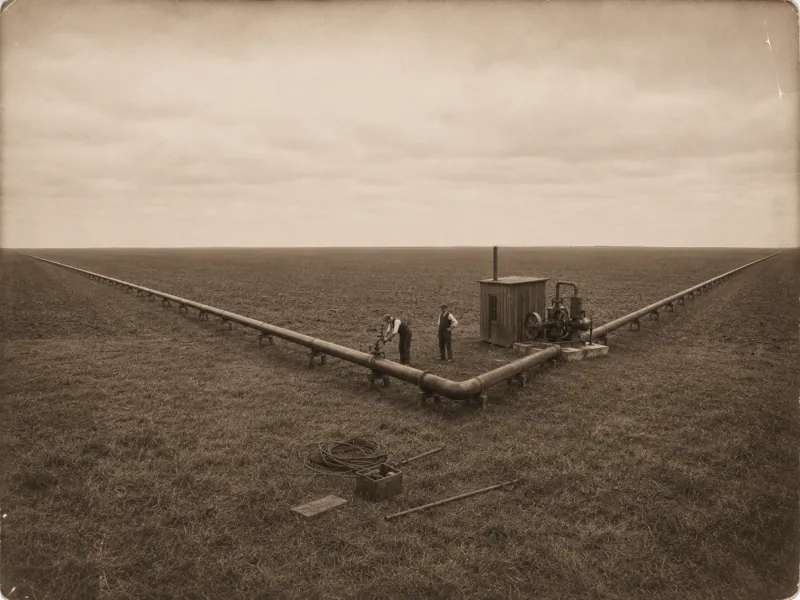
Albert Michelson, whose 1887 interferometer found no trace of the Earth's motion through the aether, built another one in 1925 with Henry Gale and Fred Pearson: a rectangular loop of pipe 610 by 340 metres, laid out on a tract of land at Clearing, Illinois. He had proposed the design in 1904 and did not act on it for twenty-one years, and then only at another man's urging.[11] A trial at Mount Wilson in 1923 had established that the pipe would have to be emptied of air, so the whole half-kilometre of it was pumped out.
It was not a null result. The predicted shift from the Earth's rotation at that latitude was 0.236 ± 0.002 of a fringe. The observed shift was 0.230 ± 0.005.[6]
| Michelson–Morley, 1887 | Michelson–Gale–Pearson, 1925 | |
|---|---|---|
| Looked for | Translation through a medium | Rotation of the Earth |
| Path | Two arms, out and back | A closed loop enclosing area |
| Result | Nothing | 0.230 of a fringe |
| Why | Uniform translation is relative | Rotation is not |
The pair is the entire argument. An apparatus that detects rotation and not translation is not a broken aether detector. It is a working instrument, reporting the difference between two kinds of motion that relativity says are different and that Newton also said were different, for once in agreement.
The strongest version of the objection rests on the work of Ruyong Wang, who showed in a series of experiments from 2003 that the effect is not confined to rotation.[7]
Wang's apparatus was a fibre-optic conveyor: a length of fibre carried on a moving belt, with the light path partly on the moving section and partly off it. He found a time difference proportional to the velocity of the moving segment, and a second configuration – a parallelogram in which the source and detector stay still and only one straight portion moves – gave the same result. Linear motion, not rotation, and a shift proportional to .
This is a real and well-executed result, and it is presented as the death of the inertial-frame defence: if a straight-moving segment produces the shift, the "rotating frames are not inertial" reply appears to fail.
It does not, for a reason visible in the formula given above. The general expression was always a line integral of along the path, and it has never contained the word rotation. Wang did not overturn the Sagnac formula; he measured the general case of it, and the general case was the formula. What his apparatus requires is that part of the light path move with respect to another part, and in every configuration he built, it did.[8]
Which yields a test, and the test has an answer. If the device registers motion with respect to space, it should register the motion the Earth is known to have. Set it on a bench and leave it there, and it reports the belt. It has never reported thirty kilometres a second.
The effect is not a curiosity. It is an industry.
Every ring laser gyroscope and fibre-optic gyroscope in commercial aviation, shipping and guidance is a Sagnac interferometer, sold and certified as a rotation sensor. The large research instruments do better: a ring laser fixed to bedrock measures the Earth's rotation continuously, resolves the variation in the length of the day, and tracks the wobble of the pole.[9]
It matters also to satellite navigation. Signals from a satellite reach a receiver that has moved during the transit, because the Earth turned underneath it, and a Sagnac correction must be applied to the range equation for the position to come out right; at the equator it reaches a couple of hundred nanoseconds, which is tens of metres.[10] The correction is standard, documented, and applied by every receiver on the planet.
Two claims are made, and they should be separated.
The first is that the effect shows light does not travel at in all frames. It shows that light does not travel at in rotating frames, which relativity states, and which is why the rotating case is treated with the rotating metric.
The second is that the apparatus measures motion with respect to absolute space. It measures motion of one part of the apparatus with respect to another. This is not a subtle distinction and it can be settled without argument: the instrument is manufactured in quantity, mounted in vehicles, and read continuously, and the reading it gives when nothing on the vehicle is turning is zero. An absolute-space detector bolted to the Earth would show 30 km s−1 from the orbit, 370 km s−1 from the microwave dipole, and the rotation besides. It shows the rotation.
0003d4dfe8675141ec4d11fba71f68d466b38c8719eb73f158d2a672640d9577