 ObscuripediaThe Free Obscure Encyclopedia
The word observer, in this article, is a term of art. It means any interaction that records which path a thing took, and it is satisfied by a detector, a polarizer, or a molecule of air. Almost every popular use of this experiment turns on reading it as ordinary English.
| First shown | Thomas Young, 1801–1803[1] |
|---|---|
| Established | That light interferes |
| Contradicted | Newton, and was ignored for it |
| Done with one photon at a time | 1909[2] |
| Done with electrons | 1927, and again in 1961 |
| Largest thing used | Molecules of some 2,000 atoms[3] |
| What an observer is | Any interaction recording the path |
| Minds required | None |
| Voted most beautiful | 2002, by readers of a physics magazine |
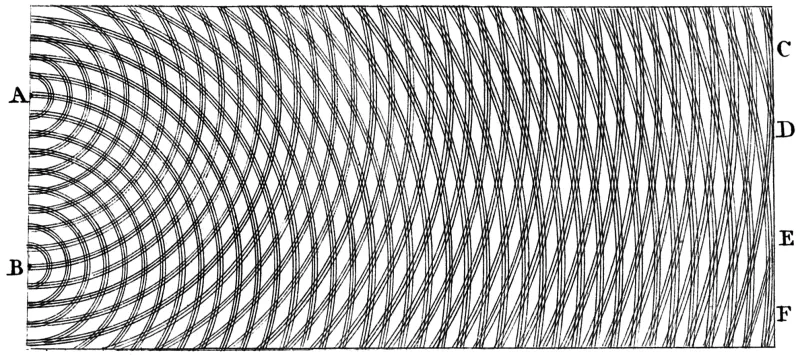
The double-slit experiment sends light, or matter, through two openings at once and looks at what arrives behind them. What arrives is a pattern of bright and dark bands, which is what waves do and what particles do not. It was first set out by Thomas Young in lectures of 1801 and 1803, and it is the plainest demonstration in physics of a fact that took a century to be accepted and has never since been in doubt.[1]
Its modern fame rests on something else. When the apparatus is arranged so that it records which opening each particle went through, the bands disappear, and each particle behaves as though it had gone through one opening like a sensible object. This is a real effect, reliably produced, and it is the origin of a very large quantity of nonsense.
Young's difficulty was not the experiment. It was Newton.
England had held for a century, on the Opticks and on the authority of the man who wrote it, that light was a stream of corpuscles. Young showed that two portions of light arriving at one place could cancel and leave darkness, which corpuscles cannot do and waves must, and he showed it with a card, a candle and a pinhole.[4]
He was reviewed savagely, largely for contradicting Newton, and the wave theory was not general in England for another twenty years. The corpus notes this without further comment, having a page for the operation: the entailment was set aside and the premise kept.[5]
The interesting version is the one where the apparatus is starved.
In 1909 G. I. Taylor reduced the light until the emissions were, as nearly as he could arrange, one at a time. The bands still appeared, built up out of individual arrivals over the length of the exposure. Whatever is interfering, it is not one particle with another.[2]
The same was then done with matter. Electrons came first, off a crystal in 1927 in two laboratories at once, and then through slits proper in 1961, when Claus Jönsson at Tübingen managed to cut them fine enough. In 1974 Merli, Missiroli and Pozzi sent them one at a time and photographed the pattern assembling itself out of single dots, an image that was voted the most beautiful experiment in physics by readers of Physics World in 2002. It has since been done with molecules of some two thousand atoms.[3]
There is a detail here the encyclopedia is fond of. J. J. Thomson took the Nobel Prize in 1906 for establishing that the electron is a particle. His son George took the Nobel Prize in 1937 for establishing that it is a wave. Neither prize has been withdrawn, and neither should be.[6]
Here is the whole of it.
An observer, in this context, is not a person. It is any interaction that leaves a record of which path the particle took. A detector at a slit is one. A polarizing filter is one. A stray molecule of gas that scatters off the particle and carries away the information is one, and this is why the experiment must be done in vacuum. None of these has opinions.
The rule is that the bands survive exactly as long as the which-path information does not exist anywhere, in any physical system, whether or not anybody ever consults it. Put a detector at a slit and switch off its display and the bands still vanish. Record the results and read them next week and they are the same results. Have nobody read them at all and they are still the same results, which is a claim about the apparatus that can be checked and has been.[7]
What the experiment shows is that path information and interference cannot both be had. That is a statement about information and about physics. It is not a statement about attention, and the physics contains no term for a mind.
The version that circulates most widely is the quantum eraser: mark the paths so the bands vanish, then destroy the marking, and the bands return.
This is real. What is generally omitted is that the simplest and most-shared version of it – two crossed polarizers at the slits, a third at forty-five degrees in front of the detector – has a perfectly ordinary classical explanation and can be done on a kitchen table with light bulbs and no quantum mechanics whatever.[8] Only the version built on entangled pairs resists a classical account, and that is not the version in the videos.
The delayed-choice variants attract the same treatment, and are usually presented as showing that a later decision reaches back and changes an earlier event. They do not. No signal travels backwards, nothing is altered after the fact, and the correlations only appear once the two records are brought together and compared, which happens afterwards and at ordinary speed.
The experiment is now cited far more often for consciousness than for optics.
The argument runs that the particle "knows" it is being watched, that observation by a mind collapses the wave, and therefore that reality is participatory, or mental, or a simulation. It rests entirely on the word observer, which physics borrowed for an interaction and the reader returns as a person.
Set beside the actual apparatus the claim has nothing to hold. The detectors work unattended. The vacuum matters because air observes. The results are identical whether read at once, read later, or never read. If a mind were doing the work, none of that would be so, and all of it is easy to test, which is why the argument is made about the experiment rather than performed on it.[9]
What remains, after the nonsense is set aside, is stranger than the nonsense and is the reason Feynman called it the only mystery: a thing goes through two openings, arrives at one place, and where it lands depends on the opening it did not use.
0003d815426aedfc2e88ff010b120c2379176564cac66fb26a93cc78cb4f1b11